

The Six Numbers a CRO Should Quote Without Looking
A Chief Revenue Officer (CRO) is constantly bombarded with data. RevOps dashboards display hundreds of metrics, from email open rates to individual rep quota attainment. While having access to this granular data is important, getting lost in the weeds is a fast track to losing strategic focus.
The problem? many CROs rely too heavily on looking at their dashboards to understand the health of their business. If a CEO or a board member asks a fundamental question about the revenue engine and the CRO has to say, 'Let me check the dashboard and get back to you,' they instantly lose credibility.
This article cuts through the noise. We identify the six critical, macro-level numbers that every CRO must have committed to memory at all times. Knowing these numbers cold demonstrates absolute command of the GTM motion.
What We'll Cover
In this article, we will cover:
- Why memorizing macro metrics is a sign of executive command
- The danger of dashboard dependency for revenue leaders
- The 6 essential numbers every CRO must know
- How these numbers interlock to tell the complete revenue story
- A daily routine for keeping these metrics top-of-mind
Understanding the Approach
The 'Six Numbers' represent the vital signs of the revenue engine. They aren't tactical metrics (like conversion rates), but rather strategic indicators that measure growth, efficiency, and retention. In the context of RevOps, these are the 'North Star' metrics that all other granular data points should roll up to support.
Example: A CRO doesn't need to memorize the conversion rate from Stage 2 to Stage 3. But they absolutely must know their 'CAC Payback Period.' If they know the payback period is 18 months, they instantly know if a proposed marketing spend is viable without needing to run a complex model.
Why This Matters
Knowing these numbers without looking is critical for rapid decision-making, commanding respect in the boardroom, and maintaining a clear strategic focus.
- Before: The CRO is easily distracted by minor fluctuations in tactical metrics, losing sight of the big picture. After: The CRO focuses the team only on initiatives that move the six macro numbers.
- Before: Board meetings are tense as the CRO scrambles to find data to answer questions. After: The CRO answers questions instantly and confidently, demonstrating total control of the business.
- Before: Department heads operate in silos, optimizing their own metrics. After: The entire GTM team is aligned around moving the six numbers that the CRO champions.
The Complete Guide
Number 1: Current ARR vs. Plan
Objective: The ultimate measure of whether you're winning or losing.
Actionable Advice: You must know exactly where your Annual Recurring Revenue stands today, and the delta (positive or negative) against your board-approved plan for the quarter.
Best Practices: Never quote a 'stretch goal'; quote the hard plan.
Number 2: Next Quarter's Pipeline Coverage
Objective: The leading indicator of future success.
Actionable Advice: Know your pipeline coverage ratio (e.g., 3.5x) for the upcoming quarter, strictly calculated using only validated, late-stage opportunities.
Best Practices: Exclude early-stage 'hopes and dreams' from this number to ensure it reflects reality.
Number 3: Net Revenue Retention (NRR)
Objective: The health of your customer base and product-market fit.
Actionable Advice: Know your NRR percentage. This number tells you if your bucket is leaky (below 100%) or if your customers are expanding (above 100%).
Best Practices: Be able to quickly explain the primary driver of your NRR (e.g., 'NRR is 110%, driven primarily by cross-sells to the enterprise tier').
Number 4: CAC Payback Period
Objective: The efficiency of your growth engine.
Actionable Advice: Know exactly how many months it takes to recover the cost of acquiring a new customer. This dictates how fast you can afford to grow.
Best Practices: Ensure Sales and Marketing are aligned on the exact formula used to calculate CAC.
Number 5: Win Rate (Competitive vs. Status Quo)
Objective: The effectiveness of your sales messaging and product positioning.
Actionable Advice: Know your overall win rate, but more importantly, know the split: how often you lose to a direct competitor versus how often you lose to 'no decision' (status quo).
Best Practices: If you're losing to the status quo, your problem is urgency, not features.
Number 6: Average Sales Cycle Length
Objective: The velocity of your revenue engine.
Actionable Advice: Know the average number of days it takes to close a deal from the moment an opportunity is created.
Best Practices: Know this number segmented by your primary customer tiers (e.g., SMB vs. Enterprise).
How to Implement This
To operationalize this, RevOps must build a 'CRO Daily Snapshot'—an automated email or Slack message delivered at 8:00 AM every day containing only these six numbers. No charts, no deep dives, just the numbers. The CRO must make it a daily habit to review this snapshot before opening any other emails, ensuring these vital signs are the lens through which they view the rest of the day.
Next Steps
Leadership is about focus. By committing these six numbers to memory, you elevate yourself above the tactical noise and position yourself as a strategic operator who truly understands the mechanics of the business.
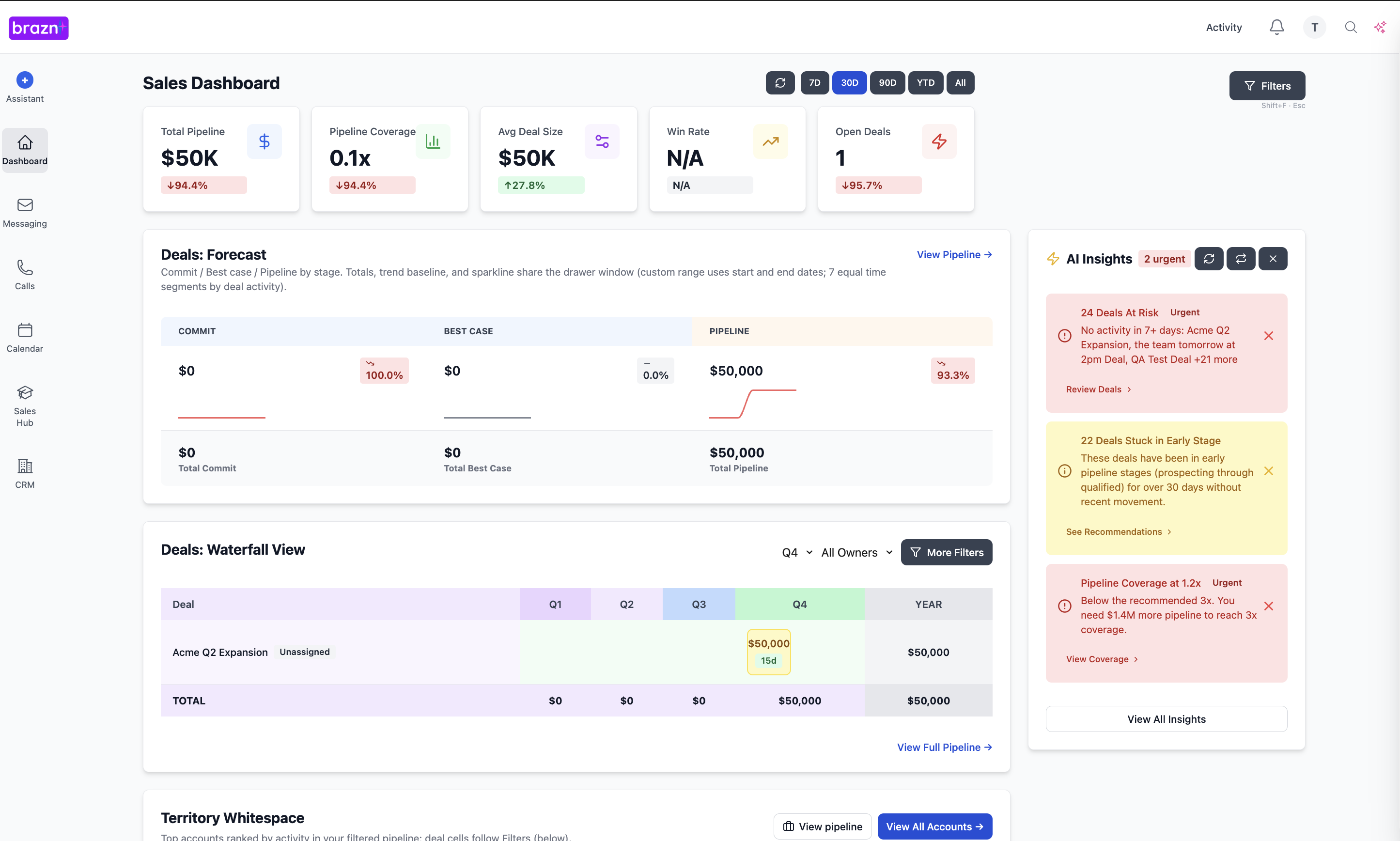
Write these six numbers on a sticky note and put it on your monitor right now. By the end of the week, you should be able to throw the sticky note away. Ready to get crystal-clear visibility into your revenue engine? See how Brazn's executive reporting surfaces the metrics that matter.
Book a demo to see how Brazn AI fits into your sales stack.

About the Author

Alex Margarit, Sales AI Expert, SaaS Sales Leader, BMC, ServiceNow, Docusign — 25+ years in SaaS sales.