
How Chief Revenue Officers Use AI to Improve Forecast Accuracy
Forecast accuracy is the metric that defines a CRO's credibility with the board and the CEO. Miss the number consistently — in either direction — and it signals that the revenue organisation lacks the discipline or visibility to manage its own pipeline. Get it right consistently, and it demonstrates operational maturity that builds trust and enables better resource allocation.
The average SaaS company misses its quarterly forecast by 20–25%. AI is changing that — not by replacing the judgment of experienced revenue leaders, but by replacing the subjective, self-reported inputs that make traditional forecasting so unreliable.
Why Traditional Forecasting Fails
The root cause of forecast inaccuracy is almost always the same: the inputs are wrong.
Traditional forecasting aggregates rep self-reporting. Reps assess their deals based on recency of positive interactions, personal relationship with the champion, and natural optimism bias. A deal that had a great call two weeks ago, with an enthusiastic champion and a verbal commitment, gets committed in the forecast — even if the economic buyer has never been engaged, the decision process is unclear, and legal hasn't been mentioned.
The manager reviews the rep's assessment, adjusts slightly based on intuition, and rolls it up. The CRO sees a number that reflects the cumulative optimism bias of the entire team, amplified through each reporting layer.
AI replaces this process with objective, signal-based inputs. The question changes from "what does the rep think will close?" to "what does the evidence say will close?"
The Four Ways CROs Use AI for Forecasting
1. AI deal scoring that reflects qualification realityThe most fundamental change AI brings to forecasting is deal-level scoring based on objective signals rather than stage and rep confidence.
AI deal scoring models analyse every available signal for each opportunity:
Call transcript content — qualification language, decision process clarity, champion behaviour, EB engagement.
Email engagement patterns — recency, frequency, multi-threading across stakeholders.
CRM data completeness — are qualification fields populated and current?Deal velocity — how does this deal's progression compare to historical won deals of similar size and segment?
MEDDPICC completeness (in methodology-aware tools) — which qualification elements are evidenced and which are missing.The result is a deal score that reflects the actual state of the deal — not the state the rep believes it to be in. Deals that are well-engaged but under-qualified get lower scores. Deals with clear metrics, confirmed EB engagement, and an established decision process get higher scores regardless of whether the rep has formally advanced the stage.
2. Historical pattern matchingAI forecasting tools that have access to historical won/lost data can compare every current deal to the full history of how similar deals resolved. The questions become quantitative:
What percentage of deals at this stage, of this size, in this segment, with this velocity closed on time vs slipped in the last 12 months?
Which deals at this stage typically take 30 more days vs 90 more days based on their current qualification pattern?
What percentage of deals that were committed in the forecast 30 days from close actually closed on time?
This historical calibration replaces the intuitive adjustments that CROs make manually — with data that reflects actual outcomes from the team's own pipeline history.
3. Proactive risk surfacingAI doesn't wait for the weekly pipeline review to surface at-risk deals. Modern tools monitor deal signals continuously and alert CROs and managers when a committed deal shows:
Declining engagement — fewer calls, slower email replies, meeting no-shows.
Stakeholder loss — a champion changes role or leaves the company.
Qualification regression — a deal that had established metrics suddenly stops referencing them.
Velocity deviation — a deal that is moving significantly slower than comparable won deals at the same stage.
Missing paper process — a deal approaching close date with no Procurement, legal, or approval process established.
CROs who receive these alerts in time can intervene — providing strategic guidance, requesting executive sponsorship, or adjusting the forecast before the deal misses, not after.
4. Scenario modellingAI-powered scenario modelling gives CROs the ability to stress-test the forecast before presenting it. Typical scenarios:
Base case: Current commits close as predicted. Conservative: Remove top 3 deals from commit — what's the number? Upside: Best case pipeline converts at historical best-in-class rates — what's the ceiling? Slip scenario: All deals currently forecast to close in the last 10 days of the quarter slip to next quarter — what's the impact?These scenarios convert the forecast from a point estimate into a range with known probabilities — giving the CRO a more defensible position with the board than a single number.
What the Best CROs Do Differently with AI
The CROs who get the most from AI forecasting tools share three operational habits:
They use AI scores as the starting point, not the override point. They don't start with rep self-reporting and adjust for AI signals. They start with AI signals and require reps to defend deviations from them. They run weekly deal-level inspection, not just roll-up review. AI surfaces the specific deals most likely to slip or be misforecast. They inspect those deals individually — using call transcripts, qualification scores, and stakeholder maps — before finalising the forecast. They close the loop on outcomes. When a deal that AI scored as high-risk closes, or a deal AI scored as healthy slips, they review why — and ensure the model's feedback loop is capturing those outcomes to improve future scoring.How Brazn Helps CROs Forecast Accurately
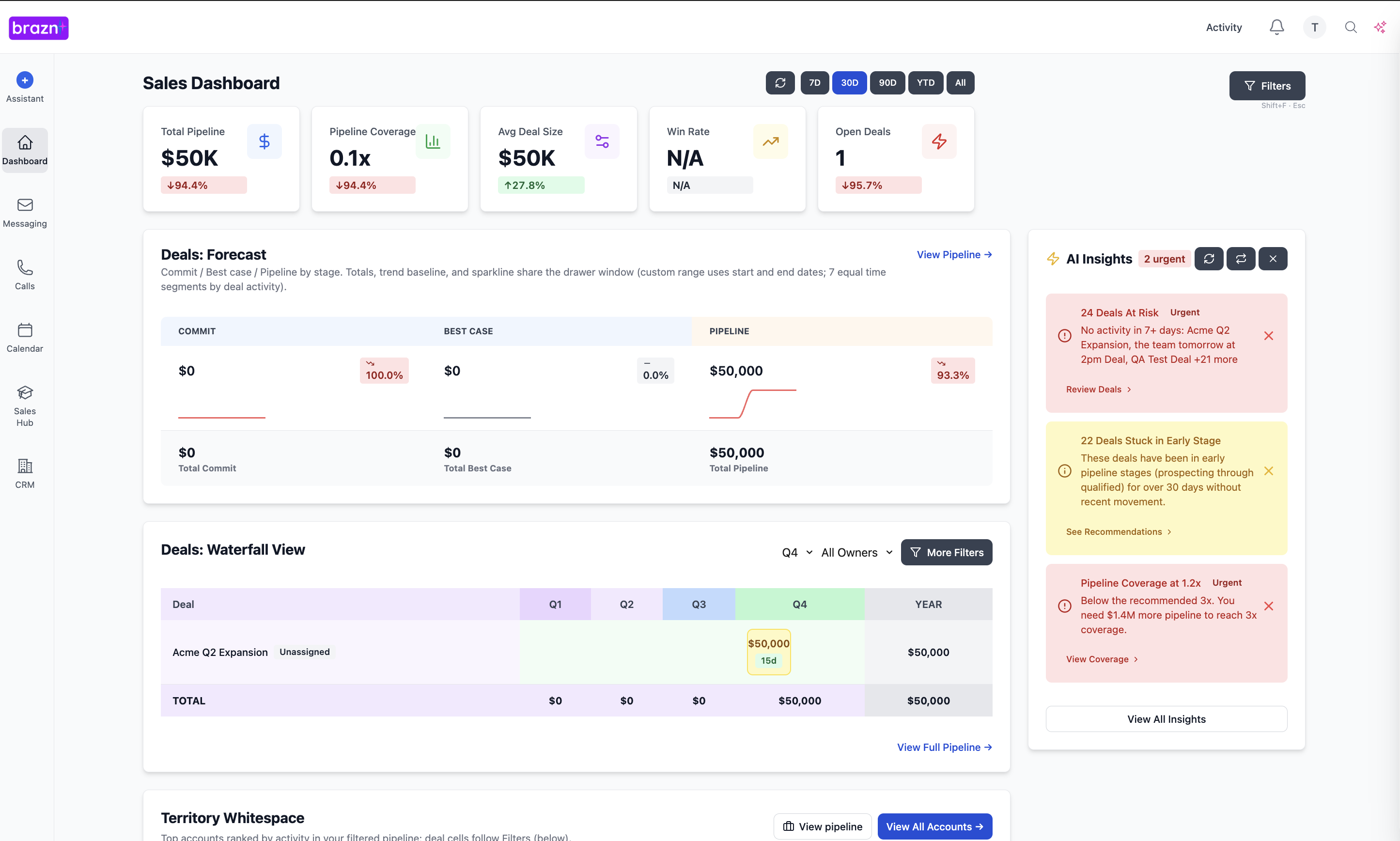
Brazn gives CROs a qualification-based forecast signal — MEDDPICC completeness scores per deal, updated after every interaction, that reflect the objective state of qualification rather than rep confidence. For CROs who have experienced late-stage losses on "healthy" deals, Brazn's qualification-aware scoring addresses the root cause of forecast failure: deals being committed before they are genuinely qualified.
---
####
Book a demo to see how Brazn AI fits into your sales stack.
About the Author

Alex Margarit, Sales AI Expert, SaaS Sales Leader, BMC, ServiceNow, Docusign — 25+ years in SaaS sales.