

How to Improve Sales Forecast Accuracy with AI
The average SaaS sales forecast is accurate to within ±20% in any given quarter. For most companies, that means the CEO, CFO, and board are making hiring, spend, and growth decisions based on a number that could be wrong by a fifth in either direction. The cost of that inaccuracy — over-hiring on an optimistic number, under-investing on a conservative one — compounds across every operational decision the business makes.
AI improves forecast accuracy not by replacing the human judgment involved in forecasting but by removing the specific, systematic biases that make human forecasting unreliable. Understanding what those biases are and how AI addresses each one is the prerequisite for implementing an AI-powered forecasting process that actually holds up.
---
The Root Causes of Forecast Inaccuracy
Root cause 1: Optimism bias in rep self-reportingReps are optimistic by nature and by incentive. Deals that feel good get committed. Deals that feel bad stay in best case until they can't. The result is a Commit category that historically closes at 65–75%, not 100% — a systematic over-commitment that inflates every forecast.
AI addresses this by replacing rep confidence assessment with objective qualification scoring. A deal's MEDDPICC completeness score and engagement signals don't know the rep is optimistic — they reflect what is actually evidenced in the deal record.
Root cause 2: Missing or incorrect CRM dataForecast accuracy depends on the quality of the underlying pipeline data. If close dates are aspirational, deal values are approximate, and stage assignments don't reflect exit criteria, the forecast calculation is built on unreliable inputs. Garbage in, garbage out — regardless of how sophisticated the model is.
AI addresses this through automated CRM enrichment — extracting deal data from call transcripts, emails, and engagement signals and writing it to CRM fields without relying on rep manual entry. Brazn's auto-enrichment eliminates the most common source of CRM data degradation: rep updates that are delayed, incomplete, or optimistic.
Root cause 3: No historical calibrationMost forecast categories are assigned static probability multipliers — Commit = 90%, Best Case = 50% — that bear no relationship to the team's actual historical close rates. If Commit historically closes at 71%, using a 90% multiplier produces a systematic over-forecast every quarter.
AI addresses this through dynamic historical calibration — calculating actual close rates by category, by deal size, by segment, and by AI score band from historical data, and applying those empirical probabilities rather than conventional assumptions.
Root cause 4: Late-stage surprise lossesDeals that were Committed and then lost in the final two weeks of the quarter are the most disruptive forecast events. They're also the most preventable — because the qualification gaps that caused the loss were present weeks earlier, just not surfaced.
AI addresses this through continuous deal monitoring — tracking MEDDPICC completeness trends, engagement velocity changes, and champion activity patterns in real time. Deals whose qualification is declining are flagged weeks before close date, when there's still time to intervene.
Root cause 5: Management aggregation errorsAs forecasts aggregate upward — rep to manager to VP to CRO — each layer adds its own adjustment, often based on intuition, historical relationships with specific reps, and recency bias. The adjustments compound errors rather than correcting them.
AI addresses this by providing the same objective view of deal quality at every level of the organisation simultaneously. The CRO's AI-weighted forecast and the rep's AI deal score are derived from the same data — removing the information asymmetry that makes management adjustments necessary.
---
The Four-Layer AI Forecasting Architecture
Layer 1: Automated CRM data qualityAI writes clean, complete deal data to CRM automatically — MEDDPICC elements from call transcripts, engagement data from email and calendar, and qualification scores updated after every interaction. The forecast model's inputs are current and objective rather than stale and optimistic.
Layer 2: Deal-level AI scoringEvery deal in the pipeline has an AI-generated close probability based on: MEDDPICC completeness score, days in stage relative to team median, engagement velocity trend, champion activity signals, and competitive mention context. This score is continuously updated — not a one-time assessment.
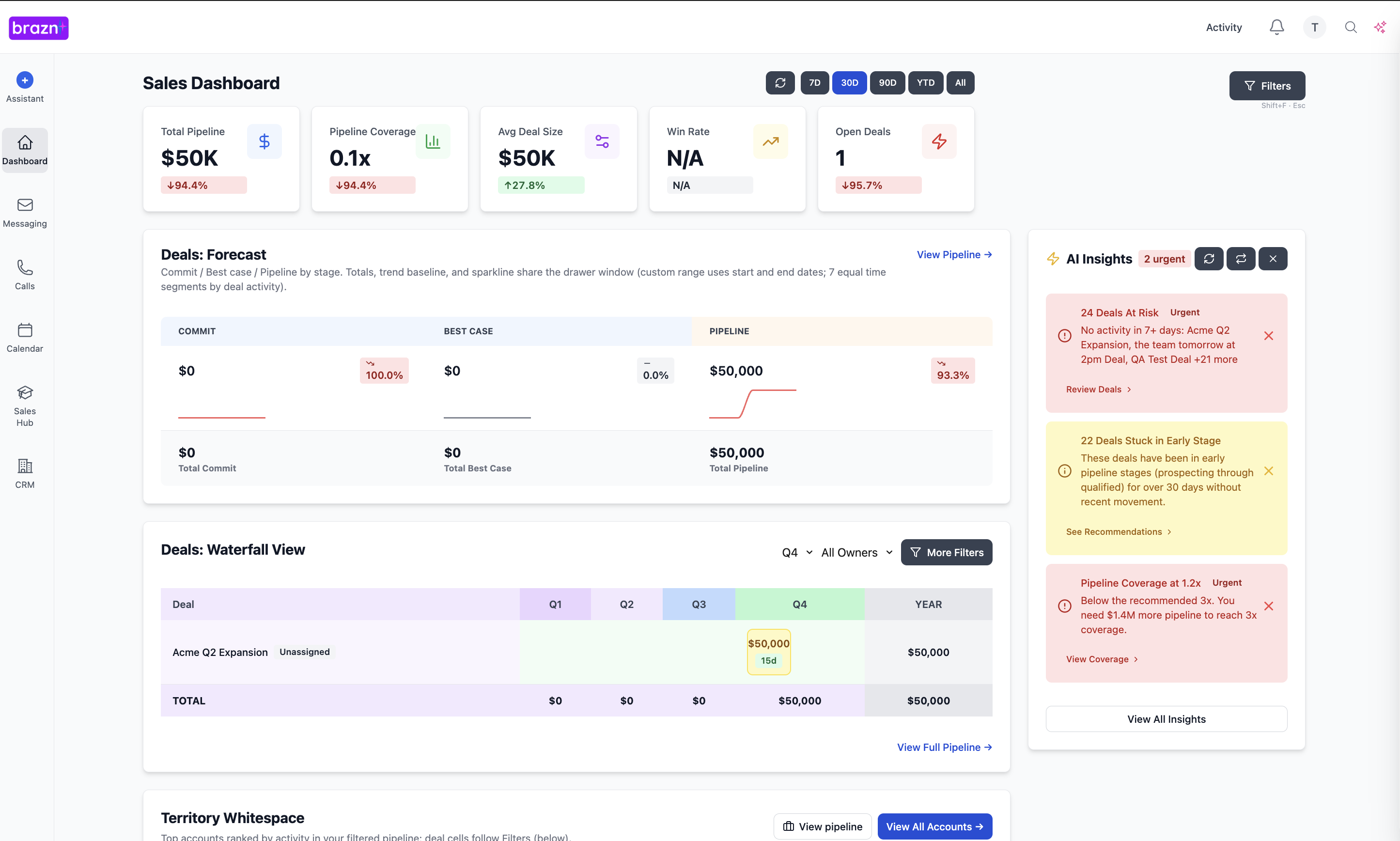
Layer 3: AI-weighted forecast calculationThe forecast model combines rep category assignments (Commit / Best Case / Pipeline) with AI deal scores to produce an AI-weighted forecast. Where the AI score significantly differs from the rep's category assignment, the deal is flagged for manager review. The AI-weighted number provides an objective check on the category-based number.
Layer 4: Risk and upside identificationAI identifies the specific deals driving the gap between the conservative and upside scenarios — the deals most at risk of slipping and the deals with the strongest qualification signals that could pull forward. This deal-level narrative enables the CRO to make targeted interventions rather than managing the number at the aggregate level.
---
Implementation: What Has to Change for AI Forecasting to Work
AI forecasting does not work if the inputs are wrong. Before implementing an AI forecasting layer, four prerequisites must be in place:
1. Defined stage exit criteriaAI can't score MEDDPICC elements it can't find. Stage definitions must include specific, buyer-verifiable exit criteria that align with MEDDPICC. Without defined exit criteria, AI scoring is imprecise.
2. Call recording for all customer-facing callsBrazn's AI enrichment reads call transcripts to extract MEDDPICC evidence. If calls aren't recorded, the richest source of qualification data is unavailable. Call recording must be standard, not optional.
3. CRM custom fields for MEDDPICC elementsAI-extracted qualification data needs a structured home in CRM. Each MEDDPICC element should have a dedicated CRM field — not a notes field, but a structured property that can be scored, reported, and trended.
4. Management commitment to using AI data in reviewsThe most common failure mode in AI forecasting implementations is that the AI data is available but managers continue to run forecast reviews on feel and rep relationship. The AI forecast must be the primary input to the forecast conversation — challenged when evidence contradicts it, but never simply ignored.
---
Measuring Forecast Accuracy Improvement
Track forecast accuracy as a primary metric before and after AI implementation:
`textForecast Accuracy = 1 - |Actual Revenue - Forecasted Revenue| / Forecasted Revenue × 100`
Measure at the team level, by category, and over rolling quarters. The improvement trajectory should be visible within 2–3 quarters of AI-powered forecasting implementation — as the historical calibration data accumulates and the AI model improves with each outcome record.
Teams using Brazn for AI-powered forecasting consistently report forecast accuracy improvement of 15–25 percentage points within two quarters — moving from the industry typical ±20% accuracy to ±8–12% accuracy. At that level of precision, the CEO and board are making decisions on a number they can trust.
---
####
Book a demo to see how Brazn AI fits into your sales stack.

About the Author

Alex Margarit, Sales AI Expert, SaaS Sales Leader, BMC, ServiceNow, Docusign — 25+ years in SaaS sales.