
How Brazn Fits Into Your Existing SaaS Sales Stack (Gong, Salesforce, Apollo)
The first thing most SaaS sales leaders say when they see Brazn is some version of this:
"This looks great. But we already have Gong, Salesforce, Apollo, Salesloft, ZoomInfo, and about four other tools we're still paying for from 2022. The last thing we need is another platform to onboard, train reps on, and get adoption for."It's a completely fair response. Sales tech stack bloat is a real problem. The average SaaS revenue team runs twelve to fifteen tools. Each one came with a compelling demo, a strong business case, and an adoption curve that was steeper than the vendor promised. The idea of adding one more is legitimately exhausting.
So let's be direct about what Brazn actually is — and isn't — in the context of your existing stack.
Brazn is not a replacement for Gong. It's not a replacement for Salesforce. It's not a replacement for Apollo or Salesloft or ZoomInfo. It doesn't ask you to rip anything out or retrain your team on a new workflow.
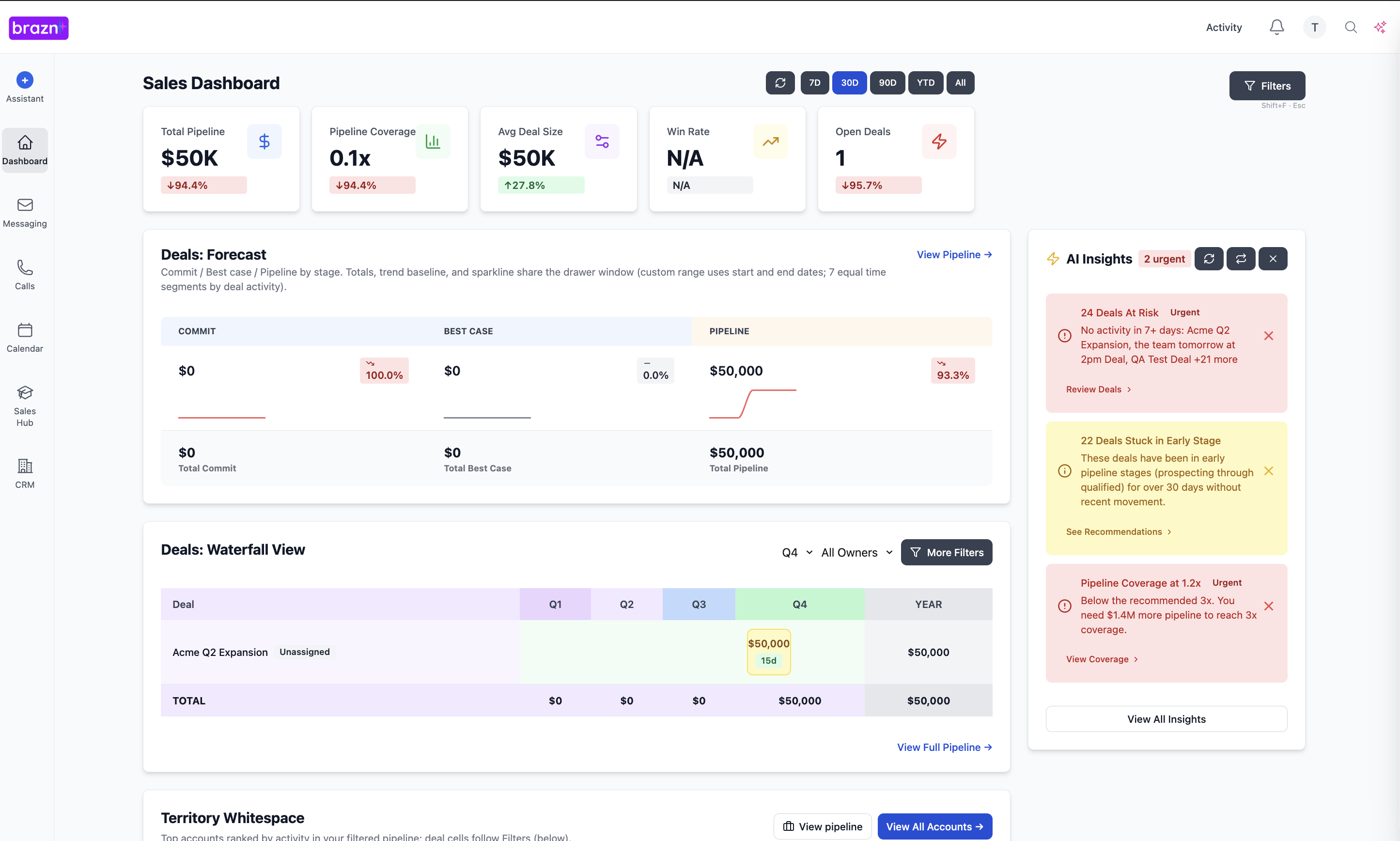
Brazn is the intelligence layer that sits on top of everything you already have — and makes it all work together in a way it currently doesn't.
The Problem With Your Stack Right Now
Your existing tools are excellent at their individual jobs. The problem is they don't talk to each other in the way that actually serves the rep.
Gong records every call and produces a transcript. Brilliant. But the insights stay in Gong. Someone has to go into Gong, find the relevant recording, extract the key information, and manually transfer it to Salesforce. Nobody does this consistently. The transcript sits in Gong, unused after the first 24 hours. Salesforce stores your pipeline data. But it only knows what someone typed into it. It has no idea what was said on the last call unless a rep took the time to log it. Which, as we've established, they mostly don't. Apollo manages your outbound sequences and prospecting. It knows your cadence and your target accounts. But it doesn't know what's happening in your open deals. It doesn't know that the account you're prospecting into just had a discovery call that revealed three new contacts worth reaching. It fires its sequences regardless of deal context. ZoomInfo or Cognism enriches your contact and account data. Useful. But the enrichment stays in the enrichment tool unless someone manually pulls it into Salesforce or pastes it into an email. Salesloft or Outreach manages your engagement sequences. It knows when emails were opened and replied to. But it doesn't know whether the deal is qualified, whether MEDDPICC coverage is healthy, or whether the rep should even be in this sequence or picking up the phone instead.Each tool is doing its job. But the connective tissue between them — the intelligence layer that takes outputs from one tool and turns them into inputs for another — that's missing. And filling that gap currently falls on the rep. Who is already maxed out.
That's the gap Brazn fills.
How Brazn Connects to Each Tool in Your Stack
Brazn + Gong (or Chorus)
This is where the magic starts.
Every time a call ends and Gong produces a transcript, Brazn reads it automatically. It extracts:
- MEDDPICC evidence from what was said on the call
- Next steps explicitly agreed by rep and prospect
- Stakeholder context — who was on the call, what their apparent priorities are, what objections they raised
- Competitive mentions — any reference to alternatives being evaluated
- Deal risks — anything that suggests the deal is more complex, more uncertain, or more at risk than the current CRM record suggests
- Champion signals — is the champion actively engaged, neutral, or showing signs of going cold?
All of that gets written back to Salesforce automatically. The rep gets a confirmation notification. The transcript that was previously sitting idle in Gong is now driving real-time CRM updates without a human in the middle.
Brazn + Salesforce
Salesforce is Brazn's source of truth and its primary output destination.
Brazn reads from Salesforce to understand the current state of every deal — what's been logged, what fields are blank, what the pipeline looks like. It writes back to Salesforce with updates from calls, emails, and enrichment data. It flags deals where field coverage is weak or where the data hasn't been refreshed in too long.
The result is a Salesforce that reflects reality — not the rep's memory of reality, not the state of the pipeline three weeks ago, but what's actually happening in every deal right now. For RevOps teams who've spent years fighting the data quality problem, this is transformative.
Brazn also works with your existing Salesforce custom fields and MEDDPICC layouts. It doesn't require you to restructure your CRM or adopt a new data model. It maps to what you've already built.
Brazn + Apollo (or Salesloft / Outreach)
Your sales engagement platform manages execution. Brazn manages context.
Brazn monitors your active sequences and cross-references them with deal context. If an account in an active outbound sequence just had a discovery call — meaning it's now an active deal, not a cold prospect — Brazn flags that the sequence should be paused and the engagement strategy should shift from outbound cadence to deal management mode.
Conversely, if a deal has gone cold and re-engagement outreach is warranted, Brazn drafts the message and queues it in Salesloft or Apollo for the rep's one-click approval. The sequence fires with full deal context — referencing the previous conversation, the specific value discussion, the named stakeholder — not a generic re-engagement template.
Brazn also identifies net-new contacts at active accounts — people mentioned on calls or flagged by enrichment data as relevant stakeholders — and builds personalised outreach for them, feeding them into the appropriate sequence for the rep to review and activate.
Brazn + ZoomInfo / Cognism
Enrichment data is only useful when it's deployed at the right moment. Brazn makes that happen.
When a rep is prepping for a discovery call, Brazn pulls relevant ZoomInfo or Cognism data — firmographics, technographics, contact details, org chart context — and incorporates it into the pre-call research brief. The rep doesn't log into ZoomInfo separately. They get a brief that already has the enrichment woven in.
When a new contact is identified on a deal — either from a call transcript or from manual addition — Brazn automatically enriches the contact record using your connected enrichment tool and adds the relevant context to the deal record in Salesforce.
Brazn + Your Inbox (Gmail / Outlook)
Email is where deals live between calls. Brazn monitors deal-relevant email threads and extracts signal from them — buying intent, objections surfaced, stakeholders CC'd, timelines referenced, next steps agreed.
This means Salesforce stays updated even when deals are progressing over email rather than on calls. A prospect who replies with a question about security compliance gets their response logged. A champion who forwards your proposal to three new stakeholders gets that multi-threading signal captured. An email that references a competitor gets flagged for competitive intelligence.
What the Rep's Experience Actually Looks Like
Here's the important question: does adding Brazn mean reps have to log into yet another platform, learn yet another interface, and build yet another habit?
No. Brazn is deliberately designed to work through the surfaces your reps already use.
Deal briefs arrive in Slack or email before calls — wherever your reps already read information in the morning. CRM update confirmations arrive the same way — a quick message with a one-click approve or edit. Sequence step notifications come through the same channel. Flagged deal risks land in the rep's feed without them having to open a dashboard.
For the rep, Brazn mostly feels like having a very switched-on assistant who sends useful things at useful times. The outputs show up where the rep already is. The inputs — the calls, the emails, the CRM data — all come from systems the rep is already using.
The learning curve is minimal because the workflow change is minimal. The rep does their job. Brazn does the connective tissue work between the tools. Salesforce looks better. Sequences fire smarter. Pipeline reviews run faster.
The Stack-Wide Effect
The return on Brazn isn't just the rep-level time saving — though that alone is significant. It's the stack-wide improvement in data quality and workflow coherence that compounds over time.
Gong becomes more valuable because its transcripts are being acted on automatically, not just stored. Salesforce becomes trustworthy because AI is maintaining it in real time, not waiting for end-of-week CRM hygiene sessions. Apollo and Salesloft become smarter because they're receiving deal context from Brazn — not just firing sequences blindly based on list membership. ZoomInfo and Cognism become more impactful because their data is delivered to the rep at the right moment, not sitting in a separate tab. Your forecast becomes more accurate because the data feeding it reflects reality.You don't get a bigger stack. You get a smarter one. The tools you've already invested in start working the way you always wanted them to — because there's finally an intelligence layer connecting them.
---
Want to see how Brazn connects to your specific stack?Provide your details below — we'll map your current tools and show you exactly where Brazn plugs in and what changes on day one.
---
####
Book a demo to see how Brazn AI fits into your sales stack.

About the Author

Alex Margarit, Sales AI Expert, SaaS Sales Leader, BMC, ServiceNow, Docusign — 25+ years in SaaS sales.