
The Modern SaaS AI Sales Stack: How Brazn Complements Gong, Apollo, and Your CRM
Every SaaS revenue team has a stack diagram somewhere.
It usually lives in a Notion page, a Confluence doc, or a slide deck that gets pulled out during board meetings and RevOps planning sessions. It shows all the tools — Gong on the left, Salesforce in the middle, Apollo somewhere near the bottom, ZoomInfo in the corner, Salesloft connecting to something, a few integrations drawn with arrows that everyone agrees are a bit optimistic about how well the data actually flows.
The diagram looks complete. The reality is messier.
Because what the diagram doesn't show is the space between the tools. The manual work that happens when a Gong transcript needs to become a Salesforce update. The cognitive load on the rep when Apollo fires a sequence step and they need to remember what was said on the last call before personalising their reply. The gap between the ZoomInfo data sitting in one tab and the email being written in another.
That space — the connective tissue between the tools — is where most of the lost selling time lives. And it's the space that the modern AI sales stack is designed to fill.
This article is about what that complete stack looks like. Not the tools in isolation — you already know those. But how they fit together, what role each one plays, and where the missing layer goes.
The Four Layers of the Modern SaaS Sales Stack
Think of a complete SaaS sales stack as four distinct layers, each with a specific job.
Layer 1: Data and Enrichment
The foundation. This layer knows who your buyers are — firmographics, technographics, contact details, intent signals, org chart context. Without good data, everything above it underperforms.
Tools: ZoomInfo, Cognism, Clearbit, Apollo (data layer), 6sense, Bombora
Layer 2: CRM and Pipeline Management
The system of record. This layer stores deal history, tracks pipeline stages, manages contacts and accounts, and feeds the forecast. It's only as good as the data that goes into it — which is the central problem the whole stack is trying to solve.
Tools: Salesforce, HubSpot, Pipedrive
Layer 3: Engagement and Communication
The execution layer. This layer manages outbound sequences, call recording, email tracking, and multi-channel communication. It's where the rep's activity lives — calls made, emails sent, meetings booked, sequences progressed.
Tools: Gong, Chorus, Salesloft, Outreach, Apollo (engagement layer), Gmail, Outlook
Layer 4: Intelligence and Orchestration
The missing layer in most stacks. This layer reads the outputs of Layers 1–3, synthesises the context, identifies what needs to happen next, and acts — updating the CRM, building research briefs, drafting communications, flagging risks, maintaining deal hygiene.
Tools: Brazn
Most SaaS teams have Layers 1–3 covered reasonably well. Layer 4 is either absent entirely or being performed manually by the rep — which is why, according to Salesforce's State of Sales report, reps spend only 28% of their week actually selling.
Why Layers 1–3 Alone Aren't Enough
Let's trace a single deal through a stack that has Layers 1–3 but no Layer 4, and see where the friction accumulates.
Monday morning. The rep has a discovery call at 9am. To prepare, they need to pull firmographic data from ZoomInfo, check the account history in Salesforce, review the previous call notes in Gong, and cross-reference the active sequence in Apollo to understand what touchpoints have already happened. Four tools. Four logins. Thirty to forty-five minutes of prep for a forty-minute call. If they're busy — and they're always busy — this doesn't happen properly. They go in underprepared.
After the call. Gong has a transcript. Salesforce has an outdated record. The rep needs to read the transcript, extract the relevant MEDDPICC updates, open Salesforce, navigate to the opportunity, and update the relevant fields. Then write a follow-up email. Then log the call activity. Then set the next step tasks. Then update the contact record with anything new they learned about stakeholders. Forty-five minutes to an hour. If they have another call in thirty minutes, most of this gets deferred to later — which means it often doesn't happen at all.
End of week. Pipeline review prep. The rep opens Salesforce and realises half their deals haven't been updated since the last review. They spend Sunday evening in catch-up mode, reconstructing deal context from memory and updating fields with information that is already a week old.
The sequence layer. Apollo or Salesloft is firing sequence steps. Some of them are going to accounts that the rep now knows are warm — they had a conversation last week. The cold outreach is landing at the wrong time with the wrong tone. Nobody has updated Apollo with the deal context because the bridge between Gong/Salesforce and Apollo is manual.
This is the stack without Layer 4. It's functional. It's not efficient. And the inefficiency falls entirely on the rep.
Where Brazn Lives in the Stack
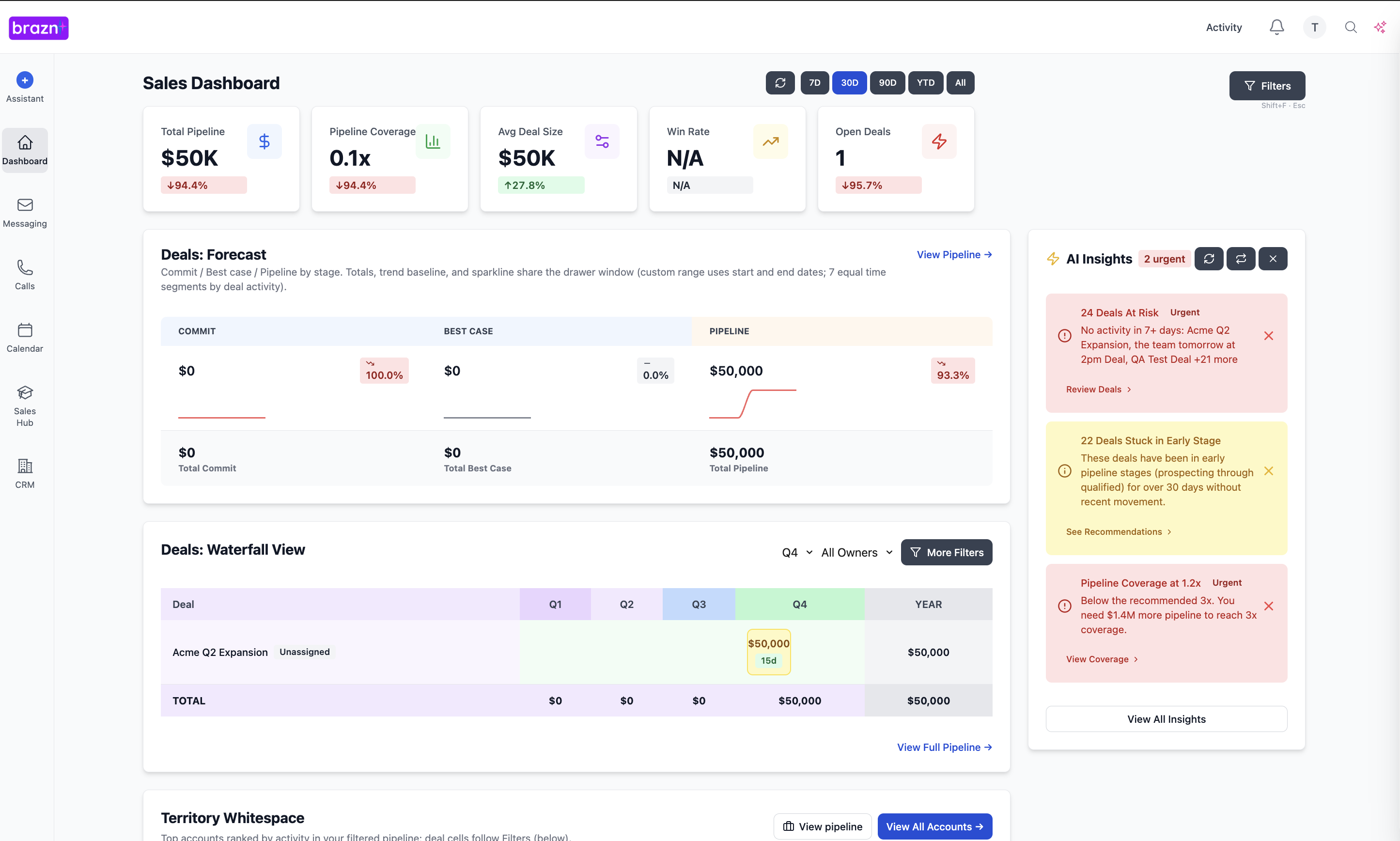
Brazn is Layer 4. Here's exactly how it connects to and enhances each of the other layers.
Brazn + Layer 1: Data and Enrichment
Brazn pulls from your enrichment tools — ZoomInfo, Cognism, Clearbit — and deploys that data at the moment it's actually useful.
When a rep has a call in thirty minutes, Brazn builds a research brief that incorporates enrichment data automatically — firmographics, technographics, recent news, contact context, relevant trigger events. The rep doesn't log into ZoomInfo separately. The enrichment is delivered in context, at the right moment, in a format that's immediately usable.
When a new contact is identified — from a call transcript, an email CC, or a product usage signal — Brazn automatically enriches the contact record using your connected enrichment tool and adds it to the relevant deal in Salesforce.
Enrichment data stops sitting idle in a separate platform and starts feeding directly into rep workflows.
Brazn + Layer 2: CRM (Salesforce, HubSpot, Pipedrive)
This is Brazn's most impactful integration — and the one that solves the most painful problem in most SaaS stacks.
Brazn reads from your CRM to understand the current state of every deal. It writes back to your CRM after every meaningful interaction — updating MEDDPICC fields from call transcripts, logging activity, capturing next steps, refreshing deal stage, adding new contacts, flagging risks.
The CRM stops being a manual data entry system and starts being a genuinely accurate real-time record of what's happening in the pipeline. For RevOps teams who've spent years fighting the data quality problem — running training sessions, building validation rules, begging reps to update their fields — this is the structural fix they've been missing.
Brazn also works with your existing CRM configuration. It maps to your custom fields, your MEDDPICC layout, your deal stages. You don't restructure your CRM to accommodate Brazn. Brazn accommodates what you've already built.
Brazn + Layer 3: Engagement and Communication
With Gong and Chorus:
Every transcript gets read automatically after the call ends. MEDDPICC updates, next steps, stakeholder context, competitive mentions, deal risks — all extracted and written to Salesforce without the rep touching a keyboard. The transcript that was previously sitting idle in Gong becomes the primary driver of CRM accuracy.
Brazn also uses transcript history to build pre-call briefs — not just current deal context but a synthesis of everything that's been discussed across all previous calls on the account. The rep walks into every call already knowing the full conversation history, the open gaps, and the specific questions they need to answer.
With Salesloft, Outreach, and Apollo:
Brazn monitors active sequences and cross-references them with deal context. When an account moves from cold prospect to active deal, Brazn flags that the sequence strategy should change and queues the appropriate follow-up. When a deal goes quiet and re-engagement is warranted, Brazn drafts the message and routes it to the rep for one-click approval.
Brazn also feeds net-new contacts — identified from call transcripts or enrichment triggers — into the appropriate sequences with personalised outreach already drafted. The engagement layer fires smarter because it's receiving better inputs.
With Gmail and Outlook:
Brazn monitors deal-relevant email threads for signal — buying intent, new stakeholders, timeline references, competitive mentions, objections raised. These signals get logged to Salesforce and incorporated into deal health scoring. Deals that are moving over email — not just on calls — stay current in the CRM.
What the Complete Stack Looks Like in Practice
Let's run the same deal scenario through the complete four-layer stack and see the difference.
Monday morning. The rep's phone buzzes at 8:30am. Brazn has sent the pre-call brief for the 9am discovery call — firmographics, recent company news, stakeholder context, open MEDDPICC gaps from previous calls, suggested discovery questions. The rep reads it in four minutes over coffee. They walk into the call fully prepared.
After the call. Gong processes the transcript. Brazn reads it within minutes and updates Salesforce — MEDDPICC fields refreshed, next steps logged as tasks, new stakeholder added to the contact record, competitive mention flagged. The rep gets a Slack notification: "Deal updated — 3 fields refreshed, 2 next steps logged, 1 risk flagged. Review and confirm?" They spend ninety seconds approving. Done.
End of week. Pipeline review prep is already done. Brazn has maintained every deal record throughout the week. The manager opens Salesforce and it reflects reality. The review starts at strategy, not status.
The sequence layer. Apollo is firing sequences. But Brazn has been feeding it context — pausing sequences on accounts that have moved to active deal status, queuing re-engagement messages on deals that have gone quiet, routing net-new contact outreach with personalised drafts already built. The engagement layer is working smarter because the intelligence layer is feeding it properly.
The rep gets 2–3 hours a day back. The CRM is accurate. The pipeline review takes half the time. The forecast reflects reality. The stack that looked complete on the diagram actually is complete — because the missing layer is finally in place.
Building Your Stack for 2026 and Beyond
The SaaS sales stack is not done evolving. But the direction of travel is clear.
The tools in Layers 1–3 are mature. Gong is excellent. Salesforce is entrenched. Apollo and Salesloft have solved the outbound execution problem. The incremental gains from optimising within those layers are real but limited.
The transformational gain is in Layer 4. The intelligence and orchestration layer that connects everything, eliminates the manual connective tissue work, and lets the rep spend their time on the work that actually requires a human.
The teams building this stack now — with an agentic AI layer sitting above their existing tools — are not just incrementally more efficient. Gong's research found that AI-enabled sales teams generate 77% more revenue per rep than those without it. They're operating in a structurally different way. Their reps carry more pipeline with less admin. Their CRM data is trustworthy. Their pipeline reviews produce strategy instead of status updates. Their forecast surprises nobody.
That's the modern SaaS AI sales stack. And it's available right now.
Ready to add the missing layer to your stack?
Provide your details below — we'll map your current tools and show you exactly what changes when Brazn connects to them.
Book a demo to see how Brazn AI fits into your sales stack.

About the Author

Alex Margarit, Sales AI Expert, SaaS Sales Leader, BMC, ServiceNow, Docusign — 25+ years in SaaS sales.