
What Is a Mutual Close Plan? SaaS Sales Guide
A Mutual Close Plan is a shared, time-bound document co-created by a sales rep and a prospective buyer that maps every step, owner, and deadline required to get from the current deal stage to a signed contract. It is functionally equivalent to a Mutual Action Plan (MAP) — the terms are often used interchangeably in SaaS sales — with the specific emphasis on the closing sequence: the final milestones of legal review, procurement, approvals, and signature.
---
Mutual Close Plan vs Mutual Action Plan
In most SaaS sales organisations, a Mutual Close Plan and a Mutual Action Plan refer to the same artifact. Both are co-owned, milestone-based documents that structure the path to signature with shared accountability. If there is a distinction, it tends to be one of scope:
A MAP often covers the full buying journey — from post-discovery through to close — and may include steps like business case review, reference calls, and technical validation alongside legal and procurement.
A Mutual Close Plan tends to be introduced later — typically at the point where the buyer has indicated intent to purchase and the focus shifts to executing the administrative and legal steps required to get to a signed agreement.
In practice, most sales teams use one or the other consistently, not both. The label matters less than the discipline of co-creating it with the buyer and holding both sides to the milestones within it.
---
Why Close Plans Fail Without Buyer Co-Ownership
A close plan built by the rep and sent to the buyer is not a Mutual Close Plan. It is a project schedule. The distinction matters enormously in practice.
When a buyer co-creates the close plan — adds their own milestones, names the internal owners, agrees to the dates — they are making a commitment. They are telling the rep: "these are the steps we need to take internally, these are the people who own them, and this is the timeline we're working to." That commitment creates accountability in a way that no externally imposed schedule can.
When a rep sends a close plan without co-creation, the buyer may acknowledge it politely and then operate on their own internal timeline — which is almost certainly slower, less defined, and more prone to slippage than the one the rep had in mind.
---
The Anatomy of a Mutual Close Plan
A Mutual Close Plan in SaaS typically covers the following milestones, though the specifics vary by deal size and complexity:
Business validation- Final business case presented to Economic Buyer
- ROI model reviewed and signed off internally
Technical and security- Security questionnaire submitted and reviewed
- IT/infrastructure sign-off obtained
- Data processing agreement (DPA) reviewed
Legal and procurement- MSA/contract draft shared
- Legal redlines completed
- Procurement vendor registration completed
- Any additional compliance approvals obtained
Commercial and signature- Final pricing and terms agreed
- Internal budget approval obtained
- Contract issued for signature
- Contract countersigned — close date
Each milestone carries a named owner on the buyer side and a corresponding owner on the seller side, with a target completion date and current status.
---
Mutual Close Plan as a Risk Management Tool
In enterprise SaaS, the close plan is one of the most reliable risk management tools available to a rep. Specifically, it surfaces the Paper Process element of MEDDPICC — the sequence of legal, procurement, and administrative steps that sit between a verbal commitment and a signed contract.
Most late-stage deal slippage is not caused by the buyer changing their mind. It is caused by the rep not anticipating the Paper Process until it is too late. Legal takes three weeks instead of one. Procurement requires a vendor registration that takes ten days. The contract needs sign-off from a board member who is on holiday. These are not surprises — they are predictable steps that the close plan should have surfaced six weeks earlier.
A well-built Mutual Close Plan eliminates this category of slippage by forcing the buyer to map their internal process explicitly, early enough for the rep to build it into the forecast timeline.
---
Introducing the Mutual Close Plan
The ideal moment to introduce a Mutual Close Plan is when the buyer expresses genuine intent to move forward — typically after a successful demo, a positive technical review, or a conversation in which the buyer says something like "we want to get this done before the end of Q2."
The rep's response to that signal should be: "Great — let's build a close plan together so we can work backwards from that date and make sure we're set up to hit it. Can we get 30 minutes on the calendar this week to map it out?"
The 30-minute close plan session is one of the most productive investments a rep can make late in a deal. It surfaces every internal step the buyer needs to take, names the people who own them, and creates a shared commitment to a timeline that both sides have agreed is realistic.
---
How AI Supports Close Plan Execution
The challenge with Mutual Close Plans is not creating them — it is keeping them alive. In a pipeline of 20+ deals, a rep who is manually tracking close plan progress across every opportunity will inevitably let milestones go stale, miss overdue steps, and fail to follow up on delayed tasks.
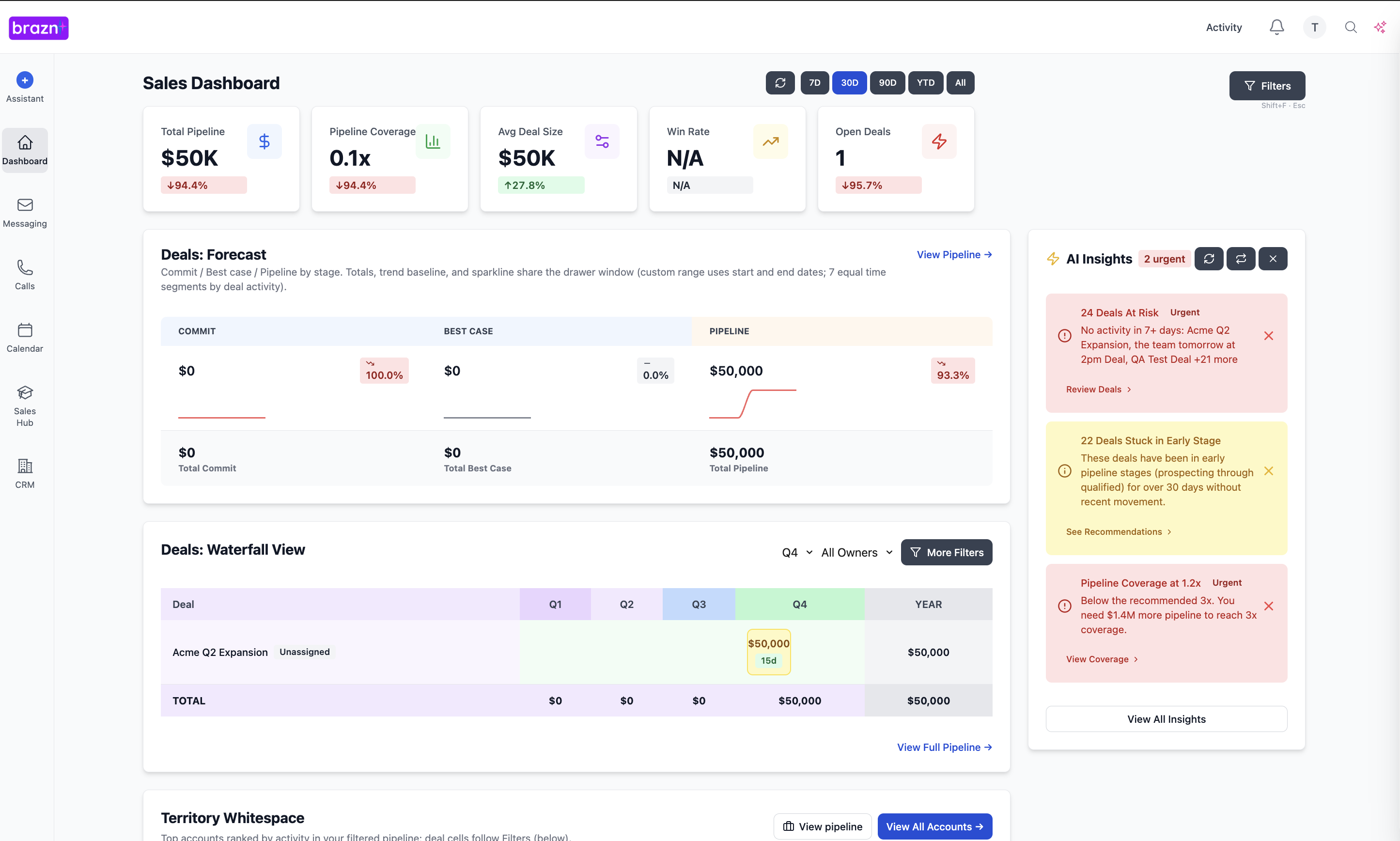
Brazn automates the monitoring layer: tracking milestone completion, flagging overdue steps, identifying when buyer engagement has dropped off relative to close plan expectations, and surfacing specific recommended actions when a milestone is at risk. Managers get a real-time view of close plan health across the entire pipeline — not just the deals the rep remembered to mention in the last pipeline review.
---
The Bottom Line
A Mutual Close Plan is the mechanism by which a rep converts a buyer's verbal intent into a structured, accountable path to signature. Without it, "we want to close by end of quarter" is a hope. With it, it is a plan — with milestones, owners, dates, and shared accountability.
For SaaS sales teams focused on improving forecast accuracy and reducing late-stage slippage, building the Mutual Close Plan discipline into the standard operating process for every deal above a certain ACV threshold is one of the highest-return operational changes they can make.
---
See How Brazn Keeps Your Close Plans on Track
Brazn monitors close plan milestones, flags overdue steps, and surfaces deal coaching actions so your most important deals close on time.
---
Book a demo to see how Brazn AI fits into your sales stack.

About the Author

Alex Margarit, Sales AI Expert, SaaS Sales Leader, BMC, ServiceNow, Docusign — 25+ years in SaaS sales.