Content: # Demo Prep, Reinvented With AI-Generated Account Intelligence
A generic product demo is the fastest way to lose a qualified prospect. Buyers expect you to understand their specific business context before you even share your screen. But thoroughly researching an account and customizing a demo takes hours that Sales Engineers (SEs) and AEs don’t have.
This article reveals how top-performing teams are using AI-generated account intelligence to reinvent demo prep—so they can deliver highly tailored presentations in a fraction of the time.
What we’ll cover
In this article, we will cover:
- Why generic demos fail in today’s market
- How AI gathers and synthesizes account intelligence
- 3 ways to use AI insights to customize your demo
- The impact on win rates and sales cycle length
Understanding the approach
AI-generated account intelligence uses an AI agent to gather and synthesize a target company’s website, financial reports, recent news, and the prospect’s LinkedIn profile into a concise brief designed specifically to inform a product demonstration.
Example: An SE is prepping for a demo with a logistics company. The AI intelligence brief highlights that the company recently expanded into Europe and is struggling with supply chain visibility. The SE tailors the demo to focus on the platform’s global tracking and reporting features, skipping domestic modules entirely.
Why this matters
Customizing demos with AI intelligence dramatically increases relevance and buyer engagement.
- Before: SEs spend 2 hours researching an account and building a custom demo environment.
After: AI provides the research in seconds, allowing the SE to focus on crafting the narrative.
- Before: Prospects tune out during the “standard pitch.”
After: Prospects lean in because the demo directly addresses their current strategic initiatives.
The complete guide
Step 1: The “Strategic Initiative” mapping
Objective: Tie your product’s value to the company’s stated goals.
Actionable advice: Use AI to analyze the company’s recent 10-K or press releases to identify their top 3 strategic initiatives. Structure your demo to show exactly how your product supports those initiatives.
Best practices: Use the company’s own terminology during the demo.
Step 2: The “Persona pain point” alignment
Objective: Ensure the demo resonates with the specific people in the room.
Actionable advice: Have the AI generate a brief on the specific attendees, highlighting their likely pain points based on their roles. Address these pain points directly during the presentation.
Best practices: If there are multiple personas, explicitly call out which feature benefits which person.
Step 3: The “Competitor context” check
Objective: Pre-emptively address competitive threats.
Actionable advice: Use AI to check whether the prospect is evaluating competitors (via intent data) or currently using a competing product. Subtly highlight your differentiators during the demo without overtly bashing the competition.
Best practices: Focus on your unique value, not their flaws.
How to implement this
Sales Engineering (or Pre-Sales) leadership should champion the use of AI for demo prep. RevOps must provide the AI tools and integrate them with the calendar so briefs are generated automatically. Enablement should train AEs and SEs on how to translate the AI insights into a compelling demo narrative.
Next steps
A tailored demo is a winning demo. By leveraging AI to automate the research phase, you empower your team to deliver highly relevant, high-impact presentations every single time.
For your next demo, use an AI tool to summarize the prospect’s recent company news. Incorporate one specific insight into your opening slide. Ready to scale your custom demos? See how Brazn’s AI can help.
Demo Prep, Reinvented With AI-Generated Account Intelligence
A generic product demo is the fastest way to lose a qualified prospect. Buyers expect you to understand their specific business context before you even share your screen. But thoroughly researching an account and customizing a demo takes hours that Sales Engineers (SEs) and AEs don’t have.
This article reveals how top-performing teams are using AI-generated account intelligence to reinvent demo prep—so they can deliver highly tailored presentations in a fraction of the time.
What we’ll cover
- Why generic demos fail in today’s market
- How AI gathers and synthesizes account intelligence
- 3 ways to use AI insights to customize your demo
- The impact on win rates and sales cycle length
Understanding the approach
AI-generated account intelligence uses an AI agent to gather and synthesize a target company’s website, financial reports, recent news, and the prospect’s LinkedIn profile into a concise brief designed specifically to inform a product demonstration.
Example: An SE is prepping for a demo with a logistics company. The AI intelligence brief highlights that the company recently expanded into Europe and is struggling with supply chain visibility. The SE tailors the demo to focus on the platform’s global tracking and reporting features, skipping domestic modules entirely.Why this matters
Customizing demos with AI intelligence dramatically increases relevance and buyer engagement.
- Before: SEs spend 2 hours researching an account and building a custom demo environment.
After: AI provides the research in seconds, allowing the SE to focus on crafting the narrative.- Before: Prospects tune out during the “standard pitch.”
After: Prospects lean in because the demo directly addresses their current strategic initiatives.The complete guide
Step 1: The “Strategic Initiative” mapping
Objective: Tie your product’s value to the company’s stated goals. Actionable advice: Use AI to analyze the company’s recent 10-K or press releases to identify their top 3 strategic initiatives. Structure your demo to show exactly how your product supports those initiatives. Best practices: Use the company’s own terminology during the demo.Step 2: The “Persona pain point” alignment
Objective: Ensure the demo resonates with the specific people in the room. Actionable advice: Have the AI generate a brief on the specific attendees, highlighting their likely pain points based on their roles. Address these pain points directly during the presentation. Best practices: If there are multiple personas, explicitly call out which feature benefits which person.Step 3: The “Competitor context” check
Objective: Pre-emptively address competitive threats. Actionable advice: Use AI to check whether the prospect is evaluating competitors (via intent data) or currently using a competing product. Subtly highlight your differentiators during the demo without overtly bashing the competition. Best practices: Focus on your unique value, not their flaws.How to implement this
Sales Engineering (or Pre-Sales) leadership should champion the use of AI for demo prep. RevOps must provide the AI tools and integrate them with the calendar so briefs are generated automatically. Enablement should train AEs and SEs on how to translate the AI insights into a compelling demo narrative.
Next steps
A tailored demo is a winning demo. By leveraging AI to automate the research phase, you empower your team to deliver highly relevant, high-impact presentations every single time.
For your next demo, use an AI tool to summarize the prospect’s recent company news. Incorporate one specific insight into your opening slide.
Ready to scale your custom demos? See how Brazn’s AI can help.
####
Book a demo to see how Brazn AI fits into your sales stack.

About the Author
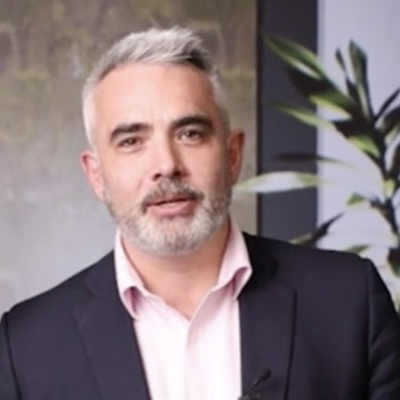
Alex Margarit, Sales AI Expert, SaaS Sales Leader, BMC, ServiceNow, Docusign — 25+ years in SaaS sales.