How to Use AI to Prep for a Sales Call
Sales call preparation is the highest-leverage pre-call activity a rep can do — and the one most commonly skipped under time pressure. The rep with 8 calls today has, in theory, no time to prepare for all of them thoroughly. In practice, the calls they prepared for go better, produce better qualification, and advance deals faster.
AI doesn't make preparation optional. It makes it fast enough that there's no longer an excuse to skip it. A thorough AI-generated pre-call brief takes 10 minutes to review — covering everything the rep needs to enter the call informed, personalised, and strategically prepared.
---
What Thorough Pre-Call Preparation Includes
For every sales call, the prepared rep knows:
- Who is on the call and what each person cares about
- What has happened at the company recently that's relevant
- What was discussed in previous calls and what was committed
- What the current MEDDPICC status is and where the gaps are
- What the call needs to accomplish to advance the deal
- What questions will establish the missing elements
- What objections are most likely and how to respond
Manually assembling this picture takes 30–45 minutes per call — reviewing previous notes, researching the company, checking the CRM record, looking up LinkedIn profiles. AI assembles it in under 2 minutes. The rep reviews in 8–10 minutes.
---
The AI Pre-Call Brief: Four Formats
Format 1: Cold outreach or first-touch callThe AI brief for a first call with a new prospect contains:
- Company overview (industry, headcount, funding, business model)
- Contact profile (tenure, career history, recent LinkedIn activity)
- Trigger event (the specific signal that makes this the right time to reach out)
- Pain hypothesis (the most likely problem based on company and role profile)
- Suggested opening line (specific, personalised, tied to trigger event)
- Suggested discovery questions for the call
The rep enters the first call knowing more about the prospect than the prospect expects — and the conversation starts at a higher level as a result.
Format 2: Discovery callThe AI brief for a discovery call includes:
- Full account context (everything from the first-touch brief, updated)
- Previous interaction summary (what was discussed in any earlier conversations)
- ICP fit assessment (how well the account matches the ICP model)
- MEDDPICC current state (what has been established, what is missing)
- Suggested discovery questions (targeting the MEDDPICC gaps)
- Key things to confirm or probe from previous interactions
Format 3: Demo preparation briefThe AI pre-demo brief is the most detailed — because demo preparation has the most variables:
- Stakeholder profiles for every confirmed attendee (name, title, likely priority)
- Pain synthesis from all previous calls (what each stakeholder cares about most)
- MEDDPICC status with specific gaps the demo should address
- Recommended demo flow (which capabilities to lead with, in which order, for which stakeholders)
- Suggested discovery questions to weave into the demo
- Most relevant reference customers to mention
- Likely objections with suggested responses
Format 4: Renewal or QBR preparation briefThe AI brief for a renewal or QBR call covers:
- Account health score and trend (usage, engagement, satisfaction signals)
- Key outcomes achieved since the last review, mapped to the original success metrics
- Open issues and their resolution status
- Stakeholder changes since implementation (champion still in role, new decision-makers)
- Expansion signals identified in usage and business intelligence data
- Renewal risk assessment and recommended positioning for the conversation
---
The 10-Minute Review Protocol
With the AI brief available, the pre-call preparation protocol is:
Minutes 1–2: Read the company summary and recent trigger events. Confirm nothing has changed that would alter the approach — a leadership change, a funding announcement, a competitive development — that requires adjusting the angle. Minutes 2–4: Review the stakeholder profiles. Identify each person's likely primary concern. Note any new attendees not previously engaged and consider how their presence changes the call's objective or priorities. Minutes 4–6: Review the MEDDPICC current state. Identify the two or three most important gaps to address on this call. Rank them by deal risk: the element whose absence most threatens the close date is the highest priority to establish. Minutes 6–8: Review the suggested questions. Edit or add based on specific context the AI doesn't have — something the prospect said off the record in the last call, an internal dynamic that isn't in the CRM, a competitive detail that emerged since the last interaction. Identify the two questions most important to ask if time is limited. Minutes 8–9: Note the most likely objections and the responses ready for each. Identify whether any objection from a prior call was left unresolved and plan to surface it proactively rather than wait for the prospect to raise it again. Minute 10: Define the specific outcome the call needs to produce — not just a successful conversation, but a specific committed next step with a named owner and a date. The rep who enters a call without a defined success condition exits it with "great chat — let's stay in touch" rather than an advancing deal.Ten minutes. The rep enters the call prepared — not hoping it goes well, but knowing what they're there to accomplish and how.
---
Before and After: What AI-Prepared Calls Look Like
Before AI preparation (the common pattern):The rep joins the call 30 seconds after it starts, having scanned the deal name in the calendar invite. They open the CRM during the first two minutes of small talk to remind themselves what stage the deal is in. They don't know which MEDDPICC elements are missing because the fields haven't been updated since two calls ago. They ask a question the prospect already answered in the last conversation. The discovery is surface-level because the rep is gathering context they should have had before the call started. The call ends with a vague "I'll send you some information" because the rep didn't know going in what specific next step was needed.
After AI preparation (the Brazn model):The rep reviews the brief 10 minutes before the call. They know the three MEDDPICC gaps going in — Economic Buyer not yet engaged, paper process not mapped, competition identified but not assessed. They know the attendees and what each one cares about. They have three specific questions ready to address the gaps. They know the most likely objection (budget not confirmed) and the diagnostic response. The call starts with a specific, personalised observation about a trigger event the prospect didn't expect them to know. The discovery is targeted. The call ends with a specific committed next step — an EB introduction call in 10 days, with the champion owning the scheduling — because the rep knew going in that EB engagement was the priority.
The difference in call quality is not subtle. The prepared rep spends the call advancing the deal. The unprepared rep spends the call catching up.
---
AI Preparation for Specific Call Types
Competitive displacement callWhen intelligence suggests the prospect is currently using or evaluating a competitor, the pre-call brief should include:
- The competitor's known strengths relative to the prospect's stated decision criteria
- The competitor's known weaknesses in the areas the prospect cares most about
- The specific framing that positions the product's differentiation without disparaging the competitor
- The questions that will surface how the prospect is evaluating the two options
The AI prompt:
"The prospect is currently using / evaluating [competitor]. Based on their stated decision criteria ([list from MEDDPICC]), generate a competitive positioning summary — where we have an advantage, where they have an advantage, and the three questions most likely to surface the evaluation criteria that favour our position." Multi-stakeholder call (evaluation team)When multiple stakeholders are attending for the first time — a technical evaluator, a finance lead, or a new VP who has just joined the evaluation — the pre-call brief needs a stakeholder-specific layer:
- Profile for each new attendee (role, tenure, likely priority, any public content or activity)
- The questions most relevant to each stakeholder's perspective
- The product moments most likely to resonate with each person's concern
- The potential veto risk each stakeholder represents and the approach to addressing it
The AI prompt:
"We have three new stakeholders joining the call: [Name, Title], [Name, Title], [Name, Title]. Based on their roles and any available profile data, generate: (1) a likely priority for each person, (2) the one question most worth asking each of them, and (3) the product capability most likely to resonate with each." Re-engagement call (deal that has gone quiet)When a deal has been silent for 2–4 weeks and the rep is attempting to re-engage, the pre-call brief should reframe the approach entirely:
- Diagnose the most likely reason for the silence (internal priority shift, champion instability, competitive development, budget freeze)
- Suggest the angle most likely to re-establish momentum
- Identify whether the original pain and metrics are still relevant or whether the context has shifted
- Recommend the specific question to ask to understand what has changed without triggering defensiveness
The AI prompt:
"This deal has been quiet for [X] days. The last interaction was [description]. The MEDDPICC state at that point: [summary]. Based on this context, what is the most likely reason for the silence, and what is the best opening for a re-engagement call that is direct without being pushy?"---
Using AI for Post-Call Preparation (The Continuous Brief)
Pre-call preparation and post-call processing are two halves of the same loop. The quality of the pre-call brief for the next call is determined by the quality of the post-call processing from the last one.
In the manual model, this loop breaks consistently. The rep finishes a call, moves immediately to the next one, and updates the CRM two days later from memory — with the specificity and accuracy that two-day-old memory produces. The pre-call brief for the next interaction is built on incomplete, outdated information.
In the Brazn model, the loop is closed automatically. After every call:
1. Brazn extracts the MEDDPICC evidence from the transcript — specific quotes, not rep interpretation
2. The CRM record updates with the current qualification state, named next steps, and owner assignments
3. The deal health score recalculates based on the new evidence
4. The follow-up email drafts from the actual conversation content
5. The pre-call brief for the next interaction generates from the updated deal record
The next call's brief is built from what was actually said in the last call — not what the rep remembered to type into the CRM three days later. The information quality compounds: each call builds on accurate data from the one before it, rather than on the degraded record that manual CRM entry produces.
---
The Preparation Habit: Building It Into the Workflow
The reps who benefit most from AI preparation are not the ones who use it occasionally for important calls — they are the ones who use it as the default for every call, without exception. The habit compounds: reps who review briefs before every call develop a pattern of entering calls with a defined objective and a prioritised question list, which produces better qualification, which produces better briefs for the next call, which produces better qualification again.
Building the habit requires three structural changes:
1. Block 10 minutes before each call in the calendar. Not as optional prep time — as a fixed, non-negotiable part of the call slot. A call scheduled at 2pm has a calendar block from 1:50–2:00 for brief review. The 10 minutes is the job, not a bonus. 2. Make the brief the first thing opened, not the CRM. The brief already contains the relevant CRM data, synthesised and prioritised. Opening the CRM directly produces the cognitive overhead of interpreting raw data under time pressure. The brief does that interpretation in advance. 3. Define the next step before the call, not during it. Based on the MEDDPICC gaps identified in the brief, the rep decides what the ideal next step is before the call starts — and structures the call's close around achieving it. This small shift — from "I'll figure out the next step when we get there" to "I know what I'm closing this call toward" — has a disproportionate impact on deal velocity.---
How Brazn Generates Pre-Call Briefs
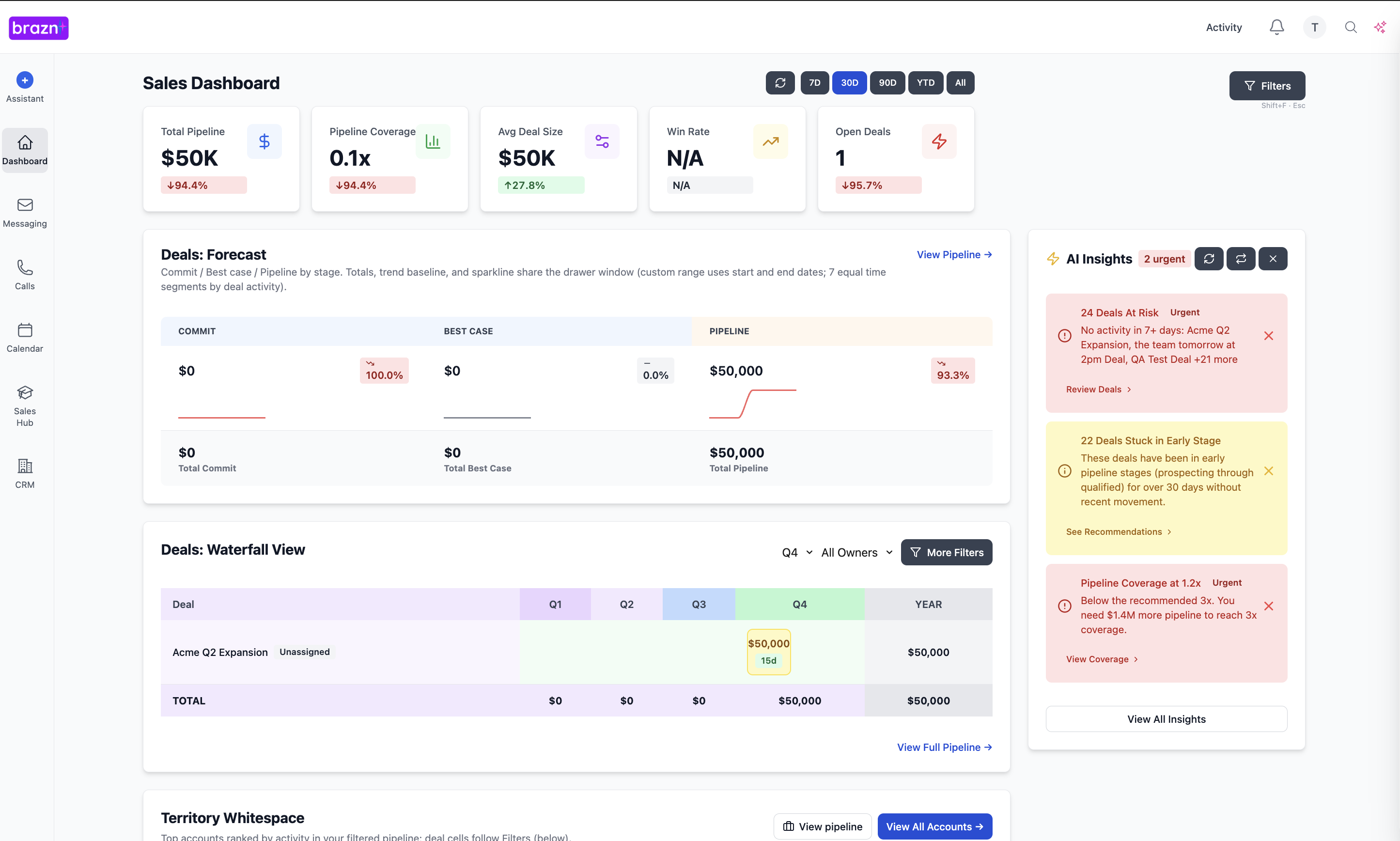
Brazn generates a structured pre-call brief automatically before every scheduled call — pulling from the CRM deal record, the MEDDPICC data extracted from previous calls, the account intelligence from external sources, and the stakeholder profiles of the confirmed attendees. The brief appears in the rep's workflow 30 minutes before the call start time and is available on mobile and desktop.
For sales managers, Brazn's brief generation means that every rep on the team is entering every call with the same quality of preparation — not just the reps who are disciplined enough to do it manually. The floor rises. The gap between the team's best-prepared and least-prepared calls narrows. And the qualification data that comes out of those calls is more complete, more consistent, and more reliable as a forecasting input — because the questions that fill MEDDPICC gaps are being asked on the call, not identified in retrospect during the pipeline review.
---
####
Book a demo to see how Brazn AI fits into your sales stack.

About the Author
Alex Margarit, Sales AI Expert, SaaS Sales Leader, BMC, ServiceNow, Docusign — 25+ years in SaaS sales.