How to Prepare a Winning Demo with AI
Most demos are lost before they start. Not because the product isn't good enough, not because the rep presents poorly, but because the preparation was insufficient — the rep enters the call without a clear picture of what each stakeholder cares about, which specific problems to anchor the narrative on, or how the product's capability maps to the prospect's stated priorities.
Good demo preparation used to take 45–90 minutes per call. Research the company, review discovery call notes, map stakeholders, identify the right demo flow, check the tech stack, look for recent news. Most reps don't invest that time — not because they don't want to, but because they have four demos this week and three discovery calls and a pipeline review, and 90 minutes of preparation per call isn't available.
AI makes thorough demo preparation fast enough to do consistently — compressing 90 minutes of manual research into a 10-minute review of an AI-generated brief that's more complete than what most reps would compile manually.
---
What Demo Preparation Actually Requires
Before any demo, the rep needs clear answers to seven questions:
1. What is each stakeholder's primary pain — in their own words from discovery?
2. What outcome are they trying to achieve — what does success look like to them?
3. Which product capabilities are most directly relevant to their stated problems?
4. What is their current tech stack and how does the product integrate with it?
5. What has happened at their company recently that provides relevant context?
6. Who are their main competitors and is there a competitive context to this evaluation?
7. What are the MEDDPICC gaps that this demo needs to address?
Manual research can answer these questions — but inconsistently, incompletely, and slowly. AI answers them consistently, completely, and fast.
---
The AI Pre-Demo Brief: What It Contains
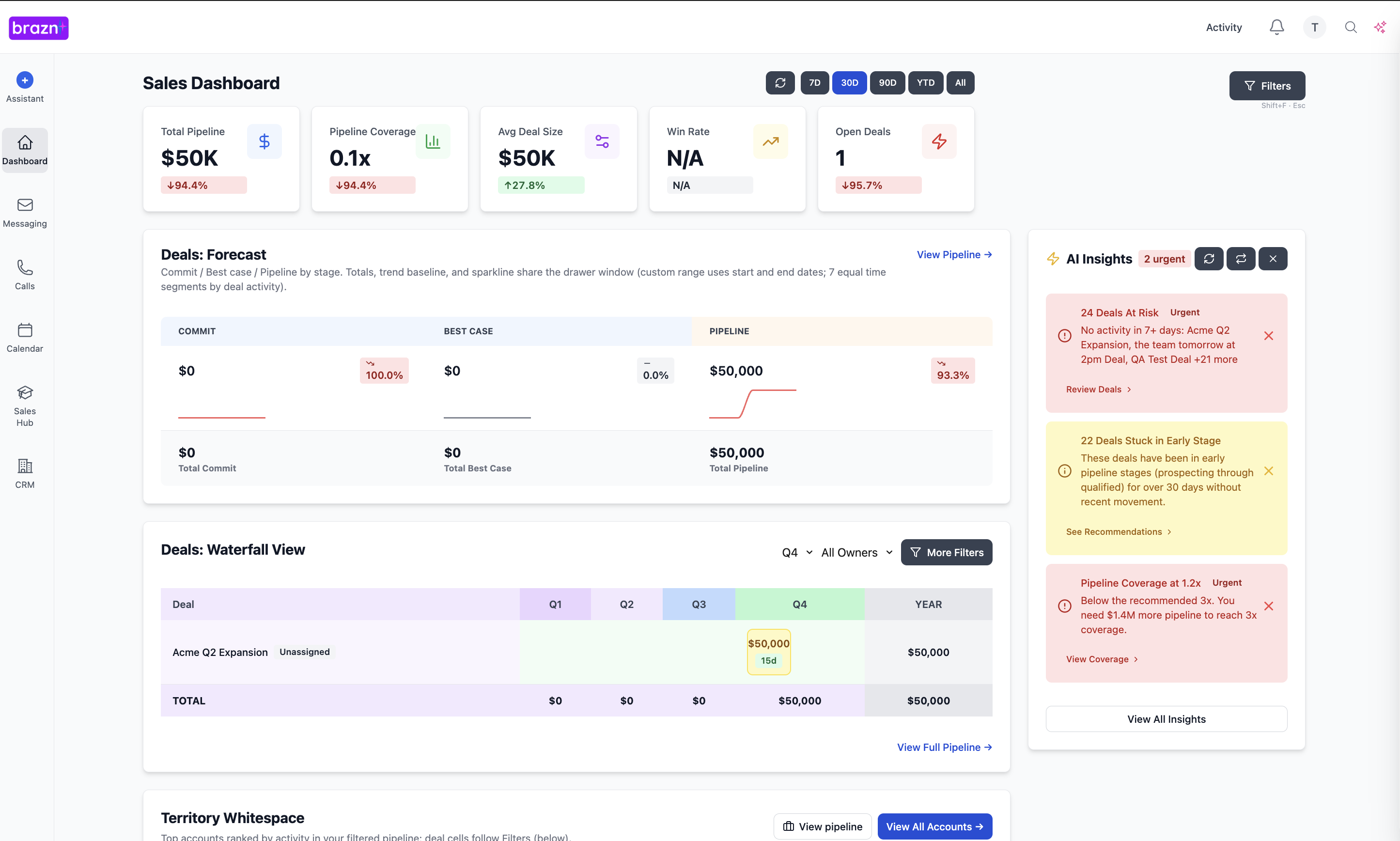
Brazn generates a structured pre-demo brief automatically before every scheduled demo. The brief contains:
Stakeholder profilesFor every confirmed attendee: name, title, role in the buying process (champion, EB, evaluator, technical reviewer), and their likely primary concern based on their function. If they've been on a previous call, their specific statements from that call are included.
Discovery call summaryA structured summary of every discovery conversation to date — key pain points surfaced, MEDDPICC elements established, objections raised, commitments made by both parties, and open questions that the demo should address.
MEDDPICC completenessThe current MEDDPICC score with specific gaps highlighted. A deal where Decision Criteria haven't been established should prompt a criteria-confirmation moment in the demo. A deal where the EB hasn't been engaged should prompt an EB introduction request before or after the demo.
Account intelligenceRecent news at the company — funding, leadership changes, product launches, hiring activity. Job postings that signal strategic direction. Technology stack from enrichment data. Competitive context from previous calls or public sources.
Recommended demo flowBased on the specific combination of stakeholders, stated pains, and MEDDPICC gaps, the brief recommends a specific demo narrative: which capability to lead with, which to cover for each stakeholder, which to deprioritise or skip, and which MEDDPICC gaps to address through discovery within the demo.
Suggested questionsDiscovery questions to weave into the demo — to establish missing MEDDPICC elements, to deepen understanding of specific pain points, or to test the strength of the business case with new information.
Social proof suggestionsThe most relevant reference customers — matched by industry, company size, tech stack, or specific use case — to reference during the demo.
The rep reads this brief in 10 minutes. They enter the demo with better preparation than a rep who spent 90 minutes researching manually — and they do it before every call, not just the big ones.
---
The Demo Narrative Architecture
A winning demo isn't a product tour. It's a narrative — a structured story that takes the prospect from their current state problem to a specific, credible future state where the problem is solved.
The five-act demo narrative: Act 1: Mirror (5 minutes)Open by reflecting back what you heard in discovery. Confirm it's still accurate. Establish that this demo was built around their specific situation, not a generic walkthrough.
"Based on what you shared with us last week — [specific problem 1], [specific problem 2], and [specific problem 3] — I've put together a session specifically around those three areas. I'll skip everything else. If something comes up that's relevant, we can go back. Does that still reflect where you are?" Act 2: Problem made vivid (10 minutes)Before showing the product, make the problem vivid and specific. Use their numbers if you have them. Use a "day in the life" scenario that reflects their reality. The product solution is most powerful when the problem has been fully felt.
"Let me show you what the current state looks like in a scenario that matches how your team operates. Your SDR sends 80 emails a week, manually updating Salesforce after each call. Here's the gap that creates..." Act 3: Solution revealed (20 minutes)Demo the primary capability with a direct, explicit connection to the problem just described. Not "here's the feature" but "here's exactly how this changes what you just saw."
Structure each capability section: current state problem → product capability → specific outcome improvement. Repeat for each primary stakeholder concern.
Act 4: Proof (5 minutes)Reference the most relevant customer story. Specific company (or anonymised equivalent), specific starting problem, specific measurable outcome achieved. Tie it to the prospect's situation: "[Company] was in a similar position to yours — [specific similarity]. Here's what happened in the first 90 days."
Act 5: Vision (5 minutes)Close with the specific future state the product enables for this prospect — using their metrics, their team, their objectives. Not the generic product vision but their specific version of success.
"Based on what you've shared — [number of reps], [current forecast accuracy], [stated objective] — here's what this looks like for [Company] 90 days after go-live."---
AI-Assisted Demo Customisation
Beyond the brief, AI supports three specific demo customisation tasks:
Generating the personalised opening lineBased on the discovery call summary and recent account news, AI generates a specific, natural opening that demonstrates preparedness: "I saw [Company] announced [news item] last week — congratulations. I had that in mind when thinking about [specific capability] — it's actually directly relevant to what [Company] is building toward."
Configuring the demo environmentFor demos in a configurable demo environment, AI suggests the specific configuration that reflects the prospect's context — their company name, their team structure, deal values in their range, and their CRM. The rep sets the configuration from the AI suggestion rather than rebuilding it from scratch.
Preparing objection responsesAI identifies the objections most likely to arise in this specific demo — based on the prospect's company stage, competitive context, and previous conversation history — and surfaces the recommended responses. The rep isn't caught off guard by a question they should have anticipated.
---
The Demo Preparation Checklist
With AI accelerating the research, the preparation checklist becomes a quality assurance step rather than the primary effort:
- Pre-demo brief reviewed — stakeholder priorities confirmed
- Demo environment configured for this prospect
- Primary pain narrative rehearsed (not memorised, but fluent)
- Transition lines between sections prepared
- MEDDPICC gaps noted — discovery questions ready to address them
- Most relevant reference customer identified and story ready
- Objection responses prepared for the two most likely challenges
- Next steps defined — what outcome does this demo need to produce?
- Technical check complete — screen sharing, audio, demo environment logged in
The checklist takes 5 minutes with the AI brief already completed. Without the brief, it's the primary effort.
---
The Post-Demo Protocol
The demo isn't finished when the call ends. The post-demo protocol is as important as the preparation:
Within 2 hours: Send a personalised follow-up that references specific moments from the demo — not a generic "great to meet you" but a note that demonstrates attention: "Your point about [specific comment] is worth exploring further — I've pulled together [specific resource] that speaks directly to that." Same day: Brazn updates the deal record — MEDDPICC elements established or updated in the demo, stakeholder reactions noted, next steps committed, and the deal health score refreshed. Within 24 hours: The Mutual Action Plan is updated with the agreed next steps from the demo and sent to the champion for confirmation.---
How Brazn Makes Every Demo a Winning Demo
Brazn's pre-demo brief transforms demo preparation from a time-intensive manual task into a consistent, structured process that every rep can execute before every call. Combined with the MEDDPICC tracking that surfaces which gaps the demo needs to address, Brazn gives reps the preparation they need to run a genuinely personalised, problem-focused demo — every time, not just for the big deals that justify extra preparation effort.
---
####
Book a demo to see how Brazn AI fits into your sales stack.

About the Author
Alex Margarit, Sales AI Expert, SaaS Sales Leader, BMC, ServiceNow, Docusign — 25+ years in SaaS sales.