
AI Sales Tools for PLG SaaS Teams: The Complete Guide
Product-led growth has changed B2B SaaS in ways that most sales tooling hasn't caught up to. According to OpenView Partners' Product Benchmarks report, PLG companies grow revenue at 2x the rate of traditional SaaS — but require a fundamentally different sales motion to capture that growth commercially. The old outbound playbook — targeted lists, cold sequences, discovery-led sales cycles — doesn't fit a business where users self-sign-up, use the product without a rep ever getting involved, and only meet sales after they've already decided the tool is valuable. PLG teams don't need reps to convince — they need reps to accelerate, expand, and convert usage into revenue.The tools that support that motion are different. This guide covers what AI sales tools actually matter for PLG SaaS teams, where the old playbook fails, and how to build a stack that turns product signal into pipeline.
---
Why PLG Sales Is Structurally Different
The fundamental difference is that in PLG, the product sells itself first and sales qualifies later. The buying journey starts inside the product — a user signs up, explores the tool, invites colleagues, hits a usage ceiling, or runs into a paywall. By the time sales gets involved, the prospect has already formed an opinion about the product.
This inverts the traditional SaaS sales model. Instead of qualifying interest and convincing of value, PLG sales teams are qualifying intent and converting proven value into commercial terms. The questions are different. The signals are different. The tooling needs are different.
Specifically:
Outbound prospecting matters less, usage-based targeting matters more. The best leads aren't cold names from a list — they're active product users whose usage patterns suggest they're ready for a commercial conversation. Amplitude's Product-Led Growth report found that companies using product signals for sales targeting achieve 40% higher conversion rates from trial to paid. Targeting is driven by product signal, not firmographic filters. Discovery is compressed. A traditional discovery call asks "what's your current process and pain?" In PLG, a lot of that answer is already visible in product usage data. The rep's job is to validate the inferred pain and move to commercial discussion faster. Expansion is bigger than acquisition. PLG businesses typically land small and expand. The sales motion is disproportionately focused on identifying expansion moments, mapping buying committees inside already-using accounts, and converting team-level usage into enterprise contracts. The buying committee forms late. In traditional enterprise sales, the buying committee is defined early in the cycle. In PLG, a user may be the only contact for months before a manager, budget holder, or procurement team gets involved. The stakeholder map emerges in parallel with the commercial conversation. Speed matters more. PLG buyers have short attention windows. A lead that doesn't hear from a rep within hours of hitting a commercial trigger is often lost to competitive inertia or lapsed interest.These structural realities mean that AI sales tools for PLG need to do different things from tools built for traditional outbound-led SaaS.
---
Where AI Creates the Biggest Impact in PLG Sales
Five specific areas where AI is reshaping PLG sales motion.
1. Product Signal to Pipeline Conversion
The central PLG challenge is turning usage data into qualified pipeline. Raw signal — "this user logged in 14 times last week" — isn't actionable on its own. What matters is the combination of signals that indicate commercial readiness: usage trajectory, team expansion, feature adoption, role of the primary user, company firmographics, and external trigger events.
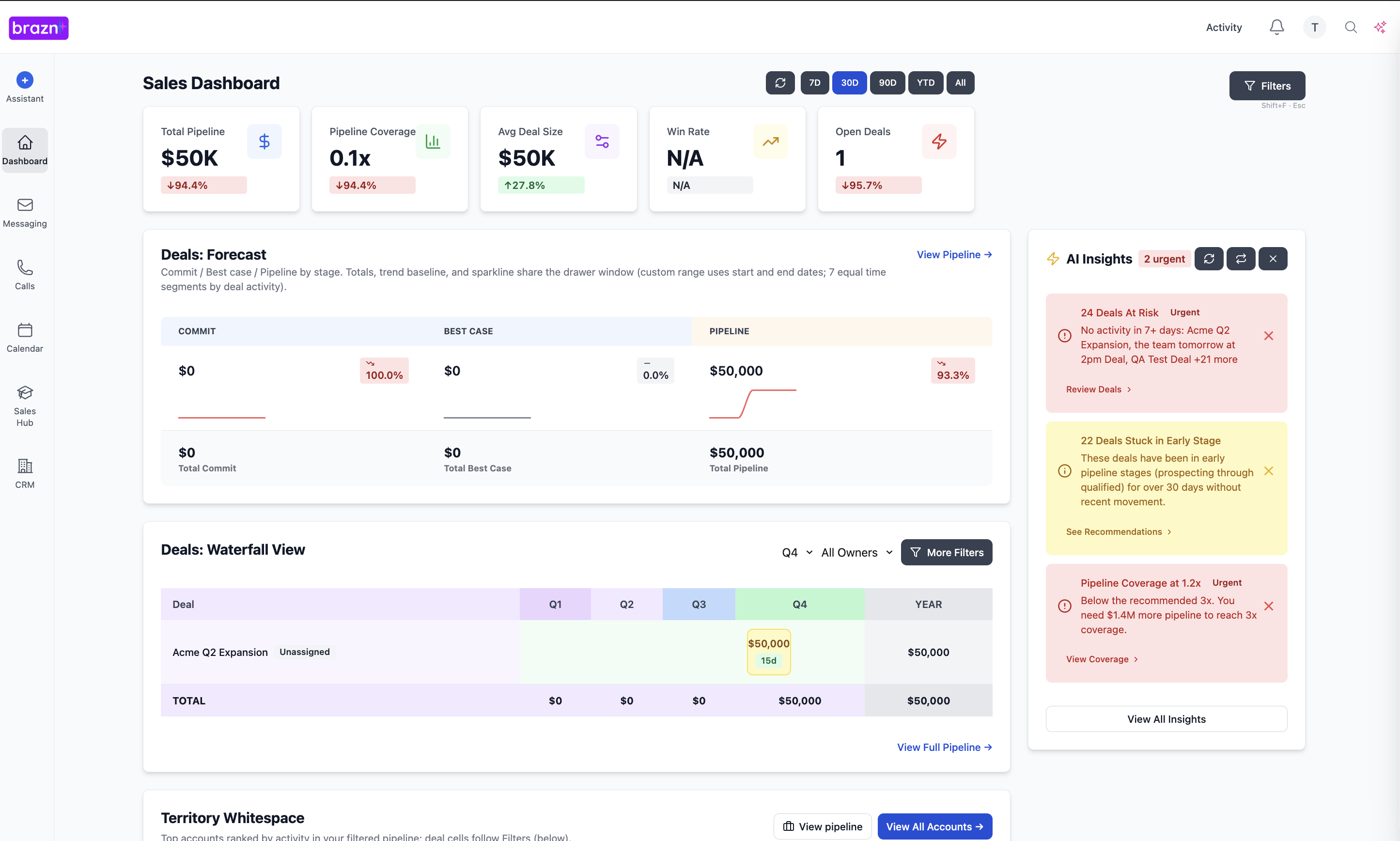
AI combines these signals into an actionable picture. Brazn can ingest product usage data alongside CRM and external intelligence to identify accounts where the full signal profile suggests commercial readiness — not just high usage in isolation. The rep's pipeline becomes a ranked list of genuinely ready accounts, not a triage exercise across thousands of free users.2. Rapid Account Research for Inbound Conversations
When a PLG lead raises their hand, speed matters. A prospect who fills out a "talk to sales" form expects a response within hours, not days — and the first vendor to engage with genuine context wins the commercial conversation.
AI makes this possible at scale. The moment a PLG lead raises their hand, Brazn auto-generates a research brief covering their usage pattern, company context, likely role and priorities, team structure, and any relevant trigger events. The rep opens the brief, has full context within two minutes, and books the meeting with a message that references the specific product behaviour the prospect has exhibited. That's a conversion rate multiplier.
3. Expansion Signal Detection
Most PLG revenue comes from expansion, not acquisition. The problem is that expansion signals are noisy — a team using a tool heavily might be ready to upgrade, or might be gaming a free tier, or might be a department that will churn next quarter. Distinguishing real expansion opportunities from false positives is where most PLG sales teams waste time.
AI pattern-matches against historical expansion profiles. Brazn identifies the combination of usage, team growth, feature adoption, and stakeholder engagement patterns that correlate with successful expansion deals. Sales teams stop chasing every high-usage account and start focusing on the ones whose signal profile matches the pattern of past wins.
4. Champion Identification in Already-Using Accounts
In PLG, the person using the tool isn't always the person who can buy it. A Director of Engineering might love the product; the VP of Engineering decides the budget; the CTO has the final yes. Mapping from active user to Economic Buyer — and identifying the right Champion along the way — is one of the harder jobs in PLG sales.
AI accelerates this. Brazn pulls organisational context automatically, identifies the likely buying committee based on company structure and the role of the active user, and surfaces the internal stakeholder most likely to function as a Champion. Instead of the rep figuring out the org chart manually across 50 accounts, the intelligence is pre-built for every expansion opportunity.
5. Velocity Through the Commercial Conversation
PLG buyers expect speed. A traditional 8-week sales cycle feels excessive when the buyer has already been using the product for four months. Gong research confirms that reps who respond to engaged product users within the first hour are 7x more likely to qualify the opportunity. AI-drafted follow-up emails, auto-generated proposal content, and continuously maintained CRM mean the rep spends their time on the commercial conversation rather than on admin — compressing the post-qualification cycle significantly.
---
What to Look for in AI Sales Tools for PLG Teams
Not every AI sales platform fits the PLG motion. Evaluate against these criteria:
Product usage integration. The platform needs to ingest product signal — usage data, feature adoption, team activity — alongside CRM and external intelligence. Tools built purely around CRM data miss the most important PLG signal layer. Speed to context. When a lead raises their hand, the rep needs a complete context brief in minutes, not hours. Platforms that require manual research requests don't fit the PLG cadence. Expansion intelligence. The platform should surface expansion opportunities proactively, not just track new pipeline. For PLG businesses, this is where the majority of revenue lives. Org mapping for buying committee. Moving from active user to Economic Buyer is a specific PLG workflow. The platform should make this systematic, not manual. Integration with product-led tools. PLG stacks typically include tools like Amplitude, Mixpanel, Heap, or Pendo for product analytics alongside the CRM. The sales AI layer needs to work with these, not just with Salesforce.---
Where PLG Teams Most Commonly Go Wrong
A few patterns worth avoiding:
Treating PLG like traditional SaaS with a trial. If the sales playbook is unchanged from outbound-led SaaS, the PLG signal goes to waste. The motion needs to be rebuilt around usage-based targeting, not bolted onto a classic SDR cadence. Under-investing in expansion. PLG businesses often have excellent new-logo acquisition and weak expansion execution. AI makes expansion the more valuable motion — but only if teams structure themselves to pursue it. Ignoring Economic Buyer access. PLG deals often die at the commercial stage because the rep has been working with the active user, not the person with budget authority. The shift from user-led to buyer-led conversation has to be deliberate. Treating product usage as the whole story. Usage is necessary but not sufficient. The best-qualified PLG pipeline combines usage signal with firmographic fit, role context, and external trigger events — AI makes combining these realistic at scale.---
How Brazn Fits the PLG SaaS Stack
Brazn is used by PLG SaaS teams as the deal intelligence layer across their hybrid stack — CRM (HubSpot or Salesforce), product analytics (Amplitude, Mixpanel, or similar), sales engagement tool, and communication platforms.
Specifically, Brazn handles:
- Product-signal-aware pipeline scoring combining usage data with CRM and external intelligence
- Instant research briefs the moment a lead raises their hand
- Expansion opportunity detection across already-using accounts
- Buying committee mapping from active user to Economic Buyer
- MEDDPICC extraction across compressed PLG sales cycles
- Automated follow-up drafting calibrated to product context
- CRM write-back keeping records current without rep admin
For PLG teams that have outgrown generic sales tools and need AI that genuinely understands the product-led motion, Brazn is purpose-built to fit.
---
####
Book a demo to see how Brazn AI fits into your sales stack.

About the Author

Alex Margarit, Sales AI Expert, SaaS Sales Leader, BMC, ServiceNow, Docusign — 25+ years in SaaS sales.