
AI Win/Loss Analysis for SaaS Revenue Teams
Most SaaS companies have a vague sense of why they win and lose deals. "We lost because of price." "We won because of the relationship." These explanations are comfortable and almost always incomplete.
Real win/loss analysis — systematic, evidence-based, analysed across many deals rather than recalled from a few — reveals patterns that change product roadmap priorities, sales messaging, competitive positioning, and rep coaching. AI makes that analysis possible at scale, for teams that couldn't afford to do it manually.
Why Most Win/Loss Analysis Is Broken
It relies on rep self-reportingAsking reps why they lost produces biased data. Reps attribute losses to price (external) rather than process (internal). They remember the last objection, not the pattern across 20 deals. Self-reported win/loss is a comfortable fiction.
It's done too rarelyManual win/loss analysis takes hours per deal. Most teams do it quarterly at best, for a small sample of high-value deals. The signal from the full pipeline — all wins, all losses, all no-decisions — is never captured.
It doesn't connect to actionEven when win/loss analysis is done well, the insights rarely reach the people who should act on them: product teams, marketing, enablement, and the reps themselves.
AI changes all three of these problems.
What AI-Powered Win/Loss Analysis Looks Like
Input: every deal, not a sampleAI reads call transcripts, email threads, CRM data, and qualification records across your entire closed pipeline — not just the deals someone remembered to analyse. Every win and every loss becomes a data point.
Processing: pattern recognition at scaleAI surfaces patterns invisible to manual review:
Which MEDDPICC elements are most strongly correlated with wins.
Which stage most commonly precedes loss.
Which competitor is displacing you most often, and in which segments.
Which discovery questions or product features are mentioned most in won deals.
Which personas or company characteristics predict loss before it happens.
Output: actionable insight for multiple teams| Team | Insight from Win/Loss |
| --- | --- |
| Sales Leadership | Which reps and segments have the best win patterns |
| Product | Which capability gaps are mentioned in lost deals |
| Marketing | Which messaging and positioning resonates in wins |
| Enablement | Which objections reps handle poorly across the team |
| RevOps | Which deal signals predict close before the rep's confidence does |
The Four Most Valuable Win/Loss Questions AI Can Answer
1. Where are we losing deals we should be winning?AI identifies deals where qualification and engagement looked strong but the deal was lost — and surfaces the common factors. This is the "preventable loss" category and often the highest ROI coaching target.
2. Which competitor do we lose to most — and why?AI tracks competitor mentions across all calls and maps them to outcomes. "We lose to [Competitor] most often at the technical evaluation stage when the prospect asks about [specific feature]" is actionable. "We lose to [Competitor] because of price" is not.
3. What do our best reps do differently in discovery?AI compares the discovery patterns of high win-rate reps to low win-rate reps. The differences — which questions they ask, how they handle objections, when they introduce pricing — become the coaching template.
4. Which accounts are we wasting time on?AI identifies the account characteristics (segment, size, tech stack, persona) that most strongly predict loss — before the deal is run. This feeds territory prioritisation and ICP refinement.
Connecting Win/Loss Insight to Action
Win/loss analysis only creates value if it changes behaviour. An AI-powered loop looks like this:
AI analyses closed pipeline weekly.
Patterns are surfaced in manager and RevOps dashboards.
Specific coaching actions are triggered for reps showing loss patterns.
Product and marketing receive a monthly structured brief on capability gaps and positioning mismatches.
ICP and territory models are updated based on segment win rate data.
The insight doesn't sit in a report. It feeds the system.
How Brazn Supports Win/Loss Analysis
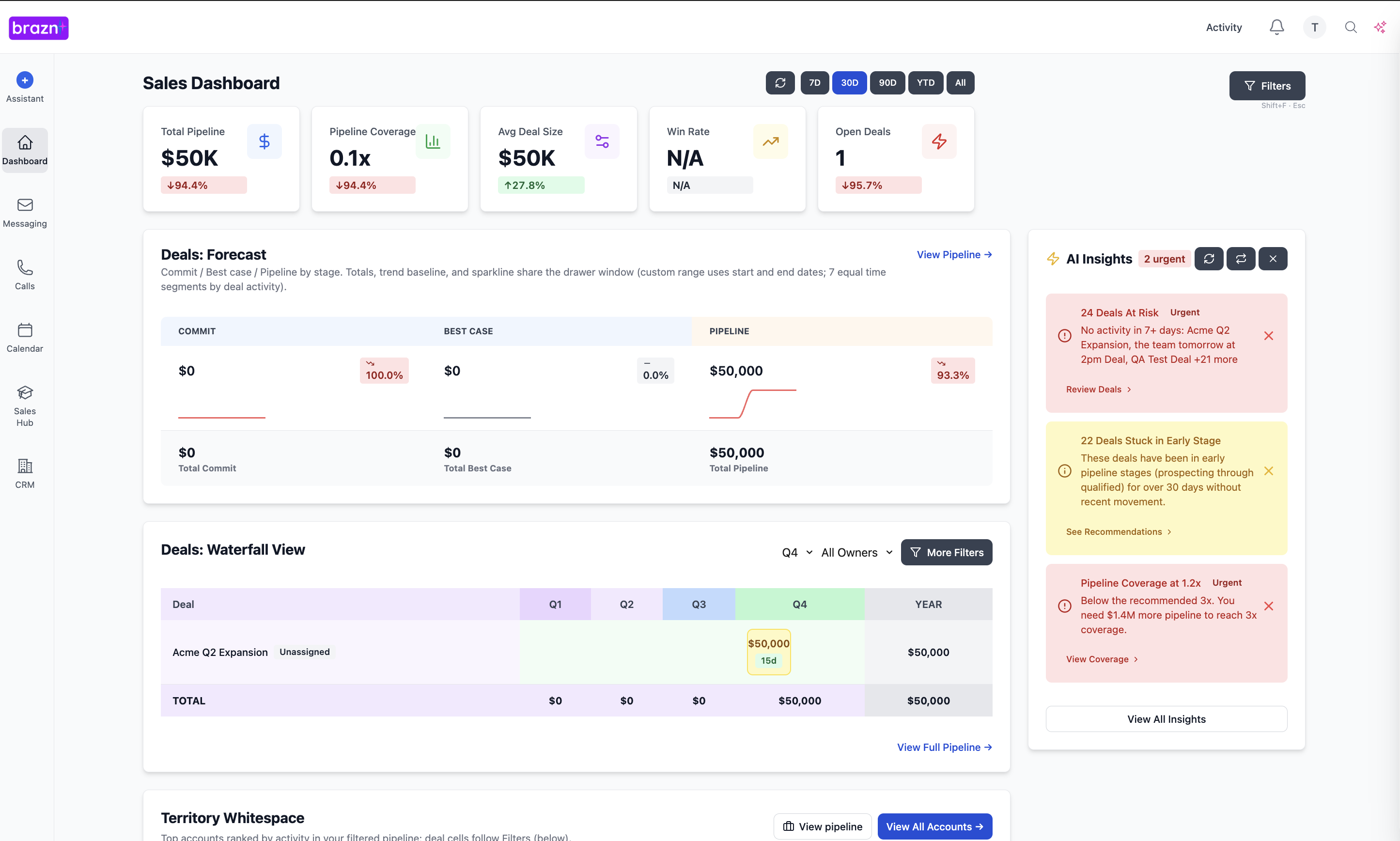
Brazn's deal intelligence layer captures the qualification and engagement data that makes win/loss analysis meaningful — from MEDDPICC coverage per deal to competitive signals per call. Revenue teams get a systematic, AI-powered view of why they win and lose, without the manual overhead that makes traditional win/loss analysis impractical.
AI Win/Loss Analysis for SaaS Revenue Teams
Win/loss analysis should tell you why you’re winning and losing — in a way that changes coaching, messaging, and product decisions. Most teams don’t do it consistently because it’s too manual.
AI makes win/loss systematic by reading the evidence across calls, emails, and CRM.
Why traditional win/loss breaks
- Rep self-report bias (“price” becomes the default reason)
- Too small a sample size
- Insights don’t reach product/marketing/enablement
What AI-powered win/loss looks like
Inputs- Call transcripts and summaries
- Email threads
- CRM deal fields (stage, close date changes, competitors)
- MEDDPICC coverage
Outputs- Pattern detection across all wins/losses (not anecdotes)
- Top 3 reasons you lose in each segment
- Which MEDDPICC gaps correlate with losses
- Competitive narratives that win vs lose
The four most valuable questions
1. Where are we losing deals we should be winning?
2. Which competitor do we lose to most — and why?
3. What do our best reps do differently in discovery?
4. Which accounts are we wasting time on?
How Brazn supports it
Brazn captures qualification and engagement evidence (MEDDPICC + deal health + competitive signals) so analysis is based on real data, not memory.
---
####
Book a demo to see how Brazn AI fits into your sales stack.
About the Author

Alex Margarit, Sales AI Expert, SaaS Sales Leader, BMC, ServiceNow, Docusign — 25+ years in SaaS sales.