
What Is Revenue Intelligence? Definition and Guide for SaaS
If you've been in a SaaS leadership conversation in the last three years, you've heard someone describe their platform as "revenue intelligence." The term gets used by conversation intelligence vendors, forecasting tools, pipeline management platforms, and a growing number of AI sales assistants. Each of them is describing something real — and each of them is describing something different. The result is a category that everyone invokes and very few people define precisely.
This guide fixes that. It gives a clear definition of revenue intelligence, covers what it actually includes, where it overlaps with related categories, and how SaaS leaders should think about it in 2026 as AI shifts the category from reporting tool to operating system.
---
A Clear Definition
Revenue intelligence is the practice of using data from across the revenue process — sales, marketing, customer success, product, and finance — to produce an accurate, continuously updated picture of where revenue is coming from, where it's at risk, and what's driving the variance. It combines signal extraction, analytics, and actionable insight delivery into a single operating layer that revenue leaders use to run the business.
The key distinction versus traditional sales analytics is the word "intelligence." A dashboard tells you what happened. Revenue intelligence tells you what's happening, what's likely to happen next, and what you should do about it. It's diagnostic, predictive, and prescriptive — not just descriptive.
The four core components of any genuine revenue intelligence capability:
- Signal ingestion — pulling data from CRM, email, calendar, call recordings, product usage, marketing automation, and finance systems into a single model
- Interpretation — turning raw signal into meaningful units of analysis (deal health, pipeline quality, forecast confidence, rep performance, account risk)
- Surfacing — presenting insights in ways revenue leaders can act on (dashboards, alerts, recommended actions, coaching prompts)
- Closed loop — feeding outcomes back into the model so intelligence improves over time
---
Why the Category Emerged
Revenue intelligence as a named category is relatively recent — popularised in the late 2010s and early 2020s as B2B SaaS organisations realised that traditional sales analytics weren't keeping up with deal complexity.
The driving problems were familiar: forecasts that were wrong quarter after quarter, pipeline coverage that looked healthy on paper and fell apart in practice, rep-reported data that didn't match deal reality, and revenue leaders making multi-million-dollar decisions based on gut feel rather than evidence. Something needed to sit between the raw data in CRM and the strategic decisions the CRO was making — and that something needed to be continuously running, not quarterly produced.
Conversation intelligence platforms like Gong and Chorus were early entrants, approaching the problem from the call angle. Forecasting platforms like Clari approached from the pipeline angle. CRM-native tools added AI-powered deal health scores. Each of these was a partial answer to the revenue intelligence problem — not a complete one.
---
What Revenue Intelligence Actually Does
A mature revenue intelligence capability does several things that matter to SaaS leaders.
Forecast accuracy. The most-cited use case. Revenue intelligence replaces stage-weighted probability math with signal-based deal health scoring, weights the forecast against engagement quality and MEDDPICC completeness, and surfaces specific deals driving forecast variance. The number becomes defensible with deal-level evidence rather than manager sentiment. Pipeline quality assessment. Raw pipeline coverage is a vanity metric. Revenue intelligence quality-adjusts coverage so leaders can see what's actually real — and identifies the specific teams, segments, or deal types where quality is degrading before it shows up as forecast miss. Deal risk detection. Signals of deal slippage — declining engagement, stakeholder disengagement, unqualified Paper Process — get surfaced continuously, not at quarter end. Revenue leaders can intervene when there's still time to act. Rep performance diagnostics. Which behaviours correlate with wins? Which reps are systematically weak on specific skills? Revenue intelligence turns this from subjective manager judgement into measured pattern analysis. Cross-functional revenue visibility. The best revenue intelligence platforms connect marketing, sales, and customer success signal into a single picture — showing not just what pipeline exists, but where it's coming from, how it's converting, and what happens to accounts post-sale.---
Revenue Intelligence vs Related Categories
Because the term is used loosely, it's worth drawing the distinctions clearly.
Conversation Intelligence (Gong, Chorus) focuses on the call as the unit of intelligence. It's a component of revenue intelligence, not a substitute for it. Call signal is important; it's not the whole picture. Sales Analytics / BI is descriptive — telling you what happened in the past. Revenue intelligence is predictive and prescriptive. Both matter; they do different jobs. Forecasting platforms (Clari, BoostUp) focus on the pipeline and forecast layer specifically. Genuinely excellent at that layer; often weaker on deal-cycle intelligence or rep behaviour analytics. AI Sales Assistants (Brazn) work at the deal and rep level — pre-call research, MEDDPICC extraction, follow-up drafting, CRM automation. Feed into revenue intelligence rather than constituting the whole thing. Revenue Operations (RevOps) is the function, not the tool. Revenue intelligence is what modern RevOps teams run to do their job effectively.In a mature SaaS stack, revenue intelligence is the layer above all of these — ingesting signal from each and producing the operating view that leadership uses to run the business.
---
The 2026 Shift: From Reporting Layer to Operating System
The category is evolving meaningfully. In the early generation, revenue intelligence was primarily a reporting layer — giving leaders better dashboards and more accurate forecasts. In 2026, the best platforms have moved further: from reporting to acting.
Agentic revenue intelligence platforms don't just surface that a deal is at risk — they draft the re-engagement email, trigger a stakeholder research brief, and populate the MEDDPICC fields with the latest context automatically. They don't just tell you a rep's follow-up cadence is slow — they draft the follow-ups the rep isn't writing. They don't just show you that forecast coverage is thin — they identify the specific accounts most likely to convert and prepare the outreach.
This is the shift from intelligence as visibility to intelligence as execution. For SaaS leaders, the implication is significant: revenue intelligence is no longer a category you buy for reporting. It's a category you buy to change how the revenue organisation actually runs.
---
How to Evaluate Revenue Intelligence for Your Team
If you're considering revenue intelligence for your SaaS organisation, the right questions are:
What signal does it ingest? CRM-only tools miss the signal in email, calendar, and conversations. Genuinely useful revenue intelligence needs broad signal coverage. Does it produce actionable insights or just dashboards? A dashboard with no recommended action is a BI tool, not intelligence. Does it close the loop? If the insight just sits in a dashboard, it doesn't change behaviour. Integrated platforms that write back to CRM and drive action across the workflow produce different outcomes. How does it learn? Static rules don't improve over time. Platforms that learn from deal outcomes get more accurate the longer you use them. Who uses it day-to-day? Revenue intelligence that only the CRO looks at is low-leverage. Platforms that serve reps, managers, and executives with role-appropriate views drive real behaviour change.---
The Bottom Line
Revenue intelligence is the category name for the capability that turns revenue data into accurate, continuously updated operating insight. In 2026, the best implementations go further — from insight to action, from reporting to execution.
For SaaS leaders evaluating the category, the key question isn't "do we need revenue intelligence?" — everyone does. The question is "what kind of revenue intelligence fits how our revenue organisation actually runs?" The answer shapes the tooling, the process, and ultimately the forecast accuracy and revenue outcomes that matter.
---
See Agentic Revenue Intelligence in Action
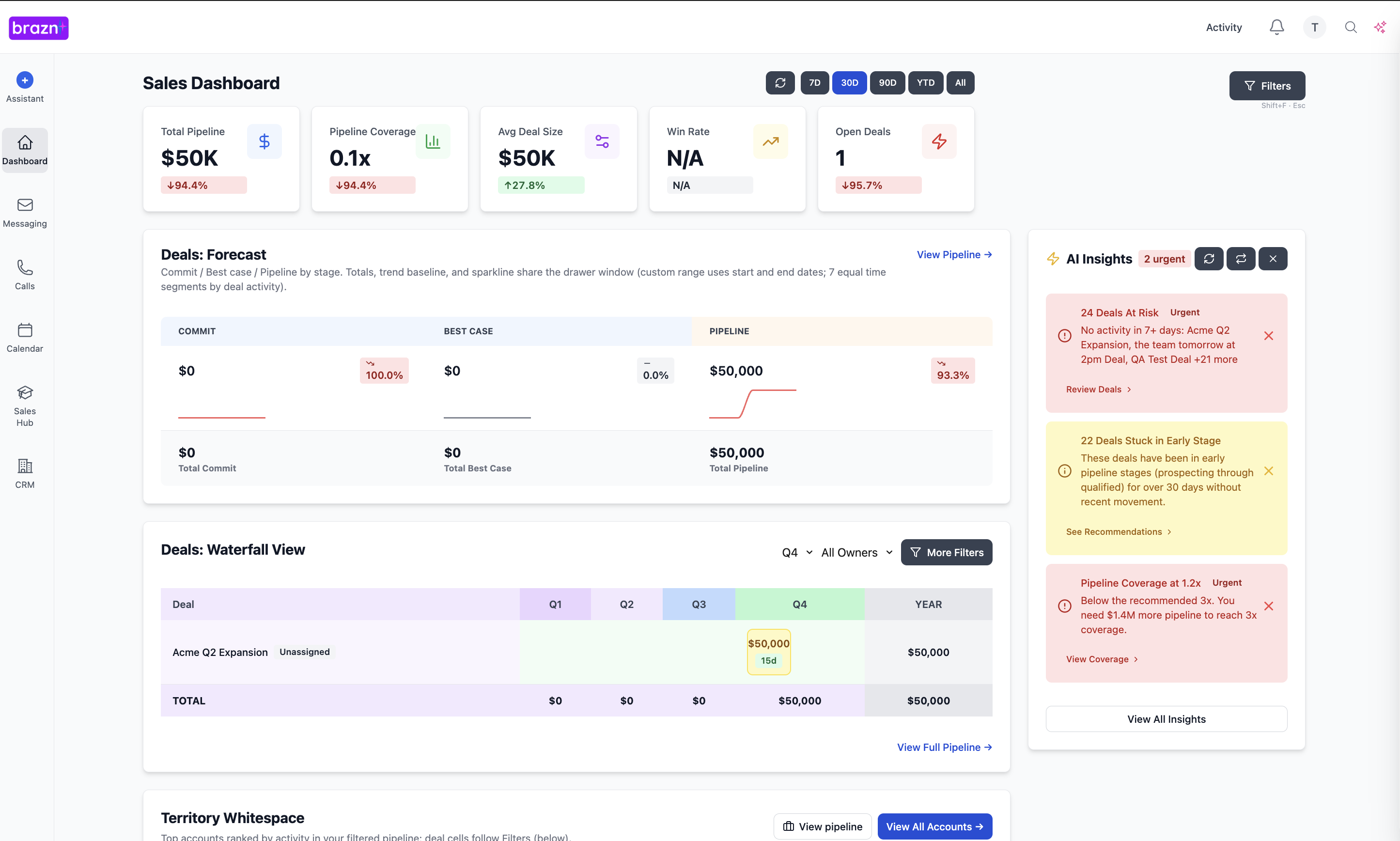
Brazn operates as the agentic intelligence layer across the SaaS revenue stack — ingesting signal, surfacing actionable insight, and executing the deal-cycle work that turns intelligence into revenue.
---
Book a demo to see how Brazn AI fits into your sales stack.

About the Author

Alex Margarit, Sales AI Expert, SaaS Sales Leader, BMC, ServiceNow, Docusign — 25+ years in SaaS sales.