
The Complete Guide to AI Sales Assistants for SaaS Teams
Primary keyword: AI sales assistant for SaaS Type: Pillar | AI Sales Assistant for SaaS | Learn | ~2,800 words---
The way SaaS teams sell has changed more in the last two years than in the previous ten. Buyers are harder to reach, deal cycles are longer, and the administrative burden on reps has grown to the point where the average AE spends less than a third of their working week actually selling. AI sales assistants exist to fix that ratio — and the best ones do far more than answer questions when asked.
This is the complete guide to AI sales assistants for SaaS teams. It covers what an AI sales assistant actually is, how it differs from older sales tools, what the best ones do, and how SaaS AEs and SDRs are using them to prepare faster, qualify better, and close more deals.
---
What Is an AI Sales Assistant?
An AI sales assistant is a software system that uses artificial intelligence to support sales reps across the activities that drive pipeline and revenue — account research, deal qualification, outbound personalisation, CRM hygiene, follow-up, and deal reviews.
The term is used loosely in the market. Some vendors call anything with a ChatGPT wrapper an AI sales assistant. The distinction that matters is between two fundamentally different architectures:
Copilot AI: Responds when asked. You open the tool, type a question, and get an answer. Useful, but passive. The rep still has to remember to use it, know what to ask, and manually act on the output. Agentic AI: Monitors your pipeline continuously, takes initiative, and surfaces the right information or action at the right moment — without being prompted. Before a call, it prepares your brief. After a meeting, it drafts your follow-up. When a deal goes quiet, it flags the risk. When a MEDDPICC criterion is mentioned in an email, it logs it.The difference between a copilot and an agent is the difference between a tool you have to drive and one that works alongside you. For SaaS sales teams managing complex, multi-stakeholder deals across large books of business, the agentic model is the one that creates transformative productivity gains.
---
Why SaaS Teams Need an AI Sales Assistant Now
The pressure on SaaS sales teams in 2026 is unlike anything from five years ago:
Deal complexity has increased. Enterprise SaaS deals now routinely involve six to ten stakeholders, multi-stage procurement processes, and security reviews that add weeks to every cycle. Managing this complexity manually is unsustainable. Admin burden has reached a tipping point. Research consistently shows SaaS reps spending 60–70% of their working time on non-selling activities — CRM updates, email drafting, research, internal reporting. That's the problem an AI sales assistant is purpose-built to solve. Buyer expectations have risen. Prospects expect reps to know their business before the first call. Generic outreach gets ignored. Discovery calls where the rep asks questions answerable by a two-minute Google search destroy credibility instantly. Forecasting accuracy is a board-level concern. CROs and VPs of Sales are under increasing pressure to deliver accurate forecasts. Without reliable, continuously maintained deal data, that's impossible. AI makes accurate data achievable without burning out the team maintaining it. The talent gap is real. Great AEs are expensive and hard to find. AI sales assistants don't replace great AEs — they make good AEs perform like great ones, by handling the work that skill and experience can't justify spending time on.---
What the Best AI Sales Assistants Actually Do
Not all AI sales assistants are built the same. Here are the capabilities that separate genuinely transformative tools from expensive features.
Pre-Call Research and Briefing
Before every scheduled customer meeting, a great AI sales assistant automatically generates a comprehensive research brief. No rep action required — the brief is waiting when they log on.
A strong pre-call brief covers:
- Company background, business model, and recent news
- Key stakeholder profiles — roles, backgrounds, LinkedIn activity
- Buying triggers — funding, hiring signals, product launches, competitive moves
- Current MEDDPICC status — what's established, what's missing
- Suggested discovery questions tailored to this account's specific context
- Prior interaction summary — what was discussed, what was agreed, what's outstanding
This brief replaces 45–90 minutes of manual research. The rep arrives at every call better prepared than they would have been with an hour of manual prep — and they spend that hour selling.
Agentic Deal Monitoring
The best AI sales assistants don't wait for reps to check in. They continuously monitor every deal in the pipeline and surface signals that require attention:
- Champion engagement dropping — flag it before the deal goes dark
- Deal stage advancing without Paper Process qualified — risk alert
- Economic Buyer not engaged in 14 days — prompt for action
- New stakeholder introduced into the deal — research brief triggered automatically
- Competitor mentioned in email thread — competitive positioning surfaced
This is agentic behaviour — the system is watching the pipeline so the rep doesn't have to watch it manually, across 30–50 simultaneous opportunities.
MEDDPICC Qualification Support
AI sales assistants extract MEDDPICC criteria from every interaction — calls, emails, meetings — and maintain the qualification framework as a living record rather than a static form.
When the CFO is mentioned in an email thread, the Economic Buyer field updates. When the prospect articulates a specific ROI number, the Metrics field captures it. When a champion mentions the internal approval process, the Decision Process field is enriched. All of this happens automatically, without the rep needing to log anything manually.
The result is MEDDPICC data that can be trusted — in pipeline reviews, in forecasting, and in coaching conversations.
Personalised Outbound and Follow-up Drafting
AI sales assistants draft outbound emails and follow-up messages based on account research and deal context. This is not template personalisation — it's genuine contextualisation.
A first-touch email references something specific and researched about the prospect's business. A post-meeting follow-up reflects what was actually discussed, confirms the agreed next steps, and includes relevant resources. A follow-up sequence adapts to prospect engagement — new angles, new triggers, new reasons to re-engage.
Reps review, approve, and send. Total time per email: under a minute. Quality: significantly higher than a manually written template.
CRM Automation
AI sales assistants eliminate the manual data entry that consumes 20–30% of every rep's working week. Call summaries are logged automatically. MEDDPICC fields are populated from interaction context. Next steps are captured and tracked. Deal stages are updated based on objective signals, not rep optimism.
The CRM becomes an accurate, continuously maintained system of record — not a manual logging burden that degrades the moment attention lapses.
Deal Review Intelligence
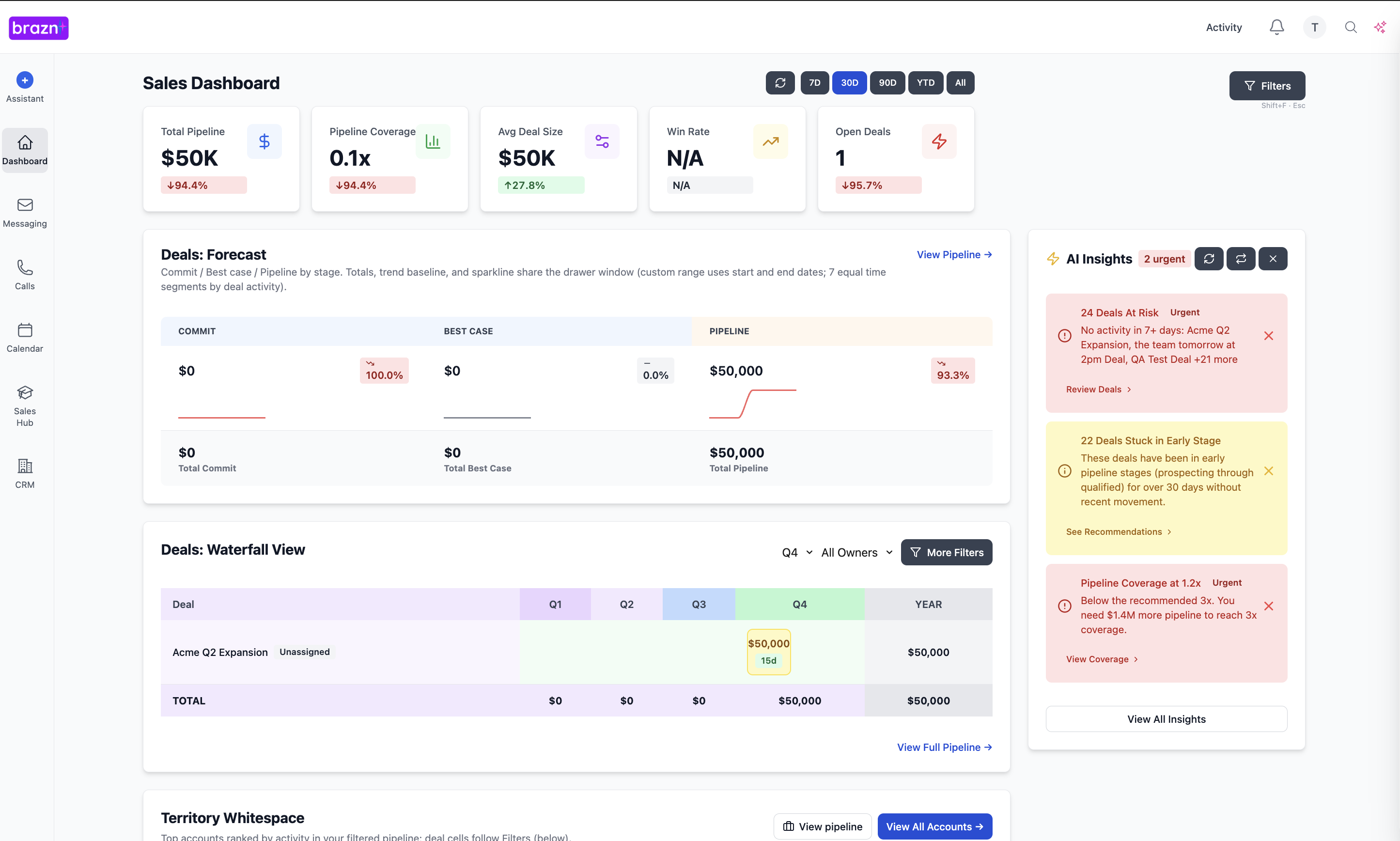
Before a pipeline review or forecast call, AI sales assistants generate a deal-by-deal health summary — MEDDPICC completeness, risk signals, last meaningful interaction, recommended actions. Managers arrive at deal reviews with a reliable picture of every opportunity in the pipeline. Reps don't spend the meeting catching managers up on basics. The conversation focuses on strategy and coaching.
---
How Brazn Works as an AI Sales Assistant
Brazn is built specifically for SaaS sales teams that want AI working across the full deal cycle — not just on calls, not just in the inbox, not just in the CRM. It's an agentic platform, not a copilot.
Here's what Brazn does across a typical sales day:
Morning: Brazn surfaces your day's briefing — upcoming meetings with pre-call research briefs, deals that need attention (risk flags, stale criteria, follow-up due), and any new account signals from overnight monitoring. Pre-call: 30 minutes before each meeting, Brazn generates a specific preparation brief — company context, stakeholder profiles, MEDDPICC gaps to address, suggested discovery questions. Post-call: Within minutes of a meeting ending, Brazn generates a structured summary — what was discussed, MEDDPICC updates, agreed next steps — and drafts the follow-up email for one-click review and send. Throughout the day: Brazn monitors your email inbox for deal signals, extracts MEDDPICC context from replies, and updates deal records automatically as new information arrives. Pipeline review: Brazn provides a real-time deal health dashboard — every opportunity scored on MEDDPICC completeness and engagement signals, risk flags surfaced, recommended actions prioritised.The rep's experience is not "using a tool" — it's having an assistant that handles the background work continuously so they can focus entirely on the conversations that close deals, not CRM admin.
---
AI Sales Assistant vs Traditional Sales Tools: The Key Differences
| Capability | Traditional CRM | Sales Engagement Tool | Conversation Intelligence | AI Sales Assistant (Brazn) |
| --- | --- | --- | --- | --- |
| Pre-call research | ❌ | ❌ | ❌ | ✅ Automatic |
| MEDDPICC auto-population | ❌ | ❌ | Limited | ✅ From all interactions |
| Agentic deal monitoring | ❌ | ❌ | ❌ | ✅ Continuous |
| Follow-up drafting | ❌ | Template only | ❌ | ✅ Context-aware |
| CRM auto-update | Manual | Partial | Partial | ✅ Full write-back |
| Deal health scoring | ❌ | ❌ | Basic | ✅ MEDDPICC-based |
| Works proactively | ❌ | ❌ | ❌ | ✅ Agentic |
---
Who Benefits Most From an AI Sales Assistant
AI sales assistants create the most value for specific roles and team profiles:
SaaS AEs managing complex deals: The prep, MEDDPICC maintenance, follow-up drafting, and deal review support directly address the activities that consume most of an AE's non-selling time. SDRs running high-volume outbound: Research automation and personalised sequence drafting allow SDRs to manage significantly more prospects with better personalisation than a manual process allows. Sales managers running pipeline reviews: Deal health dashboards and MEDDPICC scoring make pipeline reviews faster, more accurate, and more focused on coaching rather than interrogation. RevOps teams maintaining CRM data quality: Automatic field population and deal monitoring eliminate the manual cleanup cycles that consume RevOps bandwidth. VPs of Sales and CROs managing forecast accuracy: Reliable MEDDPICC data and deal health signals make forecasts more accurate and more defensible.---
What to Look for When Evaluating AI Sales Assistants
If you're evaluating AI sales assistant options for your SaaS team, these are the questions that matter:
Is it agentic or copilot? Does it take action without being prompted, or does it only respond when asked? Does it work across the full deal cycle? Pre-call, post-call, outbound, follow-up, MEDDPICC, CRM — or just one piece of it? How does it integrate with your existing stack? Native integrations with Salesforce, HubSpot, Pipedrive, Salesloft, Outreach, and Gmail are essential. Anything that requires manual export/import is not a genuine integration. Does it improve over time? AI tools that learn from your team's specific deals, win patterns, and buyer behaviour get better the longer you use them. Ask vendors how their models adapt to your data. What does implementation look like? Complex, multi-month implementation projects indicate a tool built for a different era. Modern AI sales assistants should be live within days, not quarters. What does the ROI story look like? Quantify the time saving — if a rep saves two hours per day on admin and research, that's 40+ hours per month redirected to selling. At a typical AE quota, that number has a very clear commercial value.---
Getting Started: The First 30 Days
The teams that get the most value from AI sales assistants are the ones that implement with intention. Here's a 30-day framework:
Week 1: Connect integrations (CRM, email, calendar, sales engagement tool). Let Brazn begin monitoring your existing pipeline and building deal context from historical interaction data. Week 2: Introduce pre-call research briefs into your daily workflow. Review the brief before every customer meeting. Note the difference in call quality and preparation confidence. Week 3: Activate automated CRM write-back. Review and approve AI-generated call summaries and MEDDPICC updates. Measure CRM completeness before and after. Week 4: Use AI-drafted follow-up for every post-meeting email. Track follow-up speed and reply rates against your baseline.By the end of 30 days, the productivity difference is measurable — and the habit is established.
---
The Bottom Line
An AI sales assistant for SaaS is not a feature or an add-on. It's a fundamental shift in how the work of selling gets done. The teams that adopt agentic AI now are building a structural productivity advantage that compounds over time — better-prepared reps, better-qualified pipeline, more accurate forecasts, and more time spent on the conversations that actually close deals.
---
Book a demo to see how Brazn AI fits into your sales stack.

About the Author
Alex Margarit, Sales AI Expert, SaaS Sales Leader, BMC, ServiceNow, Docusign — 25+ years in SaaS sales.