
How AI Scores Leads in Real Time
Lead scoring has existed since the earliest days of marketing automation — assigning point values to prospect behaviours to help sales teams prioritise their time. Traditional lead scoring was rules-based: 10 points for opening an email, 25 points for visiting the pricing page, 50 points for requesting a demo. The problem is that rules-based scoring doesn't understand context and doesn't learn.
AI lead scoring replaces static rules with dynamic models that consider dozens of signals simultaneously, weight them based on historical conversion patterns, and update scores in real time as new data arrives. The result is a prioritisation system that improves over time and surfaces the right accounts at the moment their intent is highest.
What AI Lead Scoring Models Consider
Firmographic fitThe baseline: does this company match your ICP? Size, industry, geography, growth stage, and revenue range all contribute to a fit score. Companies that don't match your ICP get low scores regardless of their behaviour — preventing high-engagement low-fit accounts from crowding out lower-engagement high-fit accounts.
Technographic signalsWhat technology does the company currently use? AI models trained on your won customer data identify which technology combinations correlate with purchase — companies using Salesforce + Outreach + ZoomInfo may be in the exact stack context where your product adds most value. Companies using a competitor product may be a replacement opportunity.
Intent dataIs the company actively researching your category? Third-party intent platforms track content consumption across B2B publishing networks. High intent scores for your category, combined with strong firmographic fit, produce the highest-priority accounts in most B2B AI lead scoring models.
Trigger eventsHas something happened at this company that creates a natural buying window? Funding, leadership changes, hiring sprees, competitor product drops, and expansion announcements are all fed into AI scoring models in real time — elevating account scores when relevant events occur.
Behavioural engagementWhat has this prospect done with your own content and properties? Website visits (especially pricing and comparison pages), email engagement (especially forwarding to colleagues), content downloads, webinar attendance, and product trial activity all contribute to real-time score updates.
Historical conversion patternsAI models trained on your closed-won data identify which combinations of the above signals preceded actual purchases. This is the most powerful differentiator between simple lead scoring and AI lead scoring — the model learns from your specific win patterns rather than applying generic weights.
Real-Time Score Updates: How They Work
Traditional lead scoring updates on a batch basis — scores are recalculated daily or weekly. AI systems update in real time, which matters when the buying window is measured in days.
When a prospect visits your pricing page for the third time in a week, the AI system:
Detects the event from website tracking.
Updates the account's behavioural score immediately.
Recalculates the composite lead score combining all signal categories.
If the score crosses a priority threshold, triggers an alert to the assigned rep or SDR.
Optionally, surfaces a recommended action: "Call now — account shows strong intent + recent pricing page visit."
The rep acts on a signal that is hours old, not days old. Given that buying windows close quickly, this timing advantage is directly correlated with conversion rate.
What Makes a Good AI Lead Scoring Model
Specificity to your win patternsA generic lead scoring model that applies industry averages is significantly less valuable than a model trained on your specific historical data. The signals that predicted purchases for your product in your market are not the same as the signals that predict purchases in general. The more historical won/lost data a model has access to, the more accurate it becomes.
Signal diversityModels that use only one or two signal types are fragile. A prospect who scores high on intent data but has no firmographic fit is a different prospect than one who scores high on both. The best models combine five or more signal types.
Decay functionsLead scores should decay over time when no new activity occurs. A prospect who visited your pricing page three months ago is very different from one who visited yesterday. AI scoring models that apply time-decay functions to behavioural signals produce more accurate current-state prioritisation.
Feedback loopsThe model should learn from outcomes — when a high-scored lead doesn't convert, that signal should update the model's weights. Closed-loop AI scoring that incorporates won/lost outcomes continuously improves over time.
How Brazn Uses AI Scoring in Active Deals
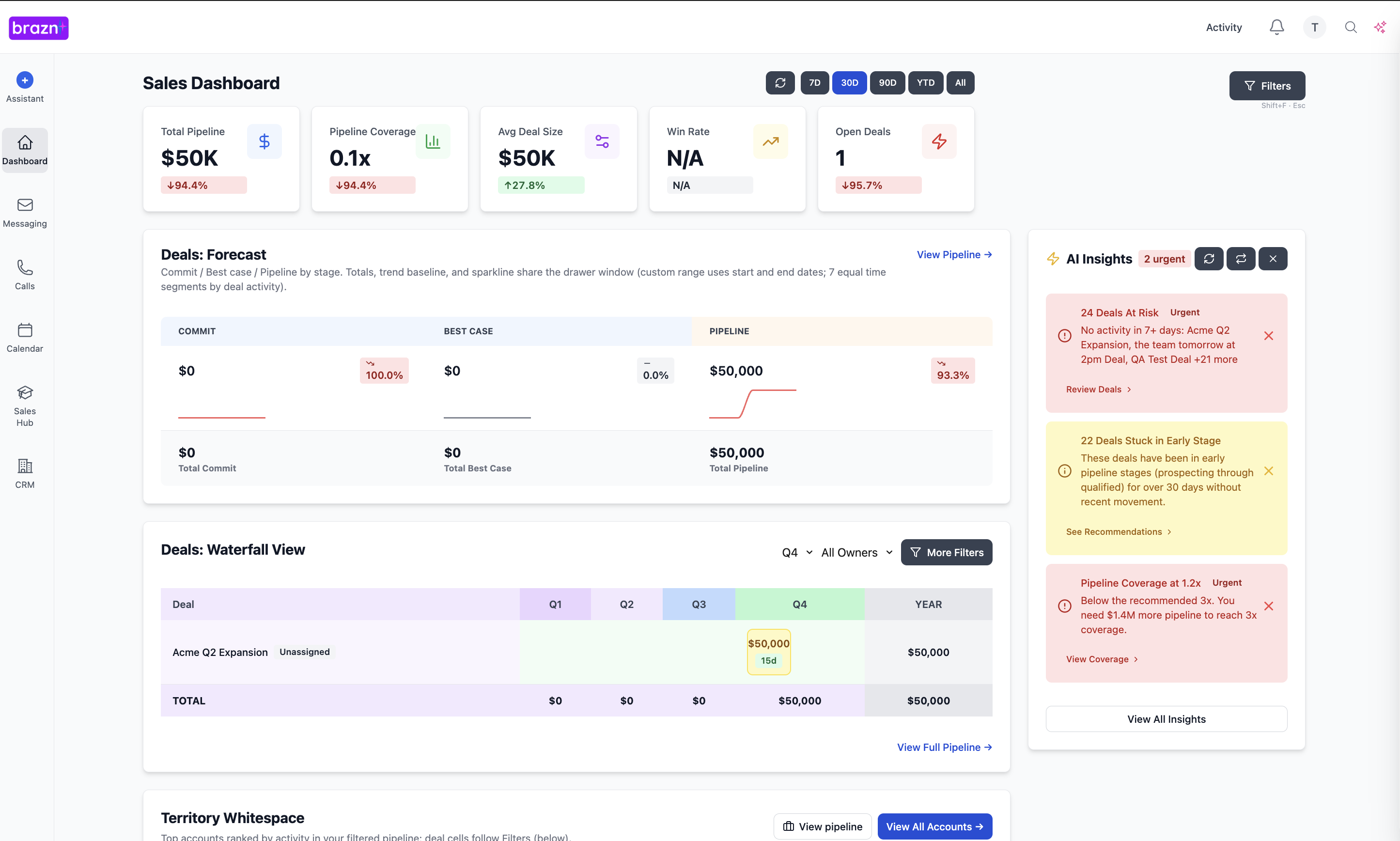
Brazn applies AI scoring at the deal level — not just at the lead level. Once a prospect becomes an opportunity, Brazn's scoring model evaluates MEDDPICC qualification completeness, stakeholder engagement, call signal patterns, and deal velocity to produce a deal-level score that updates in real time after every interaction. Managers see which deals are progressing toward qualification-justified close probability and which need immediate intervention.
---
####
Book a demo to see how Brazn AI fits into your sales stack.

About the Author

Alex Margarit, Sales AI Expert, SaaS Sales Leader, BMC, ServiceNow, Docusign — 25+ years in SaaS sales.