
The Complete Guide to AI CRM Hygiene and Pipeline Management
Bad CRM data is one of the most expensive problems in SaaS sales — and almost no one talks about it seriously until a forecast goes wrong.
This is the complete guide to AI CRM hygiene and sales pipeline management for SaaS sales teams. It covers why CRM data degrades, what it actually costs, how AI changes the equation, and what a clean, AI-maintained pipeline looks like in practice.
---
What Is CRM Hygiene — and Why Does It Matter?
CRM hygiene refers to the accuracy, completeness, and consistency of the data in your CRM. It covers everything from contact details and account fields to deal stages, MEDDPICC criteria, next steps, and close dates.
A well-maintained CRM gives revenue leaders accurate pipeline visibility, helps reps prioritise the right deals, and enables the kind of forecast accuracy that CROs can actually present to a board. A poorly maintained one does the opposite — it hides risk, distorts forecasts, and wastes everyone's time in pipeline review meetings.
The problem is that keeping a CRM clean has historically required a lot of manual rep effort. After every call, a rep is expected to update deal stage, log notes, fill MEDDPICC fields, set a next step, and mark activity. In practice, that rarely happens consistently — especially when reps are carrying a full book of business and under pressure to hit quota.
---
The Real Cost of Poor CRM Hygiene
The downstream effects of bad CRM data compound quickly:
For reps:- Time wasted searching for context before calls
- Deals that fall through the cracks because next steps weren't logged
- Duplicate outreach to contacts who've already been worked
For managers:- Forecast calls that turn into archaeology expeditions — "what's actually happening with this deal?"
- Coaching sessions spent on data cleanup rather than skill development
- No reliable way to identify pipeline risk before it becomes a missed quarter
For RevOps:- Constant data remediation projects that solve the symptom, not the cause
- Report inaccuracies that undermine confidence in CRM-generated insights
- Onboarding friction when new reps inherit dirty accounts
Industry research consistently shows that sales reps spend between 20–30% of their working time on administrative tasks — the majority of which is CRM data entry. That's one to two days per week, per rep, not spent selling.
---
Why Traditional Approaches to CRM Hygiene Fail
Most organisations have tried at least one of the following approaches — and most have experienced the same results.
Training and Process Documentation
"We'll train everyone on the correct process and document it in the playbook."
This fails because CRM hygiene is a habit problem, not a knowledge problem. Reps know they should update Salesforce. They don't do it because it's slow, tedious, and competes with actual selling time.
Manager Enforcement
"Managers will check the CRM every Friday and hold reps accountable."
This works temporarily and degrades quickly. Managers spend their limited coaching time on data admin. Reps view it as policing. Resentment builds. The next quarter looks the same.
RevOps Cleanup Projects
"We'll do a quarterly CRM cleanse and reset the baseline."
This treats the symptom. Within six weeks of any cleanup, the CRM is degrading again — because the root cause (manual data entry friction) hasn't changed.
CRM Native Tools (Salesforce Einstein, HubSpot AI)
"We'll use the built-in AI features."
These tools are improving, but they're fundamentally limited by the same constraint: they can only analyse data that's already been entered. They don't capture context from calls, emails, and conversations that haven't been logged. They're pattern recognition on incomplete data.
---
How AI Changes CRM Hygiene
The fundamental shift AI enables is moving from manual data entry to automatic data capture and enrichment.
Instead of asking a rep to log a call summary, an AI system listens to the conversation (or reads the email thread), extracts the relevant deal context, and writes it back to the CRM automatically — correctly formatted, in the right fields, without rep action.
This is not a marginal improvement. It's a category change. Here's what it looks like in practice:
Automatic Call and Meeting Summaries
After every customer interaction, an AI system generates a structured summary — what was discussed, what was agreed, what the next step is — and logs it against the opportunity in Salesforce, HubSpot, or Pipedrive. Reps don't write notes. The CRM stays current.
MEDDPICC Field Extraction
Every call, email, and interaction contains signal about MEDDPICC criteria — who the economic buyer is, what the metrics are, whether a champion has been identified. AI extracts this signal and populates the relevant fields automatically, flagging gaps where the criteria hasn't been established yet.
Next Step and Close Date Intelligence
AI monitors deal activity — email response times, meeting cadence, stakeholder engagement — and flags when a close date looks optimistic relative to actual deal velocity. It also surfaces deals that have gone dark: no recent activity, no logged next step, no contact in 14 days.
Contact and Account Data Enrichment
AI cross-references your CRM contacts against external data sources to identify outdated records — job changers, company pivots, defunct contacts — and flags them for review or automatic update.
Duplicate Detection and Merge
AI identifies duplicate contact and account records and either merges them automatically or surfaces them for one-click review — eliminating the silent data pollution that makes CRM reports unreliable.
---
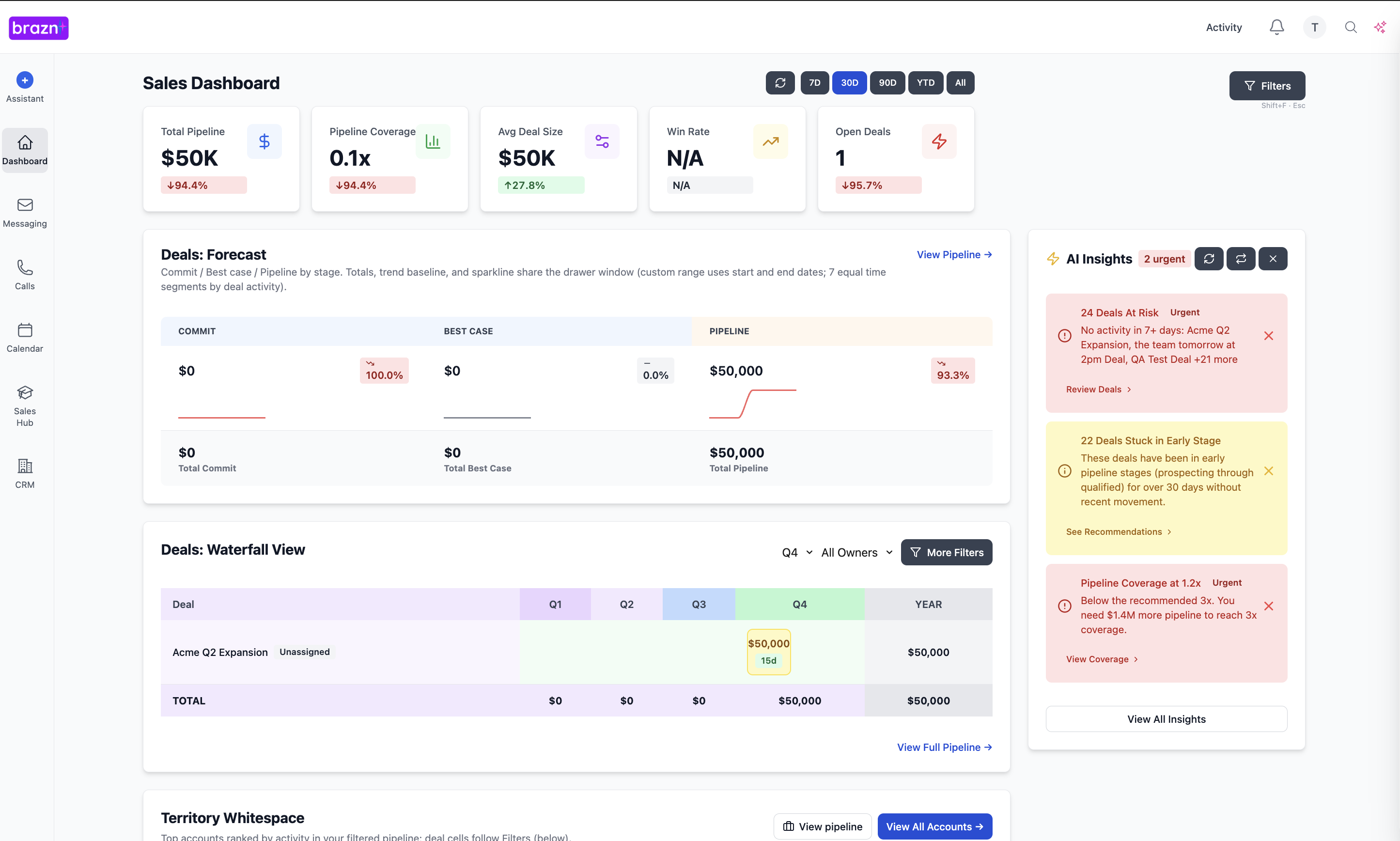
What AI-Powered CRM Hygiene Looks Like in Brazn
Brazn's CRM hygiene layer is built around one principle: the rep should never have to manually update a field that AI can populate from context.
Here's how it works in practice:
Before the call: Brazn surfaces the account context — last interaction, open MEDDPICC gaps, recent news — so the rep enters the call prepared. No CRM archaeology required. During the deal: Brazn monitors every interaction — emails, calendar events, logged calls — and continuously updates deal fields based on what it learns. If the economic buyer is mentioned in an email, it's captured. If the champion's role changes, it's flagged. After the call: Brazn generates a structured call summary, extracts MEDDPICC updates, logs the next step, and writes everything back to the CRM. The rep reviews, approves, and moves on. Total time: under two minutes. In the pipeline review: Every deal in Brazn shows a MEDDPICC health score, a risk flag if something's missing, and the last meaningful interaction — so managers can run deal reviews based on current, accurate data rather than interrogating reps about what's actually happening.---
AI Pipeline Management: Beyond Data Entry
Clean CRM data is the foundation. But AI pipeline management goes further — it uses that clean data to actively manage deal health across the pipeline.
Deal Prioritisation
Not all pipeline is equal. AI pipeline management tools analyse deal signals — engagement rate, MEDDPICC completeness, buying stage velocity, economic buyer access — and rank opportunities by probability of closing. Reps spend their time on the deals most likely to move, not the ones that feel busy.
At-Risk Deal Detection
AI monitors pipeline for the early warning signs of deal slippage: declining email response rates, cancelled meetings, extended silence from key stakeholders, MEDDPICC gaps that haven't been addressed. It flags these deals before the manager notices them in the Friday forecast call.
Pipeline Coverage Analysis
AI calculates pipeline coverage against quota in real time — not the coverage number your CRM shows based on close dates, but the adjusted coverage based on deal health signals. This gives a more accurate picture of whether the team is on track to hit the number.
Forecast Contribution Scoring
Each deal in the pipeline gets a probability-weighted forecast contribution based on AI analysis of deal health, historical win rates for similar deals, and current engagement signals. This makes the forecast more accurate and less dependent on rep optimism.
---
The MEDDPICC Connection
MEDDPICC is the most robust qualification framework for complex SaaS deals — but it only works if the data exists. Most teams that adopt MEDDPICC find that the framework degrades within a quarter because:
- Reps don't consistently fill the fields
- Managers don't consistently inspect them
- The CRM makes it cumbersome to maintain
AI solves all three problems simultaneously. When MEDDPICC fields are populated automatically from deal context, and when AI flags deals with incomplete criteria before the forecast call, the framework becomes self-reinforcing rather than self-defeating.
A Brazn-managed pipeline shows every deal's MEDDPICC score at a glance — not as a manual checklist, but as a live intelligence layer that updates as the deal evolves.
---
How to Implement AI CRM Hygiene: A Practical Framework
Getting AI CRM hygiene working well requires more than installing a tool. Here's the implementation framework that works for SaaS sales teams:
Step 1: Audit Your Current CRM Data Quality
Before you can improve hygiene, you need a baseline. Measure: what percentage of deals have a logged next step? What percentage have MEDDPICC fields populated? What percentage of contacts have been touched in the last 90 days? This gives you the before picture.
Step 2: Define Your Non-Negotiable Fields
Decide which CRM fields are mandatory for pipeline visibility. For most SaaS teams this includes: deal stage, close date, next step with date, MEDDPICC criteria (at minimum: Metrics, Economic Buyer, Champion, Decision Process), and last activity. These are the fields AI needs to maintain.
Step 3: Connect Your Communication Channels
AI CRM hygiene only works if it can read your interactions. Connect your email (Gmail or Outlook), calendar, and call system to your AI layer. This is where Brazn's integrations with Salesforce, HubSpot, and Pipedrive become essential — the system needs to see the full interaction history to extract context accurately.
Step 4: Establish the Human Review Layer
AI populates the fields. Reps review and approve. This step matters — it keeps reps engaged with their pipeline data rather than treating CRM hygiene as something that happens to them. The review loop should take under two minutes per deal per day.
Step 5: Use Pipeline Health in Your Forecast Cadence
Once CRM data is AI-maintained and accurate, bring deal health scores into your weekly pipeline review and forecast call. Managers stop asking "what's happening with this deal?" and start asking "what do we need to do about this risk flag?"
---
Metrics That Improve When You Fix CRM Hygiene
The ROI of AI CRM hygiene shows up across multiple metrics:
- Forecast accuracy improves when close dates and deal stages reflect reality rather than rep optimism
- Win rate improves when MEDDPICC gaps are identified and addressed early rather than discovered at loss review
- Rep ramp time decreases when new hires inherit clean accounts with full interaction history
- Manager efficiency improves when pipeline reviews focus on deal strategy rather than data verification
- Deal slippage rate decreases when at-risk signals are caught and actioned weeks earlier
---
Common Questions About AI CRM Hygiene
Will reps trust AI-generated CRM data?Yes, if the review loop is well-designed. Reps who see AI populating accurate notes and MEDDPICC fields quickly shift from scepticism to reliance — because it removes work they didn't want to do anyway.
What if the AI gets something wrong?The human review step catches errors before they're committed. Over time, AI accuracy improves as the model learns from corrections. The error rate for AI-generated CRM summaries is significantly lower than the error rate for reps who don't fill fields at all.
Does this replace the need for CRM training?No — it changes what training focuses on. Instead of training reps on data entry, you train them on how to interpret AI-generated insights and use them to drive deal strategy. That's a much more valuable investment of time.
Is this compatible with our existing CRM?Brazn integrates natively with Salesforce, HubSpot, and Pipedrive. The AI layer sits on top of your existing CRM — it doesn't require a migration or a replacement.
---
The Bottom Line
Bad CRM hygiene is not a discipline problem — it's a systems problem. When data entry is manual, slow, and disconnected from how reps actually work, the CRM will always degrade. AI changes the fundamental equation by capturing deal context automatically, populating fields without rep action, and maintaining pipeline health as a continuous process rather than a quarterly cleanup project.
For SaaS sales teams that want accurate forecasts, better-qualified pipeline, and reps spending their time selling rather than administering — AI CRM hygiene is not a nice-to-have. It's the foundation everything else is built on.
---
See How Brazn Manages Your Pipeline
Brazn automatically maintains MEDDPICC fields, logs call summaries, flags at-risk deals, and keeps your CRM current — without your reps lifting a finger. See it in a live demo.
---
Book a demo to see how Brazn AI fits into your sales stack.

About the Author

Alex Margarit, Sales AI Expert, SaaS Sales Leader, BMC, ServiceNow, Docusign — 25+ years in SaaS sales.