
Tell Your Story: 8 ‘About Us’ Page Frameworks That Actually Create Pipeline for B2B SaaS
Most B2B SaaS companies treat their About Us page as a digital basement for dusty mission statements and low-resolution headshots. This is a massive missed opportunity for revenue generation. In reality, the About Us page is often the second most-visited page on a site and a critical junction where prospects decide if they trust you enough to enter a sales cycle. As buyers move away from generic feature lists and toward authentic partnerships, your brand story becomes a key differentiator.
This article breaks down 8 specific frameworks you can use to transform your About Us page from a static bio into a high-converting pipeline driver. By documenting your team's unique expertise, validating your company's history with clear authority markers, and structuring your narrative to address specific buyer pain points, you can turn passive visitors into qualified leads. Whether you choose a "founder-led" narrative or a "customer-as-hero" approach, these frameworks ensure your story builds the trust necessary to accelerate the modern B2B buyer's journey.
What We'll Cover
In this article, we will cover: - Why your 'About Us' page is a critical pipeline driver, not just a vanity project
- How to shift from a company-centric narrative to a customer-hero story
- 8 proven frameworks to structure your brand's mission, values, and history
- Key components every B2B 'About Us' page needs to establish enterprise trust
- How to measure the impact of your brand story on lead generation and sales velocity
Understanding the Approach
An "About Us" page framework in a B2B SaaS context is a strategic narrative structure designed to transform a standard company overview into a pipeline-generating asset by establishing trust, credibility, and alignment with the buyer's journey. These frameworks move beyond a simple chronological history to focus on the "why" behind the company, its mission, and the specific problems it's uniquely qualified to solve for its ideal customer profile.
Example: Instead of a generic list of executive bios and a founding date, a "Pipeline-First" framework uses a strategic narrative to position the company as a category leader. It naturally integrates social proof, such as quantified customer results and industry accolades, alongside a mission statement that resonates with the buyer’s business needs, ultimately guiding the visitor toward a high-intent call to action like a product demo or discovery call.
Why This Matters
Optimizing your 'About Us' page is critical for humanizing your B2B brand and establishing the trust necessary to move prospects into your sales pipeline. - Before: 'About Us' pages are treated as vanity projects with generic mission statements that fail to resonate with buyers. After: Framework-driven pages clearly articulate your unique perspective, building immediate credibility with 91% of buyers who research you before the first meeting.
- Before: Visitors leave the 'About Us' page without a clear next step, leading to a dead end in the customer journey. After: Strategic CTAs and trust signals transform the page into a conversion engine that captures high-intent interest.
- Before: Marketing and Sales are misaligned on the brand story, leading to inconsistent messaging during discovery calls. After: A codified framework ensures a unified narrative across all touchpoints, increasing deal-closing rates by up to 67%.
The Complete Guide
H3 Habit Category 1: Pipeline Generation (Examples 1-5)
Objective: Automate the habits that keep the top of the funnel full.
Playbook Example (Habit 2: The "No-Show" Nurture): Top reps never let a no-show go cold. Codify this: If a meeting status is marked "No-Show," Brazn automatically drafts a polite, value-add email referencing a relevant case study and suggesting a new time, pausing the standard sequence.
Best Practices: Ensure automated outreach always includes an easy "opt-out" or 1-click reschedule link to reduce friction.
H3 Habit Category 2: Meeting Preparation (Examples 6-10)
Objective: Ensure reps never walk into a discovery call blind.
Playbook Example (Habit 7: The Executive Summary Brief): Top reps know the prospect's company inside and out. Codify this: 30 minutes before any scheduled "Discovery" call, Brazn pushes a 4-bullet summary of the prospect's recent company news and 10-K filings into the rep's Slack.
Best Practices: Keep the AI-generated briefs strictly focused on actionable insights, not just general company trivia.
H3 Habit Category 3: Deal Management (Examples 11-15)
Objective: Proactively identify risks and maintain deal momentum.
Playbook Example (Habit 12: The Multi-Threading Nudge): Top reps never rely on a single point of contact. Codify this: If an opportunity reaches the "Proposal" stage and only one contact is associated with the deal, Brazn alerts the rep and suggests three other relevant stakeholders to engage based on the buyer persona.
Best Practices: Have the AI automatically draft the outreach email to the new stakeholders, referencing the ongoing conversations with the primary contact.
H3 Habit Category 4: CRM Hygiene (Examples 16-20)
Objective: Maintain a clean, accurate pipeline without nagging reps.
Playbook Example (Habit 18: The Post-Call Brain Dump): Top reps immediately log their notes. Codify this: As soon as a Zoom call ends, Brazn automatically transcribes the call, extracts the MEDDPICC criteria discussed, and updates the specific CRM fields, requiring only a single click from the rep to approve.
Best Practices: Position this playbook to the reps as a time-saver, not a surveillance tool, to drive adoption.
How to Implement This
The "About Us" page is often the most overlooked asset in the B2B SaaS journey, frequently treated as a secondary "company history" section rather than a high-intent conversion point. For most buyers, this page is a crucial stop in their due diligence process, where they seek to validate whether your company understands their specific problems and possesses the stability to solve them. To transform this page from a vanity project into a pipeline driver, SaaS teams must move beyond generic mission statements and adopt frameworks that prioritize the buyer's needs over the company's ego.
One of the most effective frameworks is the "Customer-Centric Origin Story." Instead of starting with when the company was founded, this approach begins with the specific market gap or customer frustration that led to the product's creation. By framing your history through the lens of a problem your prospects currently face, you establish immediate empathy and authority. Another powerful framework is the "Future-Proof Vision," which focuses on the long-term roadmap and the company's commitment to solving evolving industry challenges. This builds the trust necessary for long-term enterprise contracts.
To operationalize these frameworks, Marketing and RevOps should collaborate to ensure the "About Us" page includes clear, low-friction calls to action, such as booking a tour of the product or joining a community. By treating the "About Us" page as a strategic piece of the Go-to-Market engine, you can capture intent from prospects who are looking for a partner, not just a vendor, ultimately accelerating them into your sales pipeline.
Next Steps
Most 'About Us' pages are a graveyard of corporate cliches and generic mission statements that fail to resonate with modern B2B buyers. To transform this page into a pipeline-generating asset, you must shift the focus from your company’s history to the value you provide the customer.
Review these 8 frameworks with your marketing team: - The Problem-Solver: Focus on the specific pain points that led to the company’s founding.
- The Visionary: Outline a bold future for the industry and how your product leads the way.
- The Customer-Centric: Use the page to highlight customer success stories rather than internal milestones.
- The Human-First: Feature the real people and culture behind the software to build trust.
- The Data-Driven: Use hard metrics and growth stats to prove market leadership and stability.
- The Category Creator: Define a new market category and explain why traditional solutions are obsolete.
- The Product-Led: Show how the product is built specifically for the end-user’s daily workflow.
- The Value-Alignment: Connect your company’s core values directly to the business goals of your prospects.Don’t try to use every framework at once. Audit your current page and select the one that most closely aligns with your brand voice. Commit to rewriting just the headline and hero section this week to better reflect your unique value proposition. See how Brazn can help you personalize these stories for every visitor.
Book a demo to see how Brazn AI fits into your sales stack.
About the Author
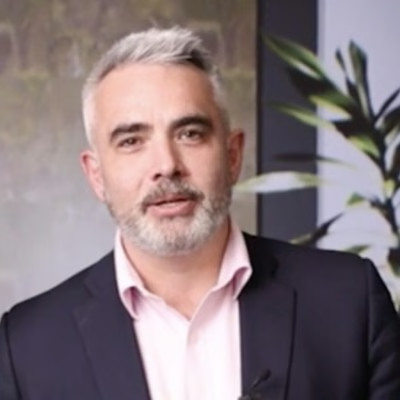
Alex Margarit, Sales AI Expert, SaaS Sales Leader, BMC, ServiceNow, Docusign — 25+ years in SaaS sales.