How to Write a Sales Follow-Up Email After a Discovery Call
The follow-up email after a discovery call is one of the most important documents in a SaaS sales process — and one of the most underinvested. Most post-discovery follow-ups are either a brief thank-you with a calendar link or a lengthy recap that reads like meeting minutes. Neither advances the deal.
A well-written post-discovery follow-up does five things: confirms the understanding of the problem, validates the business impact, formalises the next step, positions the vendor's value against the specific pain, and gives the champion something they can forward to their leadership as a concise summary of the evaluation. It should take 15 minutes to write and 3 minutes to read.
---
The Structure
Subject lineReference the call specifically — not a generic "Following up" subject line that could apply to any email in the thread:
- "Following our call — [Company] + Brazn next steps"
- "Summary: [specific topic from the call] + next steps for [Company]"
- "[Champion name] — [specific outcome agreed on the call]"
Opening: Acknowledgement with specificityOne sentence that demonstrates the email was written after this specific call — not copied from a template:
"Really useful conversation today — the challenge you described around [specific issue] and its downstream impact on [specific metric] is exactly the kind of problem we're set up to address." Section 1: What I understood (pain confirmation)Restate the pain and its business impact in the prospect's own language. This serves two purposes: it confirms the rep understood correctly, and it gives the champion a clean articulation of their problem that they can use internally.
"To make sure I have this right: the core challenge is [specific pain]. The downstream impact is [quantified business impact — use their numbers if established]. The current workaround is [what they're doing now], which isn't solving [specific gap]."If the quantified impact wasn't established on the call, use a range or a question:
"You mentioned [problem] — I'd estimate this is costing somewhere in the range of [conservative estimate]. Does that feel roughly right, or should we stress-test that number on our next call?" Section 2: What I think the right path forward isA brief, non-pitchy paragraph connecting their specific pain to the specific capability that addresses it. One problem, one solution, no feature list:
"Based on what you described, the highest-impact use case for [Company] is [specific use case]. The way Brazn addresses this specifically is [one-sentence capability description]. The outcome for teams in a similar situation has typically been [specific outcome with reference metric]." Section 3: Committed next stepThe next step agreed on the call — restated with full specificity. Owner, action, date:
"As we agreed, the next step is [specific action]. [Owner name] will [specific action] by [specific date]. I'll [vendor action] by [date] to prepare."If no next step was agreed, use the follow-up email to propose one:
"Based on where we got to, I'd suggest the logical next step is [proposed action]. Would [date/time] work for a 30-minute follow-up to [specific objective]?" Section 4: Resources (optional)One relevant resource — a case study, a relevant benchmark, a specific reference — matched to the specific use case discussed. Not a full product brochure. One resource, one sentence of context:
"I've attached the [Company] case study I mentioned — they were dealing with a very similar [specific challenge], and the outcome section is particularly relevant to what you described." ClosingBrief, direct, no filler:
"Looking forward to [next step]. Reach out if anything in the summary needs adjusting — happy to get it right."---
The Full Example
Subject: Summary: CRM admin costs + next steps for Acme "Sarah — really useful call today. The picture you painted of reps spending 2+ hours a day on post-call admin while the pipeline review data stays stale between calls is exactly the kind of structural problem Brazn is built to address. To make sure I have this right: the core challenge is that your 12 AEs are collectively spending ~24 hours per day on CRM updates, call notes, and MEDDPICC field population — time that isn't available for pipeline generation. At your current ACV and quota model, that represents roughly $800K in annual selling capacity deployed on admin. Does that math check out, or should we tighten the estimate? Based on what you shared, the highest-impact use case for Acme is call intelligence and CRM auto-update — specifically the post-call automation layer that writes MEDDPICC fields, updates the deal record, and sends the rep a summary before their next meeting. Teams at your stage typically reclaim 8–10 hours per rep per week within the first 30 days. As agreed: you'll circulate the deal to your RevOps lead, Marcus, and copy me on the introduction by Thursday. I'll prepare a 20-minute technical overview scoped specifically to your Salesforce setup for the three of us to review on [proposed date]. I've attached the Ripple case study — 120-person SaaS team, same Salesforce setup, similar rep admin problem. The section on pipeline review accuracy post-implementation is directly relevant to what you described. Looking forward to Thursday."---
Common Mistakes to Avoid
The generic thank-you opener. "Thanks so much for taking the time today!" reads as a template and wastes the first sentence. Open with something specific to the call. Restating everything that was discussed. The follow-up email is not meeting minutes. It is a positioning document. Include what advances the deal; leave out the rest. Vague next steps. "Let's find some time to connect again soon" is not a next step. A next step has a specific action, a specific owner, and a specific date. The unsolicited product overview attachment. Attaching a 20-slide product deck to a follow-up email signals that the rep wasn't listening in the call — they're sending the same content they'd send to anyone. Attach only what is directly relevant to the specific conversation. Following up without a call objective. The follow-up email cannot formalise a next step that was never established. The time to establish the next step is on the call — not in the follow-up. If the call ended without a next step, the follow-up email's primary job is to propose one.---
How Brazn Automates Post-Discovery Follow-Ups
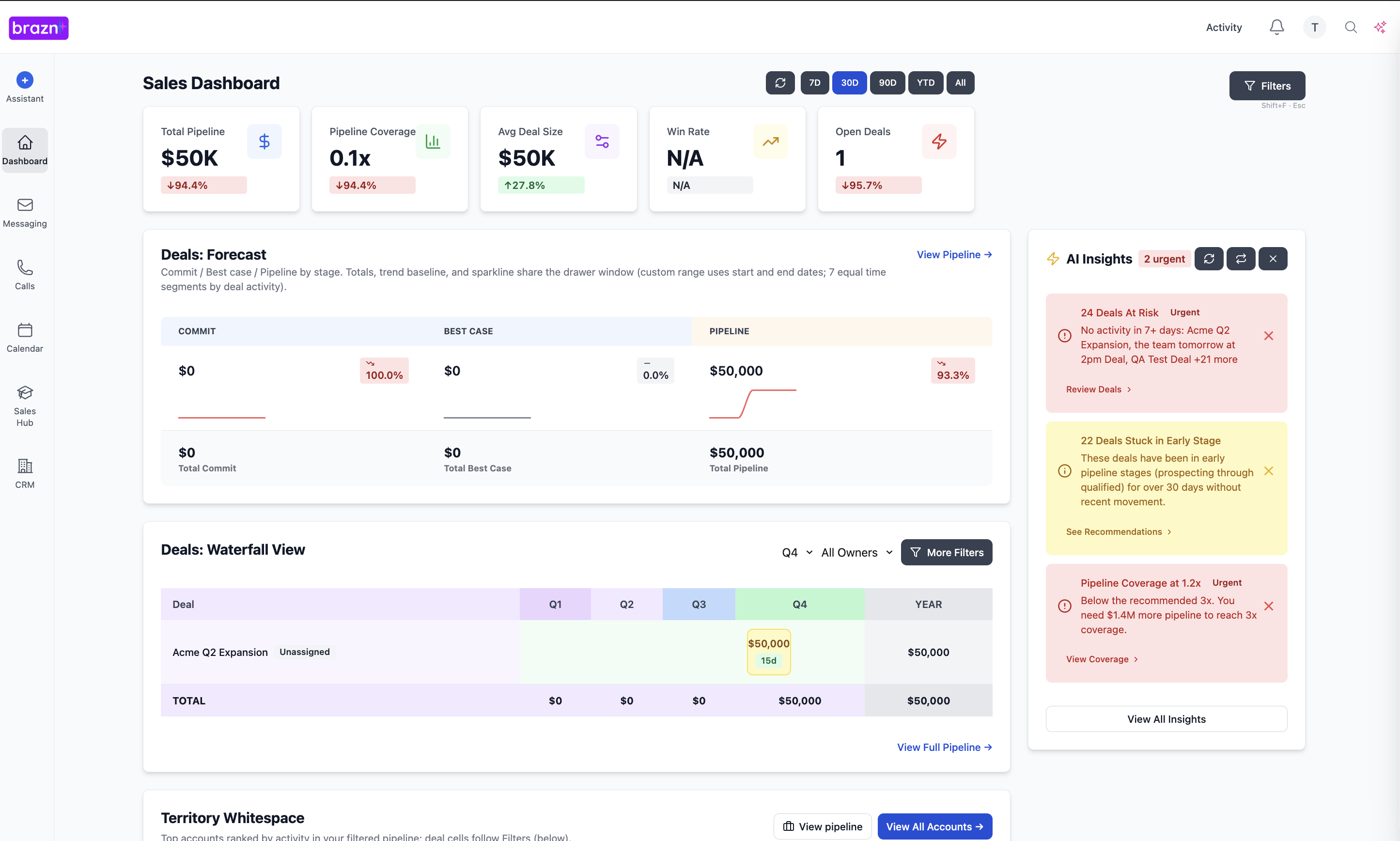
Brazn generates the post-discovery follow-up email automatically from the call transcript — extracting the pain summary, the quantified business impact, the MEDDPICC elements established, and the committed next steps from the conversation. The rep receives a complete draft within minutes of the call ending, reviews it for accuracy, adds any context the AI didn't capture, and sends. Post-call admin time drops from 30+ minutes to under 5 — and the quality of the follow-up improves because it's built from the actual conversation, not the rep's selective recollection of it.
---
####
Book a demo to see how Brazn AI fits into your sales stack.

About the Author
Alex Margarit, Sales AI Expert, SaaS Sales Leader, BMC, ServiceNow, Docusign — 25+ years in SaaS sales.