

Content: # How to Find and Fix the Data Gaps That Keep Your Forecasts Wrong
A sales forecast is only as reliable as the data underlying it. Yet many leaders accept CRM decay—missing contacts, outdated stages, and empty MEDDPICC fields—as unavoidable.
The problem: these data gaps don't just cause reporting headaches; they mask pipeline risks and lead to missed forecasts.
This article provides a systematic approach to identifying and fixing the data gaps destroying forecast accuracy. We'll show you how to use AI to automate data hygiene and enforce CRM accountability.
What We'll Cover
In this article, we will cover:
- The cost of poor CRM data hygiene
- The 3 most common data gaps that ruin forecasts
- Using AI to audit pipeline automatically
- Implementing automated enrichment and capture
- Shifting reps from data entry to data validation
Understanding the Approach
Fixing data gaps means identifying missing or inaccurate fields critical for forecasting (e.g., close date, next step, economic buyer) and capturing that data passively from workflows (emails, calls) rather than forcing manual entry.
Example: A deal looks strong because it is in commit. An AI audit finds no activity in 21 days and no next step scheduled, flags it as high risk, and prompts intervention before it slips.
Why This Matters
Data hygiene is the foundation of predictable revenue.
- Before: Forecasts are based on intuition and best-case scenarios. After: Forecasts are based on objective, complete data.
- Before: Reps spend hours updating CRM fields. After: AI logs activity and suggests field updates.
- Before: RevOps acts as CRM police. After: RevOps focuses on strategic analysis.
The Complete Guide
Gap 1: The Stale Deal Syndrome
Objective: Identify deals that lost momentum but inflate pipeline.
Actionable Advice: Flag opportunities where stage duration exceeds norms or there is no activity in 14 days.
Best Practices: Require a firm next step within 48 hours or move the deal to closed-lost or nurture.
Gap 2: Missing Stakeholders
Objective: Avoid single-threaded deals.
Actionable Advice: Ensure late-stage deals have at least three contacts and an identified economic buyer.
Best Practices: Use enrichment to pull in additional stakeholders.
Gap 3: Empty Qualification Criteria
Objective: Enforce rigorous qualification.
Actionable Advice: Make MEDDPICC fields mandatory before proposal/commit.
Best Practices: Use conversational AI to extract criteria from transcripts.
How to Implement This
RevOps deploys automation tools that capture data passively. Sales Leadership enforces the culture; if managers accept forecasts with missing data, automation fails.
Next Steps
You can't build predictable revenue on bad data.
Start small: run a report of deals closing this month with no next step scheduled and intervene now.
How to Find and Fix the Data Gaps That Keep Your Forecasts Wrong
A sales forecast is only as reliable as the data underlying it. Yet, most revenue leaders accept a certain level of “CRM decay”—missing contacts, outdated deal stages, and empty MEDDPICC fields—as an unavoidable reality.
These data gaps don’t just cause reporting headaches; they actively mask pipeline risks and lead to missed forecasts.
This article provides a systematic approach to identifying and fixing the data gaps that are destroying your forecast accuracy. We’ll show you how to use AI to automate data hygiene and enforce a culture of CRM accountability.
What we’ll cover
In this article, we will cover:
- The true cost of poor CRM data hygiene
- The 3 most common data gaps that ruin forecasts
- How to use AI to automatically audit your pipeline
- Implementing automated data enrichment and capture
- Shifting rep behavior from data entry to data validation
Understanding the approach
Fixing data gaps involves identifying the specific missing or inaccurate CRM fields that are critical for forecasting (e.g., Close Date, Next Step, Economic Buyer) and implementing automated systems to capture that data from rep workflows (emails, calls) without requiring manual entry.
Example: A forecast looks strong because a major deal is in the “Commit” stage. However, an AI audit reveals a data gap: the “Last Contacted” date was 21 days ago, and there is no scheduled “Next Step.” The AI flags this deal as high-risk, prompting the manager to intervene before the deal slips out of the quarter.Why this matters
Pristine data hygiene is the foundation of predictable revenue.
- Before: Forecasts are based on rep intuition and best-case scenarios, leading to end-of-quarter surprises.
After: Forecasts are based on objective, complete data, resulting in consistent accuracy within a 5% margin of error.- Before: Reps spend Friday afternoons manually updating dozens of CRM fields.
After: AI automatically logs activity and updates fields, giving reps time back.- Before: RevOps acts as the “CRM police,” constantly nagging reps to update their deals.
After: RevOps focuses on strategic analysis because the data capture is automated.The complete guide
Gap 1: The “stale deal” syndrome
Objective: Identify deals that have lost momentum but are still inflating the pipeline. Actionable advice: Create a CRM report that flags any opportunity where the “Stage Duration” exceeds your average sales cycle length, or where there has been no logged activity in the last 14 days. Best practices: Implement a strict rule: any deal flagged as stale must be moved to “Closed-Lost” or a “Nurture” stage if a firm next step isn’t established within 48 hours.Gap 2: Missing stakeholders
Objective: Ensure deals aren’t relying on a single point of failure. Actionable advice: Audit your late-stage pipeline to ensure that every deal over a certain ARR threshold has at least three distinct contacts associated with it, including an identified Economic Buyer. Best practices: Use data enrichment tools to automatically pull in the contact information for other executives at the target account, making it easier for reps to multi-thread.Gap 3: Empty qualification criteria
Objective: Ensure deals are rigorously qualified before being forecasted. Actionable advice: If you use MEDDPICC (or a similar framework), make those specific fields mandatory before a deal can be moved into the “Proposal” or “Commit” stages. Best practices: Use conversational AI to automatically extract MEDDPICC criteria from call transcripts and suggest updates to the CRM fields, reducing the manual burden on the rep.How to implement this
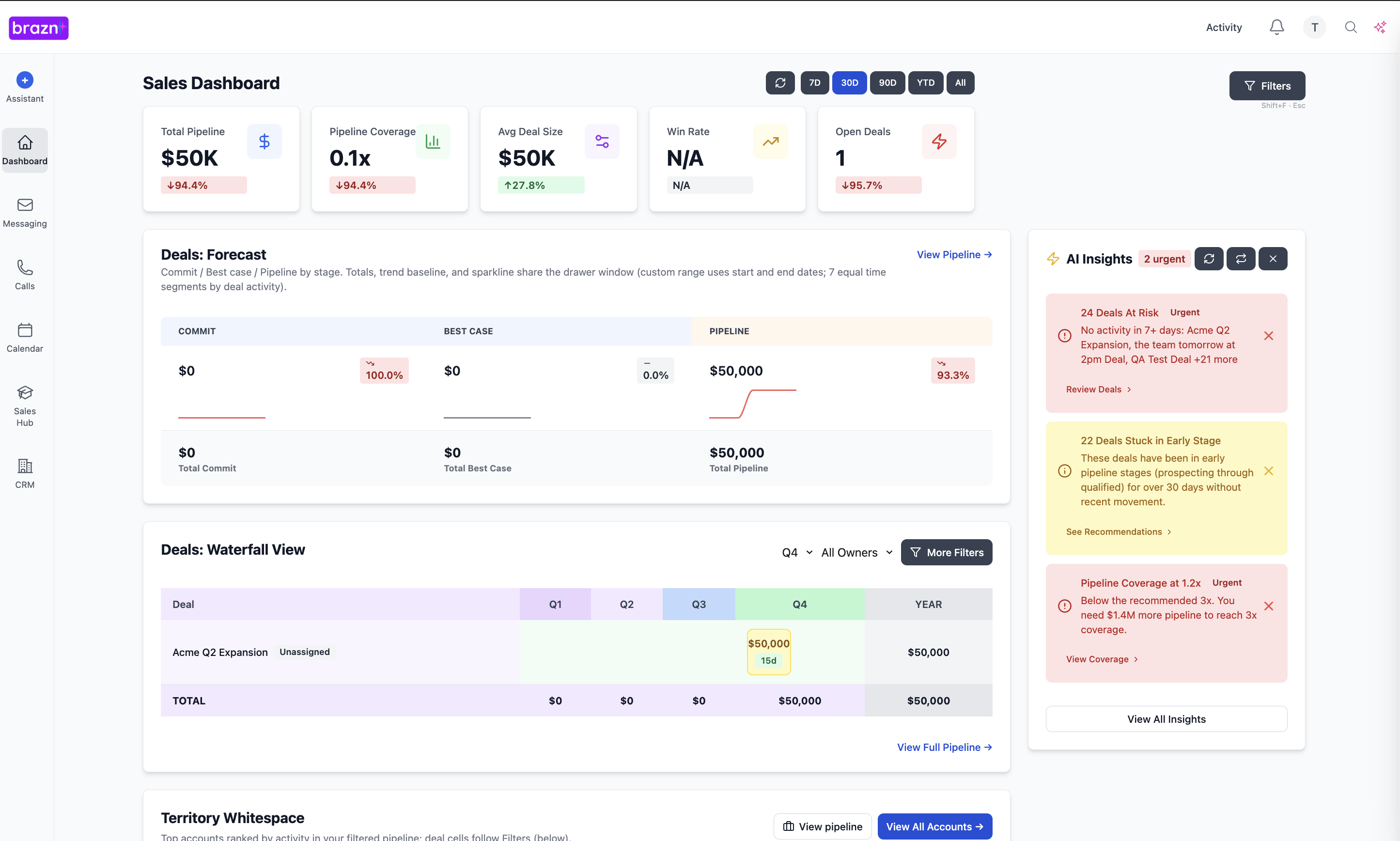
RevOps is the owner of data hygiene. They must deploy the automation tools (like Brazn) that capture data passively from emails and calls.
However, Sales Leadership must enforce the culture. If a manager accepts a forecast from a rep whose deals have missing data, the automation efforts will fail.
Next steps
You can’t build a predictable revenue engine on a foundation of bad data. By automating data capture and rigorously auditing your pipeline for gaps, you transform your forecast from a hopeful guess into a more objective system.
Start small: run a report today showing all deals set to close this month that have no scheduled “Next Step.” You will likely find your forecast is already at risk.
Ready to automate your data hygiene? See how Brazn keeps your CRM clean.
####
Book a demo to see how Brazn AI fits into your sales stack.

About the Author

Alex Margarit, Sales AI Expert, SaaS Sales Leader, BMC, ServiceNow, Docusign — 25+ years in SaaS sales.