
7 AI Prompts Your Revenue Team Can Use to Rescue At-Risk Deals and Accounts
Every sales rep knows the sinking feeling of a promising deal suddenly going dark or a key account showing signs of churn. Despite your best efforts, communication stalls, champions leave, or priorities shift. The traditional approach of sending "just checking in" emails often accelerates the disconnect, making you look desperate rather than helpful.
To rescue at-risk deals and accounts, you need to change the narrative and provide unexpected value. AI can be your secret weapon here, helping you quickly analyze the situation, identify new angles of approach, and craft messaging that reignites engagement.
This article outlines 7 powerful AI prompts designed to help your revenue team diagnose the root cause of stalled deals and generate creative, personalized strategies to get them back on track.
What We'll Cover
In this article, we will cover:
- Why traditional "follow-up" fails for at-risk deals
- How AI can analyze account history to find new angles
- 7 specific AI prompts to rescue stalled deals and accounts
- Integrating these rescue plays into your Sales Pipeline
Understanding the Approach
In the context of GTM motions, "Deal Rescue" or "Account Turnaround" refers to the strategic interventions deployed when an opportunity or existing customer shows clear signs of stalling or churning. This requires shifting from a standard sales cadence to a highly personalized, value-driven approach.
In the context of GTM motions, "Deal Rescue" or "Account Turnaround" refers to the strategic interventions deployed when an opportunity or existing customer shows clear signs of stalling or churning. This requires shifting from a standard Sales Cadence to a highly personalized, value-driven approach.
AI enhances this process by acting as an analytical co-pilot. Instead of a rep spending hours reviewing months of call transcripts and email threads to figure out what went wrong, an AI prompt can instantly synthesize this history, identify missed signals, and suggest alternative messaging strategies.
Example: A rep uses an AI prompt to analyze the last three Gong calls with a stalled prospect. The AI identifies that the prospect repeatedly mentioned integration concerns that were never fully addressed. The rep then uses another prompt to draft an email specifically addressing those integration concerns with a new technical whitepaper, bypassing the generic "checking in" message.
Why This Matters
Utilizing AI prompts for deal rescue is crucial for improving win rates and Net Revenue Retention (NRR). It allows reps to act quickly and intelligently when warning signs appear, rather than relying on guesswork.
- Before: Reps send generic "checking in" emails that are ignored, further alienating the prospect. After: AI helps craft highly relevant messages based on past interactions and unaddressed pain points.
- Before: Stalled deals sit in the pipeline for months, muddying the forecast. After: AI prompts help quickly determine if a deal is salvageable or if it should be closed-lost, improving pipeline hygiene.
- Before: Customer Success Managers (CSMs) struggle to identify churn risks before it's too late. After: AI analyzes usage data and communication history to flag at-risk accounts and suggest proactive retention plays.
The Complete Guide
Prompt 1: The "Missed Signal" Analyzer
Objective: Identify unaddressed concerns from past interactions that may have caused the deal to stall.
Prompt: "Analyze the transcripts of the last three calls with [Prospect Name] from [Company]. Identify any objections, questions, or concerns they raised that were not definitively answered or resolved by our team."Best Practices: Use the output to craft an email directly addressing the overlooked concern, showing that you're listening.
Prompt 2: The "New Angle" Generator
Objective: Brainstorm fresh approaches to re-engage a prospect who has stopped responding to your current value proposition.
Prompt: "The deal with Company] has stalled. Based on their industry [Industry] and recent company news [Insert News Link], suggest three entirely new angles or value propositions we can use to re-engage the primary [Stakeholder, [Name]."
Best Practices: Ensure the new angles are distinct from what has already been pitched.
Prompt 3: The Multi-Threading Strategist
Objective: Identify other potential stakeholders to engage when your primary champion goes dark.
Prompt: "Our main contact at [Company], [Name/Title], has stopped responding. Based on the typical buying committee for our solution in the [Industry] sector, suggest three other roles we should reach out to and draft a short, context-aware message for each."
Best Practices: Be careful not to step on toes; frame the outreach as seeking to understand broader company priorities.
Prompt 4: The "Value Add" Re-engagement
Objective: Provide immediate, unexpected value to reignite the conversation without asking for a meeting.
Prompt: "Draft an email to [Prospect Name] at [Company]. Do not ask for a meeting. Instead, summarize the key findings from our recent industry report [Report Link] that specifically address the challenges they mentioned in our first call regarding [Specific Pain Point]."
Best Practices: The goal is to be helpful, not salesy. Let the value of the content prompt their reply.
Prompt 5: The "Executive Summary" for Leadership
Objective: Equip your leadership team to step in and help rescue a high-value deal.
Prompt: "Create a 1-page executive summary of the stalled deal with [Company]. Include the original pain points, the proposed solution, the timeline of interactions, and the suspected reason for the stall. Suggest one specific action our VP of Sales could take to help unstick this."
Best Practices: Use this for tier-1 accounts where executive alignment can move the needle.
Prompt 6: The "Churn Risk" Diagnostic (for CS)
Objective: Analyze account behavior to identify why a customer might be preparing to churn.
Prompt: "Analyze the recent support tickets and product usage data for [Customer Name]. Identify any patterns indicating frustration or a lack of adoption, and suggest a proactive play for the CSM to address these issues before the renewal discussion."
Best Practices: Combine qualitative (support tickets) and quantitative (usage) data for a complete picture.
Prompt 7: The "Breakup" Email Drafter
Objective: Send a final, professional email to close out a dead deal, leaving the door open for future engagement.
Prompt: "Draft a professional 'breakup' email to [Prospect Name] at [Company]. Acknowledge that the timing might not be right, summarize the value we discussed, and clearly state that we will stop reaching out. Keep it polite and leave the door open for future contact."
Best Practices: Often, the "breakup" email is the one that finally gets a response. Keep it classy.
How to Implement This
To operationalize these rescue plays, Revops should create specific "Stalled Deal" or "At-Risk Account" stages in the CRM. When a deal enters this stage, it should automatically trigger a workflow that prompts the rep (or CSM) to use the appropriate AI prompts.
Enablement should run "Deal Clinic" sessions where reps bring their stalled deals and use these prompts collaboratively to brainstorm rescue strategies. This builds confidence in using AI for complex, nuanced situations rather than just top-of-funnel outreach.
Next Steps
Rescuing at-risk deals isn't about being more persistent; it's about being more relevant. By using AI to analyze the context and generate new angles, your team can break through the silence and re-establish value.
Start by identifying three deals in your pipeline that have been stalled for over 30 days. Apply Prompt 1 (The "Missed Signal" Analyzer) and Prompt 2 (The "New Angle" Generator) to each. You might be surprised at the insights AI uncovers and the conversations it helps restart.
####
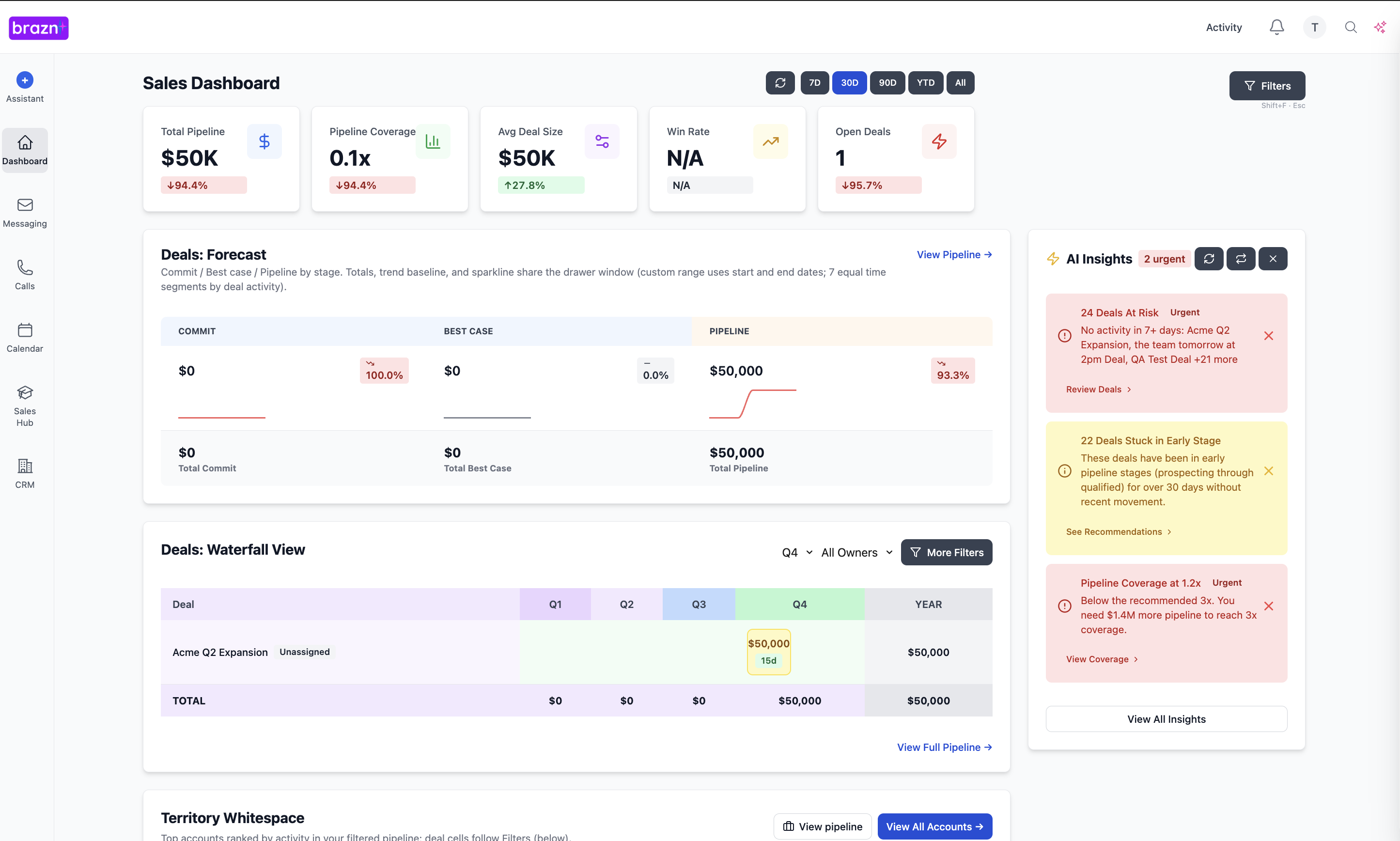
Book a demo to see how Brazn AI fits into your sales stack.

About the Author

Alex Margarit, Sales AI Expert, SaaS Sales Leader, BMC, ServiceNow, Docusign — 25+ years in SaaS sales.