
Best AI Sales Assistants for SaaS Teams (and Where Brazn Fits)
If you've spent any time recently searching for AI sales tools, you'll have noticed something immediately: everyone claims to be an AI sales assistant. The market has expanded dramatically — G2's Sales AI category now lists over 300 products, making genuine product differentiation harder to evaluate than ever.
Your call recording tool added an AI summary feature — AI sales assistant. Your CRM vendor shipped a GPT-powered field suggestion — AI sales assistant. A YC startup with a landing page, a waitlist, and a very confident founder — AI sales assistant.
The category is genuinely exploding. Which makes it genuinely difficult to figure out what's actually worth evaluating, what's marketing fluff, and — most importantly — what will actually make your SaaS sales team more effective.
This guide cuts through it. We'll cover the main categories of AI sales tooling, the leading tools in each, what they're actually good at, where they fall short, and where Brazn fits in the picture.
One important note upfront: this isn't a hatchet piece on competitors. Every tool mentioned here does something genuinely useful. The question is whether it does what your team specifically needs — and whether it solves the whole problem or just part of it.
The Four Categories of AI Sales Tools
Before comparing specific tools, it helps to understand that "AI sales assistant" actually describes four meaningfully different categories of product. Conflating them is why so many buyers end up disappointed.
Category 1: Conversation Intelligence
Tools that record, transcribe, and analyse sales calls. They surface insights from what was said — keywords, competitor mentions, talk ratios, topic tracking, deal risks. The intelligence stays in the tool unless someone manually acts on it.
Key players: Gong, Chorus (ZoomInfo), Salesloft Conversations
Category 2: Sales Engagement with AI Features
Sequencing and cadence platforms that have added AI-powered capabilities — email generation, intent scoring, personalisation suggestions, engagement analytics.
Key players: Apollo, Salesloft, Outreach, Instantly
Category 3: CRM-Native AI
AI features built directly into CRM platforms — field suggestions, forecast scoring, deal health indicators, generative email drafts.
Key players: Salesforce Einstein, HubSpot AI, Pipedrive AI
Category 4: Agentic AI Sales Platforms
Platforms built from the ground up to act across the sales stack — reading signals from multiple tools, updating CRMs automatically, maintaining deal hygiene, executing research and outreach without rep initiation.
Key players: Brazn, and a small number of emerging platforms
The first three categories have been around long enough to be well understood. The fourth is where the real transformation is happening — and where the most important buying decision lies.
Category 1: Conversation Intelligence Tools
Gong
Gong is the market leader in conversation intelligence and, for most enterprise SaaS teams, a non-negotiable part of the stack. It records every call, produces accurate transcripts, and surfaces deal intelligence — competitor mentions, next steps, risk signals, engagement patterns — at both the deal and portfolio level.
What it does brilliantly: Call analysis, coaching, portfolio-level deal intelligence, forecast risk signals, competitive tracking across transcripts.
Where it stops: Gong surfaces insights. It doesn't act on them. The MEDDPICC gap it identifies still needs a human to open Salesforce and update the field. The follow-up it flags as needed still needs a human to write and send. The research brief it can't build because it doesn't do pre-call research — that still falls on the rep. Gong is brilliant at telling you what happened. It's not designed to do anything about it.
Best for: Enterprise SaaS teams who need deep call analytics, coaching at scale, and portfolio-level deal intelligence.
Chorus (ZoomInfo)
Chorus is ZoomInfo's conversation intelligence product, tightly integrated with ZoomInfo's contact and account enrichment data. Strong transcription, solid deal intelligence, and the benefit of ZoomInfo's data layer underneath.
What it does brilliantly: Call analysis with contact enrichment context, integration with ZoomInfo's buyer intent data, solid coaching features.
Where it stops: Same fundamental limitation as Gong — it surfaces intelligence but doesn't act on it. The ZoomInfo integration is powerful but still requires manual bridging between insight and action.
Best for: Teams already deeply invested in the ZoomInfo ecosystem.
Category 2: Sales Engagement with AI Features
Apollo
Apollo has become the go-to sales engagement platform for a huge range of SaaS teams — partly because of its competitive pricing, partly because it bundles prospecting data, sequencing, and engagement analytics in one platform. Its AI features have expanded significantly — email generation, personalisation suggestions, intent signals.
What it does brilliantly: Prospecting at scale, sequence management, multi-channel cadences, data enrichment, and increasingly capable AI-generated email copy.
Where it stops: Apollo is an outbound execution tool. It's brilliant at making sure sequences run. It doesn't maintain MEDDPICC. It doesn't read your Gong transcripts and update Salesforce. It doesn't proactively flag deal risks. The AI features are additive to the sequencing engine — they don't transform it into a deal management platform.
Best for: SDR-heavy outbound motions, prospecting at volume, teams who need sequencing + data in one tool.
Salesloft
Salesloft is the enterprise-grade sales engagement platform — deeper workflow capabilities, stronger CRM integration, and more sophisticated analytics than Apollo. Its AI layer (Salesloft AI) has added forecast signals, deal health scoring, and AI-assisted communication.
What it does brilliantly: Enterprise-grade sequence management, deep Salesforce integration, pipeline analytics, and coaching workflows for sales managers.
Where it stops: Like Apollo, Salesloft is fundamentally a sequencing and engagement platform. The AI features make the platform smarter but don't transform it into an agentic deal management system. It still requires the rep to initiate, to log, to maintain.
Best for: Enterprise SaaS teams with established outbound motions who need serious workflow infrastructure.
Outreach
Outreach sits in similar territory to Salesloft — enterprise sequencing, strong analytics, increasingly capable AI features including deal health scoring and generative communication. The competitive positioning between Salesloft and Outreach is genuinely close and often comes down to existing CRM integrations and team preference.
Best for: Enterprise teams with complex multi-channel sequences and a need for deep pipeline analytics.
Category 3: CRM-Native AI
Salesforce Einstein / Salesforce AI
Salesforce has invested heavily in AI — Einstein GPT, Einstein Copilot, the broader AI Cloud product suite. CRM-native AI features include opportunity scoring, forecast predictions, generative email drafts, field suggestions, and summary generation.
What it does brilliantly: Deep CRM integration (obviously), forecast analytics, and an increasingly capable generative layer for reps who live in Salesforce.
Where it stops: Salesforce AI works within Salesforce. It doesn't read your Gong transcripts and update fields from them. It doesn't monitor your inbox for deal signals. It doesn't build pre-call research briefs. The intelligence is CRM-bound — and therefore limited by the quality of data that humans have entered into the CRM in the first place. Which, as we know, is often not great.
Best for: Teams fully committed to the Salesforce ecosystem who want AI features without adding a new vendor.
HubSpot AI
HubSpot's AI features are deeply integrated across the platform — generative email, content generation, deal forecasting, conversation intelligence, and an increasingly capable AI assistant layer. For teams in the HubSpot ecosystem, it's a natural starting point.
What it does brilliantly: Native integration across marketing, sales, and service; accessible and easy to adopt; strong for SMB and mid-market SaaS teams.
Where it stops: Same CRM-bound limitation as Salesforce Einstein. The AI enhances what's already in HubSpot but doesn't extend across the full stack.
Best for: SMB and mid-market SaaS teams already running HubSpot as their primary platform.
Category 4: Agentic AI Sales Platforms
This is the category that's genuinely changing what's possible in sales — and the one where Brazn sits.
The defining characteristic of an agentic platform is that it acts without being asked. It doesn't wait for the rep to initiate a query or click a button. It monitors the environment — CRM, call transcripts, inbox, product signals, enrichment data — identifies what needs to happen, and does it.
Brazn
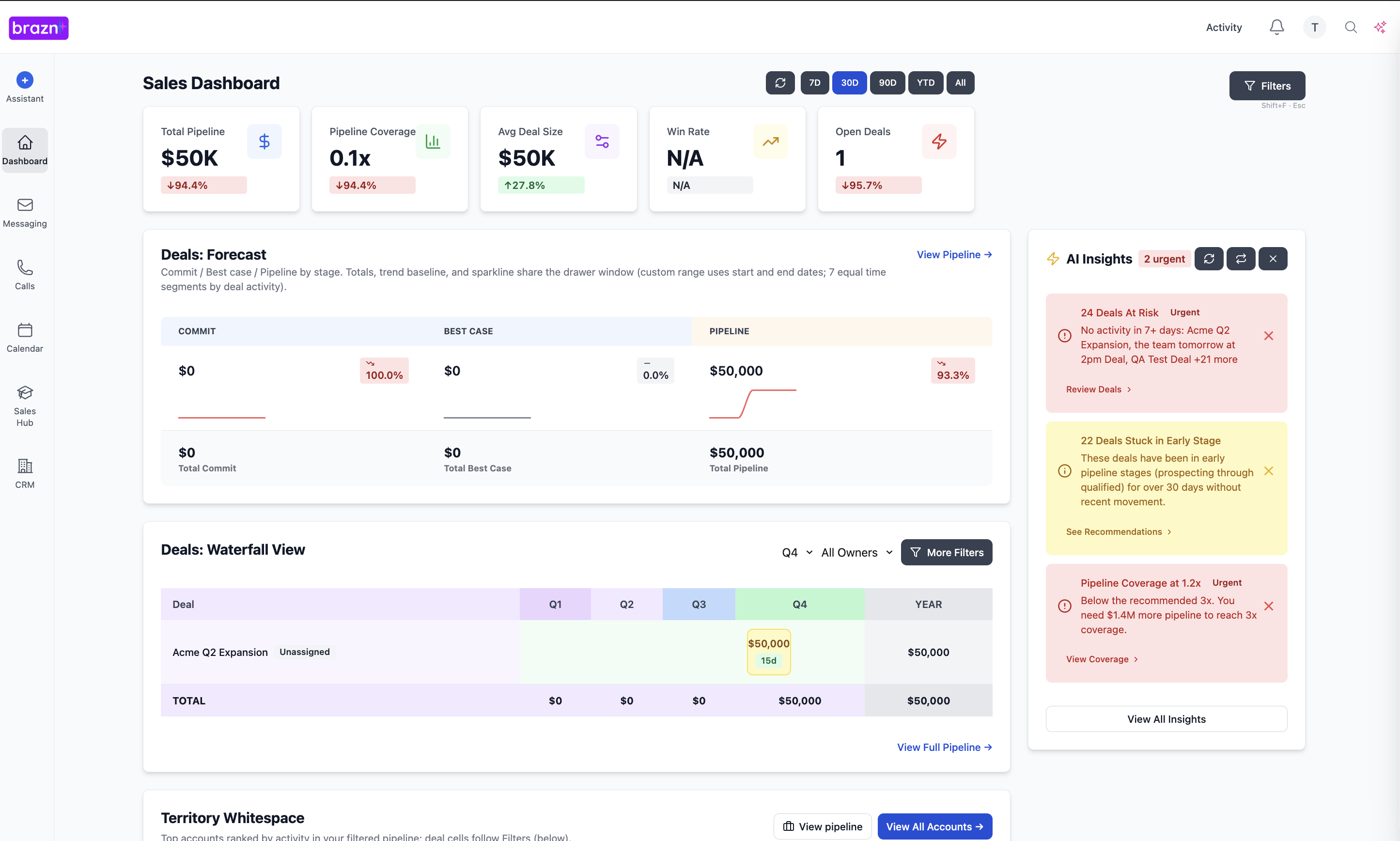
Brazn is built from the ground up as an agentic AI sales platform for SaaS revenue teams. It connects across your entire stack and operates as the intelligence layer that makes everything else work together.
What it does:
- Reads every Gong/Chorus transcript automatically and updates Salesforce MEDDPICC fields, deal stage, next steps, and contact activity — without rep intervention
- Builds pre-call research briefs for every account, delivered before the call starts
- Monitors champion engagement, EB contact status, paper process documentation, and forecast risk across every open deal — flagging issues before they become missed quarters
- Drafts personalised follow-up emails from call context — not templates, genuine personalised messages that reference what was specifically discussed
- Monitors outbound sequences and queues missing steps, proactively surfacing the accounts that need attention before they go cold
- For PLG teams, monitors product usage signals and surfaces expansion triggers with personalised outreach drafts ready to approve
- Maintains MEDDPICC hygiene continuously — not just after pipeline reviews but after every meaningful interaction
What makes it different from the tools above:
Every tool in Categories 1–3 requires a human to bridge between insight and action. Gong identifies a MEDDPICC gap — human opens Salesforce and updates it. Apollo fires a sequence step — human writes the personalised follow-up. HubSpot AI suggests a forecast risk — human decides what to do about it.
Brazn closes that bridge automatically. The insight becomes the action. The gap gets logged. The follow-up gets drafted. The risk gets flagged with a specific recovery action already queued. The human reviews and approves — they don't produce.
Best for: SaaS AEs and SDRs who are drowning in admin and losing selling time to the connective tissue work between their tools. Sales managers who need real-time pipeline visibility without relying on rep-maintained CRM data. RevOps teams who've been fighting the data quality problem for years. PLG teams running a mixed product-led and sales-led motion simultaneously.
How to Think About Building Your Stack
The honest answer for most SaaS teams is that you don't choose between these categories — you choose one from each, and you make sure they work together.
You probably need a conversation intelligence tool (Gong or Chorus). You probably need a sales engagement platform (Apollo, Salesloft, or Outreach). You probably have a CRM (Salesforce or HubSpot). What most teams are missing is the agentic layer that sits on top of all of them and makes the outputs of each one feed intelligently into the inputs of the others.
That's the gap Brazn fills. Not as a replacement for any of the above — as the intelligence layer that connects them and handles the work that currently falls on the rep to do manually between them.
| Tool | Category | Primary Job | Acts Automatically? | MEDDPICC Support | Pre-call Research |
|---|---|---|---|---|---|
| Gong | Conversation Intelligence | Call analysis & coaching | ❌ | Surfaces gaps only | ❌ |
| Chorus | Conversation Intelligence | Call analysis + ZoomInfo data | ❌ | Surfaces gaps only | ❌ |
| Apollo | Sales Engagement | Outbound sequencing + data | ❌ | ❌ | ❌ |
| Salesloft | Sales Engagement | Enterprise sequence management | ❌ | Limited | ❌ |
| Outreach | Sales Engagement | Enterprise multi-channel sequences | ❌ | Limited | ❌ |
| Salesforce Einstein | CRM-Native AI | CRM intelligence & forecasting | ❌ | Limited | ❌ |
| HubSpot AI | CRM-Native AI | Platform-wide AI features | ❌ | Limited | ❌ |
| Brazn | Agentic AI Platform | Full-stack sales execution | ✅ | ✅ Real-time | ✅ Automatic |
Ready to see what the agentic layer looks like for your specific stack?
Provide your details below — we'll map your current tools and show you exactly what changes when Brazn connects to them.
Book a demo to see how Brazn AI fits into your sales stack.

About the Author

Alex Margarit, Sales AI Expert, SaaS Sales Leader, BMC, ServiceNow, Docusign — 25+ years in SaaS sales.