
How to Automate Sales Reporting with AI
Sales reporting is one of the most time-consuming administrative burdens in a revenue organisation. Weekly pipeline reports, activity summaries, forecast updates, deal progression analyses, and rep performance reviews all require someone to extract, compile, and format data — data that is often stale by the time it reaches the person who needs it.
AI automates the reports that matter most — pulling from CRM, call intelligence, and engagement tools in real time, generating structured outputs without human compilation, and delivering them to the right people at the right moment.
The Reports Worth Automating First
Not all sales reports have equal value. The highest-priority reports for AI automation are those that are: currently manual and time-consuming, needed frequently (weekly or more), and directly connected to decision-making.
Weekly pipeline reportThe most universally valuable automated report. A real-time view of every open opportunity — stage, deal size, close date, MEDDPICC score, last activity, and AI risk flag. Generated automatically before the Monday pipeline review, delivered to managers and the Chief Revenue Officer without rep action.
What AI adds beyond a CRM export: deal health scores based on qualification and engagement signals, risk flags for deals showing warning patterns, and comparison to the same deals' status last week to surface progression and regression.
Forecast reportA weekly AI-generated forecast summary — current commit, best case, pipeline coverage, and the specific deals that move the needle between scenarios. Generated from deal signals rather than rep self-reporting, with a historical accuracy comparison that shows where the model has been right and wrong.
Rep activity reportA daily or weekly summary of each rep's activity — calls made, emails sent, meetings held, sequences active, new opportunities created. Generated automatically from CRM and engagement tool data. Delivered to managers without rep input.
What AI adds: conversion rate analysis alongside activity volume — not just how many calls, but how many calls are converting to next steps, and how that compares to team average and historical baseline.
Deal progression reportA weekly analysis of which deals advanced, which stalled, and which regressed. AI identifies the specific pattern behind each movement — what happened in the deals that advanced (calls with EB, established decision process) vs what happened in the deals that stalled (champion went quiet, demo happened but no next step set).
Win/loss reportA monthly analysis of closed won and closed lost deals — patterns in wins and losses by deal size, segment, competitive situation, and methodology adherence. AI extracts this from call transcripts and CRM data automatically, without requiring manual loss reason tagging from reps.
How AI Generates Reports: The Technical Process
Step 1: Data aggregationAI pulls data from every relevant system — CRM (opportunity data, field values, activity history), call intelligence (transcript content, qualification scores, coaching signals), sales engagement (sequence activity, email engagement, meeting data), and enrichment tools (company news, stakeholder changes).
Step 2: Structured analysisAI models analyse the aggregated data to produce structured outputs: deal scores, risk assessments, trend comparisons, pattern identifications. This is where the intelligence layer sits — not just data retrieval but interpretation.
Step 3: Natural language generationAI generates the narrative components of reports in natural language — "Pipeline coverage is at 3.2x, down from 3.8x last week, primarily due to three Stage 3 deals slipping to next quarter. The highest risk commit deal is [Company X] — MEDDPICC score of 42%, no EB engagement, and a close date 12 days away."
Step 4: Delivery and formatReports are delivered to the right recipients via email, Slack, CRM dashboard, or in-tool notification — at the right time (Sunday evening before the Monday review, or real-time for urgent risk flags).
Building an Automated Reporting Stack
| Report Type | Primary Data Source | AI Tool | Delivery |
| --- | --- | --- | --- |
| Pipeline health | CRM + Brazn | Brazn deal scores | Monday morning email/Slack |
| Forecast | CRM + Brazn | Brazn qualification model | Weekly, before forecast call |
| Rep activity | CRM + Salesloft/Outreach | Engagement analytics | Daily digest |
| Call coaching report | Brazn | Call pattern analysis | Weekly per manager |
| Win/loss patterns | Brazn + CRM | Pattern analysis | Monthly |
| Sequence performance | Salesloft/Apollo | Built-in analytics | Weekly |
What to Stop Reporting Manually
The most valuable outcome of sales reporting automation is not the addition of new reports — it's the elimination of manual report preparation that consumes manager and RevOps time without adding insight.
Stop manually compiling:
Weekly pipeline spreadsheets that are stale before they're shared.
Forecast slides built from rep call-downs the day before the board meeting.
Activity reports pulled from CRM exports and formatted in Excel.
Deal progression summaries written by managers from memory.
Replace each with an automated report that is more current, more objective, and generated in seconds rather than hours.
How Brazn Automates Sales Reporting
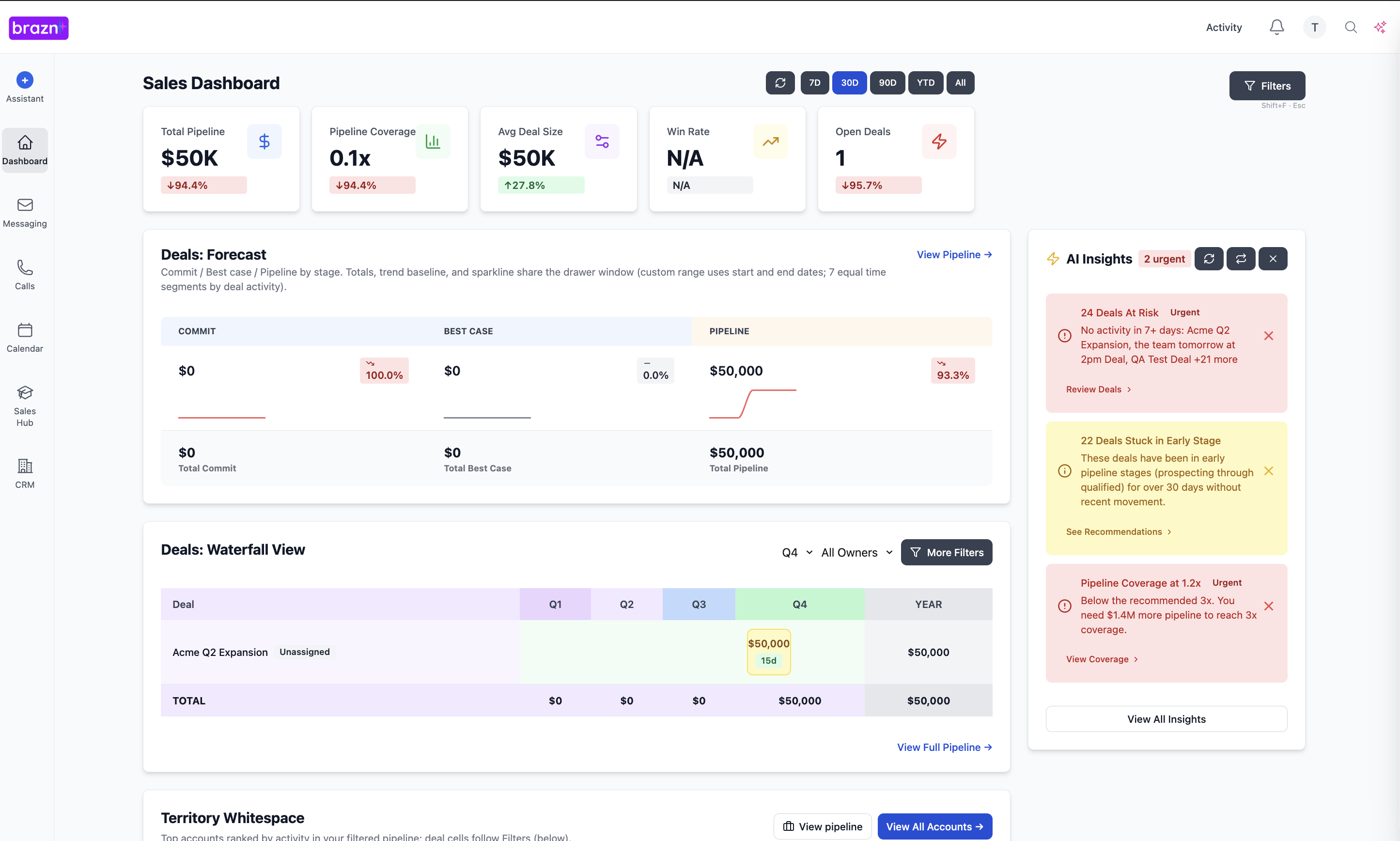
Brazn generates automated pipeline health reports, deal risk summaries, MEDDPICC coverage analyses, and rep coaching reports from call and CRM data — delivered to managers and CROs on a defined schedule without manual compilation. The qualification-aware data in these reports reflects the objective state of every deal, not the rep's last update.
---
####
Book a demo to see how Brazn AI fits into your sales stack.

About the Author

Alex Margarit, Sales AI Expert, SaaS Sales Leader, BMC, ServiceNow, Docusign — 25+ years in SaaS sales.