
AI-Powered Pipeline Reviews: How SaaS Teams Catch Slipping Deals Early
Every sales manager has a version of this story.
It's the last week of the quarter. You've got three deals in Commit that you've been counting on since week six. You open Salesforce. The close dates are unchanged. The stages are unchanged. The rep tells you they're "tracking well."
Then Monday of close week arrives. One deal pushes to next quarter because the Economic Buyer just went on leave. Another stalls because nobody mapped the InfoSec review into the timeline. The third goes quiet entirely — the champion, it turns out, left the company two weeks ago and nobody updated the record.
Three Commit deals. Zero closed. A quarter that looked fine right up until it wasn't.
This is not a forecasting problem. It's a visibility problem. According to Gong's State of Revenue Growth 2025 report, the majority of deal slippage is predictable from signals that appear weeks before the miss. And AI fixes it — not at the end of the quarter, but at the moment the signal first appears.
Why Traditional Pipeline Reviews Miss the Early Warning Signs
Here's the fundamental flaw in how most SaaS teams run pipeline reviews.
They're backwards-looking. The manager opens Salesforce, looks at deal stages and close dates, asks the rep “how’s this one going?” Salesforce's State of Sales research shows that only 46% of sales reps are currently hitting quota — in part because pipeline visibility tools show stage, not signal. and the rep gives a narrative that is equal parts fact, optimism, and unconscious wishful thinking. The manager probes a bit, nods along, and moves to the next deal.
Nothing in that process is designed to catch what's actually going wrong underneath the surface. Because the signals that predict a slipping deal — a champion going quiet, an EB who's never been directly engaged, a paper process nobody's mapped, a competitor that got mentioned twice on the last call — those signals live in transcripts, email threads, and activity logs. They don't live in the Stage field.
Traditional pipeline reviews look at the Stage field.
AI pipeline reviews look at everything else.
The Signals That Actually Predict a Slipping Deal
Before we get into the workflow, let's talk about what early warning actually looks like. These are the signals Brazn monitors continuously across every open deal:
Champion engagement drop-offYour champion was replying within hours three weeks ago. Now it's been eight days since they opened an email. Nothing has changed in the CRM — the deal is still at Stage 4. But something has changed internally at the account. Maybe they got a new boss. Maybe a competing priority landed. Maybe they're losing the internal battle. This signal, caught early, is recoverable. Caught in week twelve, it's a push.
Economic Buyer never directly engagedThe deal has been running for six weeks. The rep knows who the EB is. They've never spoken to them directly. The champion has been promising to "set up a call." This deal has a structural problem that will not resolve itself. Every week it doesn't get fixed, the close probability drops.
Paper process undocumented at late stageThe deal is at Verbal Agreement. Close date is end of month. Nobody has asked about InfoSec review, procurement timelines, or legal sign-off requirements. In enterprise SaaS, this is where deals go to die — not because the buyer changed their mind, but because the AE didn't know there was a six-week procurement process sitting between verbal and signature.
Competitor mentioned but not addressedGong picked up the word "evaluating" and "Gong" (or whichever competitor) on the last two calls. The CRM Competition field says "none identified." This is either a data quality issue or a rep who's hoping the competition disappears if they don't acknowledge it. Either way, it needs addressing.
Stale deal with no meaningful activityLast logged activity: "Email sent." Nine days ago. No reply recorded. No next step set. No follow-up call booked. The deal hasn't moved. The rep is busy. Nobody has flagged it. Without intervention, this one goes cold and eventually gets quietly pushed to next quarter.
Metrics never validated by the prospectThe rep can articulate the ROI. The prospect has never repeated it back in their own numbers. This deal is not qualified on Metrics — which means the business case hasn't landed, which means you don't actually have a champion who can sell internally on your behalf.
How AI-Powered Pipeline Reviews Work
Here's the workflow that replaces the backwards-looking status update.
Before the Review: Automated Deal Health Scoring
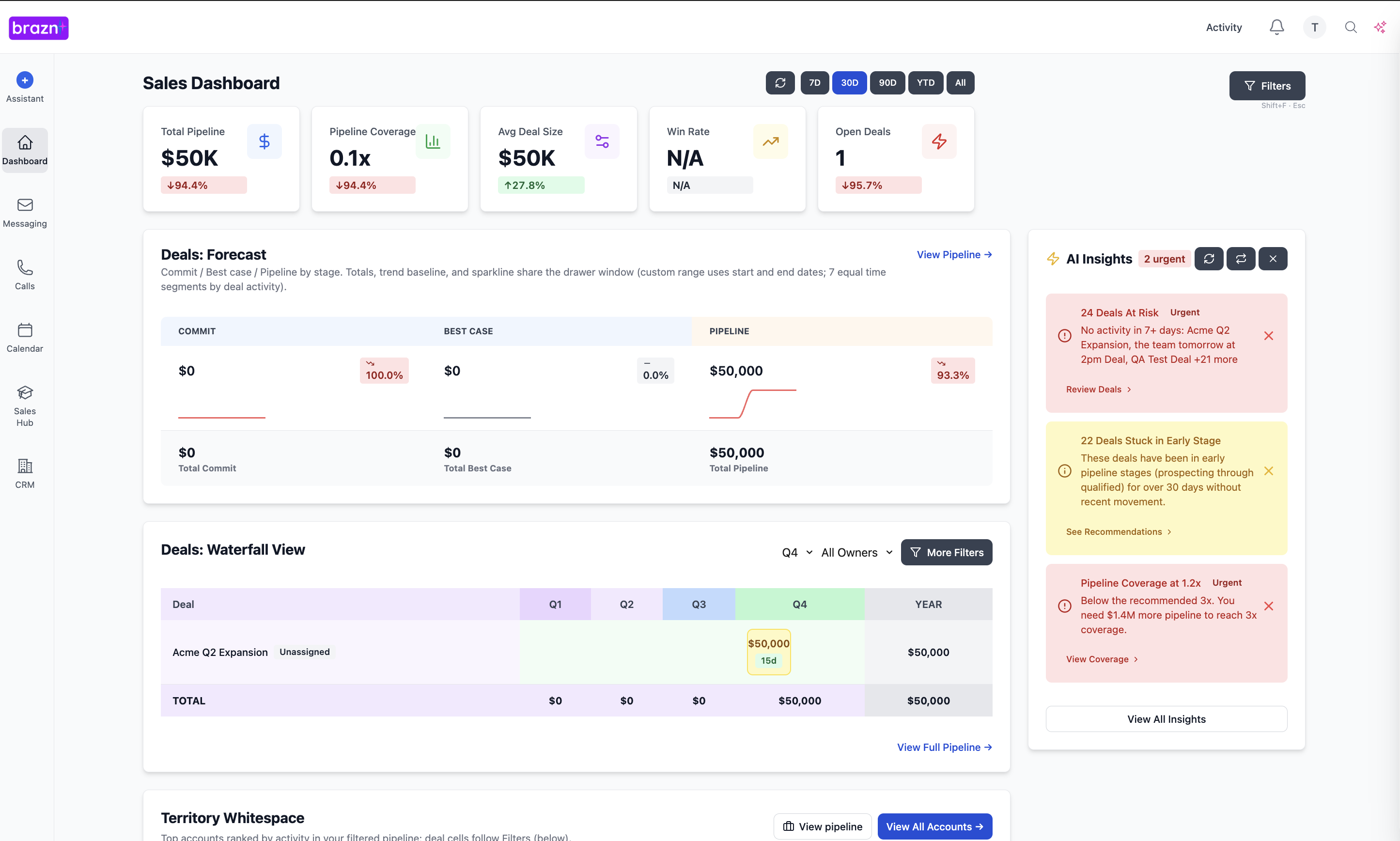
Brazn monitors every open deal continuously. Before the pipeline review starts, it generates a deal health brief for each opportunity — not based on what stage the rep put it in, but based on what's actually happening across the stack.
Each deal gets scored across MEDDPICC coverage, champion engagement, activity recency, competitive exposure, and forecast risk. Deals are flagged as Healthy, At Risk, or Critical — with specific reasons and suggested next actions for each flag.
The manager walks into the review already knowing which deals need attention. Not "let me look at the dashboard" — already knowing, because Brazn has put the brief in front of them before they opened their laptop.
During the Review: Signal-Driven Conversations
Instead of "how's this deal going?" the manager opens with "Brazn has flagged three risks on this deal — let's work through them."
For each flagged deal, the conversation is structured around the specific signal:
- Champion gone quiet: "Last engagement was 11 days ago. What's your read on what's happening internally? What's the plan to re-engage before end of week?"
- EB never engaged: "We're six weeks in and you haven't spoken to the CFO directly. What's blocking that? Do you need me to come on that call?"
- Paper process undocumented: "Deal is at Verbal, close date is 28th. Have you mapped the procurement and InfoSec path? What needs to happen between now and signature?"
These are specific, actionable conversations. Not "tell me about this deal." Not "do you still think it closes this quarter?" The AI has done the diagnostic work. The review is about the treatment plan.
After the Review: Actions Logged, Risks Tracked
Every next action agreed in the review gets logged back to Salesforce automatically. Brazn tracks whether those actions are taken — if a rep was supposed to book an EB intro call by Thursday and Thursday arrives without a meeting booked, it flags the gap.
This is the accountability layer that most pipeline review processes are missing. The actions don't evaporate when the call ends. They're tracked, reminded, and escalated if they slip.
What Changes When You Do This Every Week
The compound effect is significant — and it shows up in metrics that matter.
Forecast accuracy improves. When deal stage reflects actual qualification evidence rather than rep optimism, the gap between forecast and outcome shrinks. Gong's research shows AI-assisted teams generate 77% more revenue per rep, with forecast accuracy as one of the primary drivers. Managers stop being surprised by pushes because the signal was visible weeks earlier. Deal slippage reduces. Early warning systems only work if you act on the warnings early. AI-powered reviews surface risks at the moment they appear — which is when recovery is still possible. By the time a deal shows up as a problem in a traditional review, you've often lost two or three weeks of recovery runway. Coaching gets sharper. When the manager doesn't need to spend the review extracting status information, they can spend it on the actual coaching conversation — why the champion has gone quiet, how to get the EB engaged, what the competitive positioning strategy should be. That's the conversation that makes reps better. The status update doesn't. Rep confidence goes up. Counterintuitively, reps respond well to AI-flagged deal risks — because it removes the awkwardness of surfacing bad news manually. The AI flagged it. The manager asked about it. The rep didn't have to volunteer that a deal was in trouble. The conversation becomes problem-solving rather than confession.The Manager's New Job Description
In an AI-powered pipeline review, the manager's job changes.
They're no longer a detective extracting information from a rep who may or may not have it. They're a strategist working with a rep who has already been briefed on the risks, armed with the context, and pointed at the recovery actions.
That's a much better use of everyone's time. And it produces much better outcomes for the pipeline.
Brazn handles the data. The manager handles the coaching. The rep handles the selling. Everyone does the job they're actually good at.
---
Want to see what AI-powered pipeline reviews look like for your team?Brazn surfaces deal risks before they become missed quarters.
---
####
Book a demo to see how Brazn AI fits into your sales stack.

About the Author

Alex Margarit, Sales AI Expert, SaaS Sales Leader, BMC, ServiceNow, Docusign — 25+ years in SaaS sales.