
MEDDPICC Deal Reviews with AI: 5 Patterns SaaS Revenue Teams Miss
Most SaaS revenue teams that use MEDDPICC don't have a methodology problem. They have a consistency problem. MEDDPICC is the most rigorous qualification framework in enterprise SaaS — but according to Salesforce's State of Sales report, reps spend only 28% of their week actually selling, leaving little bandwidth for consistent CRM maintenance. Gong research shows that 77% of revenue comes from just 25% of the pipeline — making rigorous qualification of the right deals the single highest-leverage action a revenue team can take.
The framework is solid. The training has been done. Every AE can recite the eight components. But when you look at the actual CRM data before a pipeline review — the Metrics fields are vague, the Economic Buyer is named but not engaged, the Paper Process hasn't been discussed on a £200K deal that's supposed to close in 6 weeks.
The gap isn't knowledge. It's bandwidth. Maintaining MEDDPICC coverage across 15–20 open opportunities, in real time, while running discovery calls, writing follow-ups, and updating Salesforce, is more than any rep can do manually without something slipping.
AI-assisted deal reviews change this — not by replacing the manager's judgement, but by doing the pattern recognition work continuously, across every deal, before the review even starts. Here are the 5 most common patterns that AI catches that traditional deal reviews miss.
---
Pattern 1: The Phantom Economic Buyer
What it looks like: The EB is named in Salesforce. It says "CFO — Sarah Chen" in the deal record. The AE is confident. The deal is forecast as Commit. What's actually happening: Sarah was mentioned once by the Champion in week 2. She has never appeared in an email thread. She has never been on a call. The AE has never spoken to her directly and has no confirmed view on whether she's actually the EB, whether she's aware of the evaluation, or whether she supports it. Why it gets missed: Deal reviews are time-pressured. The manager sees a name in the EB field and moves on. The AE believes the champion's word that "Sarah is supportive." Nobody has verified it. What AI catches: Brazn cross-references the named EB against email threads, call transcripts, and CRM activity. If the EB has had zero direct engagement in the last 30 days on a late-stage deal, it flags a Phantom EB risk — and surfaces a suggested multi-threading action: a personalised outreach from the AE directly to Sarah, or a request through the champion to set up a formal executive alignment call. The fix: Get the EB on a call before the deal enters late stage. Even a 15-minute executive briefing confirms alignment and creates a direct communication channel that doesn't rely on the champion as the sole conduit.---
Pattern 2: Metrics That Aren't Actually Metrics
What it looks like: The Metrics field in Salesforce says: "Wants to improve sales efficiency and reduce time on admin." The deal is £150K ARR. It's in Stage 4. What's actually happening: That's not a metric. It's a sentiment. There's no baseline, no quantified current state, no agreed success measure, and no business case that could survive scrutiny from a CFO. Why it gets missed: Reps fill in the Metrics field because the CRM requires it. Managers see text in the field and assume it's been qualified. The review moves on. The deal slips in Q4 because there was never a business case strong enough to justify the spend. What AI catches: Brazn analyses Metrics field content for specificity markers — numbers, percentages, time periods, cost-of-inaction language. Entries that are qualitative rather than quantitative get flagged, and Brazn generates a set of discovery questions to surface proper metrics on the next call: "What does your team currently spend per week on manual research? What would a 50% reduction in that time be worth in revenue capacity terms?" The fix: Metrics need to be bilateral — the rep's articulation of value AND the prospect's acknowledged number. Both need to be in the CRM. If only one exists, the deal isn't properly qualified on M.---
Pattern 3: A Champion Who Has Gone Quiet
What it looks like: The champion is named, they were enthusiastic in weeks 2–4, the deal is progressing. But it's now week 8 and the last inbound communication from the champion was 12 days ago. What's actually happening: Something has changed. Either the champion's internal priority has shifted, they've hit internal resistance and don't want to deliver bad news, a competing project has emerged, or they're waiting for something the AE hasn't provided. Silence from a previously engaged champion is one of the most reliable early signals that a deal is at risk. Why it gets missed: Reps are busy. They notice the silence but attribute it to the champion being busy too. The deal stays in forecast. The manager doesn't see engagement cadence data in the review — they see the deal stage and the close date. What AI catches: Brazn tracks champion engagement velocity — how frequently the champion is initiating contact vs. just responding, response time trends, and whether they've introduced any new stakeholders recently (a sign of internal momentum) or gone quiet (a sign of stalling). A sharp drop in inbound engagement triggers a Champion at Risk flag, with a suggested re-engagement sequence: a value-forward check-in referencing a relevant trigger, or a request to reconnect on decision timeline. The fix: A disengaged champion needs to be re-engaged or replaced. Multi-threading to find a secondary champion is the right move before the deal reaches a point where the champion's silence becomes a rejection.---
Pattern 4: Decision Process Mapped to One Version of Events
What it looks like: The Decision Process field says: "VP of Sales signs off, procurement reviews, legal takes 2 weeks, target close end of Q2." Clean. Documented. The deal is on the forecast. What's actually happening: That's the champion's version of the process, given in week 3, based on how a previous purchase went. It may not reflect reality for a deal of this size, for this vendor category, or under the current procurement environment. Deals die in paper process all the time — not because the buyer changed their mind, but because the AE didn't know about the security review, the InfoSec questionnaire, the board-level approval threshold, or the 6-week legal SLA that kicks in above £100K. Why it gets missed: The Decision Process looks documented. It passed the review. Nobody asked "and is that the same process for a SaaS contract of this value with a new vendor?" What AI catches: Brazn flags Decision Process entries that were last updated in early stages and haven't been re-verified as the deal has progressed. It also identifies deals where the stated close date and the documented paper process steps don't leave enough time — a £180K deal with a 2-week legal review that's supposed to close in 10 days is flagged as a Timeline Risk, with a prompt for the AE to run a formal paper process call immediately. The fix: Paper process should be re-confirmed at every stage gate, not just documented once. Run a dedicated "path to close" call 6–8 weeks before the target date and map every step with the champion, including who owns each one and what the realistic timelines are.---
Pattern 5: Competition Acknowledged but Not Addressed
What it looks like: The Competition field says "Gong, Apollo." The AE knows the landscape. The deal review moves on. What's actually happening: Knowing who the competition is and having a differentiated response to them are two very different things. If the AE hasn't explicitly positioned Brazn's agentic execution model against Gong's conversation intelligence positioning — and documented that the prospect understands the difference — then the deal is vulnerable to a last-minute competitive pivot that the AE has no prepared response to. Why it gets missed: Competition feels like a product knowledge question, not a deal review question. Managers assume reps know their competitive positioning. But knowing the positioning and having delivered it clearly to the right stakeholders in the deal are not the same thing. What AI catches: Brazn analyses call transcripts and email threads for competitive mentions and cross-references them against the Competition field. If a competitor has been named by the prospect but there's no documented competitive response in the deal record — no differentiation discussed, no "why us" documented — it flags a Competitive Blind Spot and surfaces the relevant positioning for the AE to deploy on their next touchpoint. The fix: Competitive positioning needs to be delivered and confirmed, not just known. Ask directly: "Have you looked at [competitor]? Here's how we're different, and here's why that matters for your specific use case." Document the response. If the prospect can't articulate why Brazn vs. the alternative, the deal isn't positioned — it's just active.---
What changes when AI runs the pattern recognition
The five patterns above aren't obscure edge cases. They appear in almost every pipeline at some stage of most deals. The problem isn't that managers don't know to look for them — it's that reviewing 8 components across 20+ deals in a 60-minute pipeline call, with a rep presenting optimistically, makes it structurally impossible to catch all of them consistently.
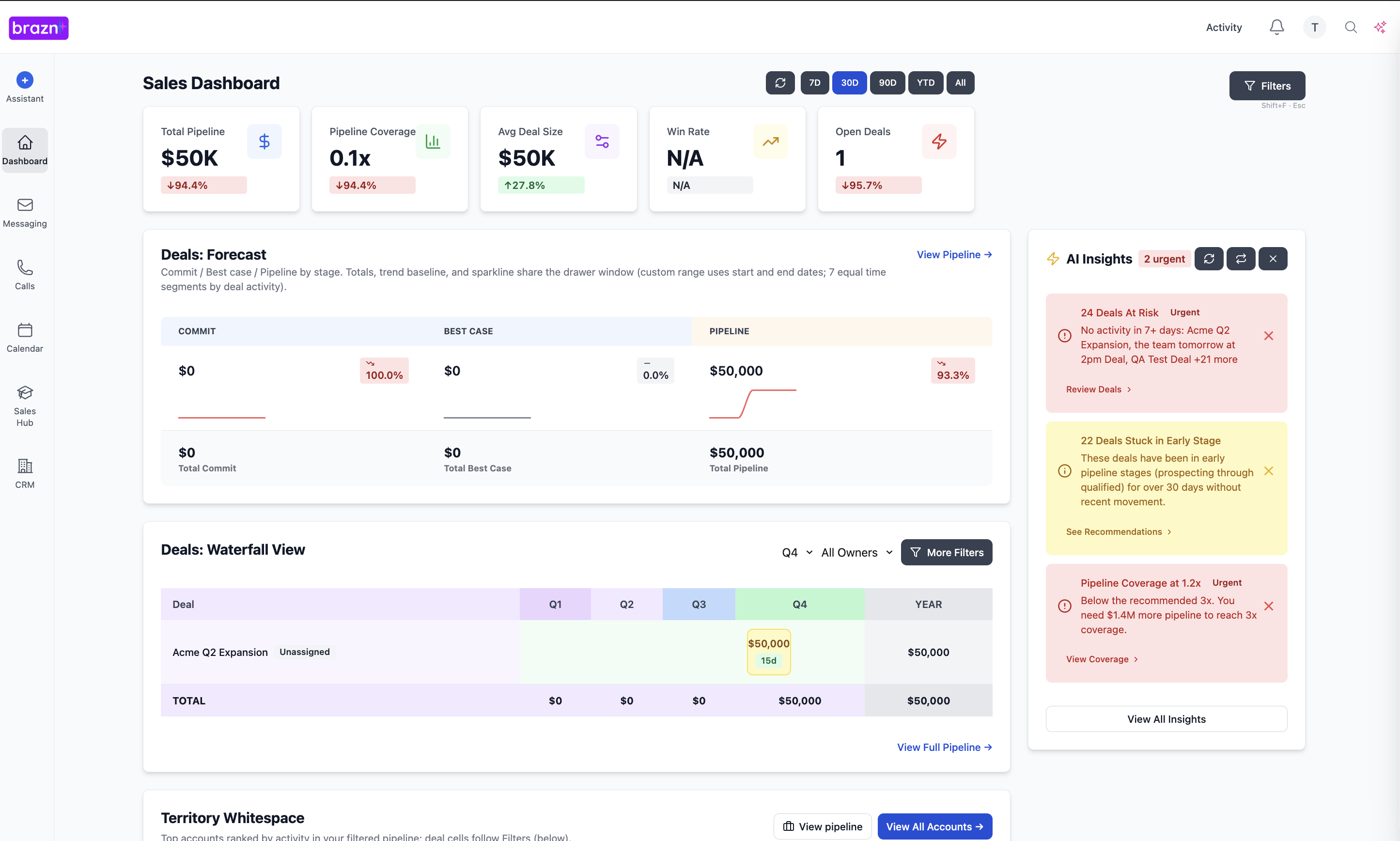
AI-assisted deal reviews change the dynamic by doing the pattern recognition before the call starts. When Brazn analyses every deal against these signals continuously — not just weekly, not just when the manager has time — the review becomes a conversation about what to do, not a hunt for what's missing.
Managers spend less time asking "what's the status?" and more time asking "here's what we're going to do about this." Reps spend less time defending their pipeline and more time executing the actions that actually move deals forward.
That's not a better deal review process. It's a fundamentally different one.
####
Book a demo to see how Brazn AI fits into your sales stack.

About the Author

Alex Margarit, Sales AI Expert, SaaS Sales Leader, BMC, ServiceNow, Docusign — 25+ years in SaaS sales.