AI for Sales Coaching: How to Give Reps Better Feedback
The biggest constraint in most sales organisations isn't territory, product, or even pipeline. It's coaching.
Frontline managers carry 6–10 reps, run their own pipeline reviews, join key customer calls, and still somehow need to give each rep meaningful feedback on a weekly basis. In practice, most coaching is reactive (what went wrong on that call last Tuesday?), inconsistent, and hard to scale.
AI changes the inputs and the pace of that cycle — without replacing the manager.
---
Why Most Sales Coaching Falls Short
- It's based on memory rather than data ("I think you rushed the pricing conversation last week").
- It's frequency-constrained — a good 1:1 per week, if you're lucky.
- It focuses on outcomes (why did you lose?) rather than behaviours (what specifically happened in discovery that made this hard to win?).
- It's hard to be consistent across 8 reps with very different styles and deal types.
AI doesn't fix bad managers, but it gives good managers a much sharper toolkit.
---
1. Call Intelligence as a Coaching Foundation
Before AI coaching is possible, you need call data. Tools like Gong, Chorus, or Brazn record, transcribe, and analyse sales calls and pull out:
- Talk/listen ratio per rep.
- Topics mentioned and in what order.
- Questions asked and how prospects responded.
- Competitor mentions and how they were handled.
- Keywords from qualification frameworks (MEDDPICC terms, pricing, next steps, timeline).
A manager reviewing a 45-minute call manually takes 45 minutes. An AI summary takes 2 minutes and flags the moments worth discussing.
---
2. Pattern-Level Insights Across the Team
Individual call review catches single-rep issues. AI allows pattern recognition across the whole team:
- Which reps consistently struggle to establish pain before moving to the demo?
- Who never asks about economic buyer or decision process?
- Which reps have higher close rates when they use multi-threading vs when they don't?
These patterns are invisible without AI aggregating hundreds of calls. With it, managers can make structural coaching decisions instead of anecdotal ones.
---
3. Specific, Evidence-Based Feedback
"You need to do better discovery" is not a useful coaching note. What's useful is:
> "In Tuesday's call with [Company], you moved to the demo at minute 12 before you'd confirmed their current metrics or established who owns the budget decision. Here's the exact transcript segment. Compare it to how [Rep X] handled a similar situation last month."
>
AI enables this level of specificity at scale. The manager's role becomes curation and conversation, not investigation.
---
4. Rep-Level Coaching Scorecards
AI can generate a weekly scorecard for each rep based on call and pipeline data:
- Discovery quality score (are all pain elements present before stage 2?)
- Qualification completeness (what % of MEDDPICC criteria are populated and believable?)
- Activity consistency (calls, emails, meetings — week on week)
- Pipeline health (deal score trends, stage velocity, slippage rate)
A manager who walks into a 1:1 with this data can spend the full 30 minutes on growth coaching instead of admin hygiene.
---
5. AI-Assisted Role Play and Objection Prep
Some platforms now allow reps to practise with an AI buyer — a simulated prospect that responds to discovery questions, pushes back on pricing, and creates realistic objection scenarios.
This is especially useful for:
- Onboarding new reps faster.
- Preparing for a specific high-stakes meeting.
- Building muscle memory around a new methodology (MEDDPICC, Challenger, SPIN).
Reps who practise objection handling in a safe environment land better when it's real.
---
6. Coaching at Hire and Onboarding
AI can compress ramp time by:
- Identifying which of a new rep's calls look like winning patterns vs early red flags.
- Surfacing the specific moments in their calls where top reps diverge from how they're behaving.
- Creating a personalised improvement plan based on actual evidence, not assumptions.
Getting a new rep to quota in 4 months vs 7 months is a material revenue impact for a growth-stage SaaS org.
---
What Good AI-Powered Coaching Still Requires
AI provides signal. Managers provide meaning.
- A manager still needs to understand why a rep behaves the way they do (confidence, process, product knowledge, territory fit).
- AI can flag that a rep isn't asking about metrics, but it can't know if that's skill, habit, or fear.
- The human coaching conversation — the one where a rep commits to change — still happens between people.
The best AI-augmented coaching reduces the time managers spend gathering data to near-zero, so all of their coaching time is spent on actual development.
---
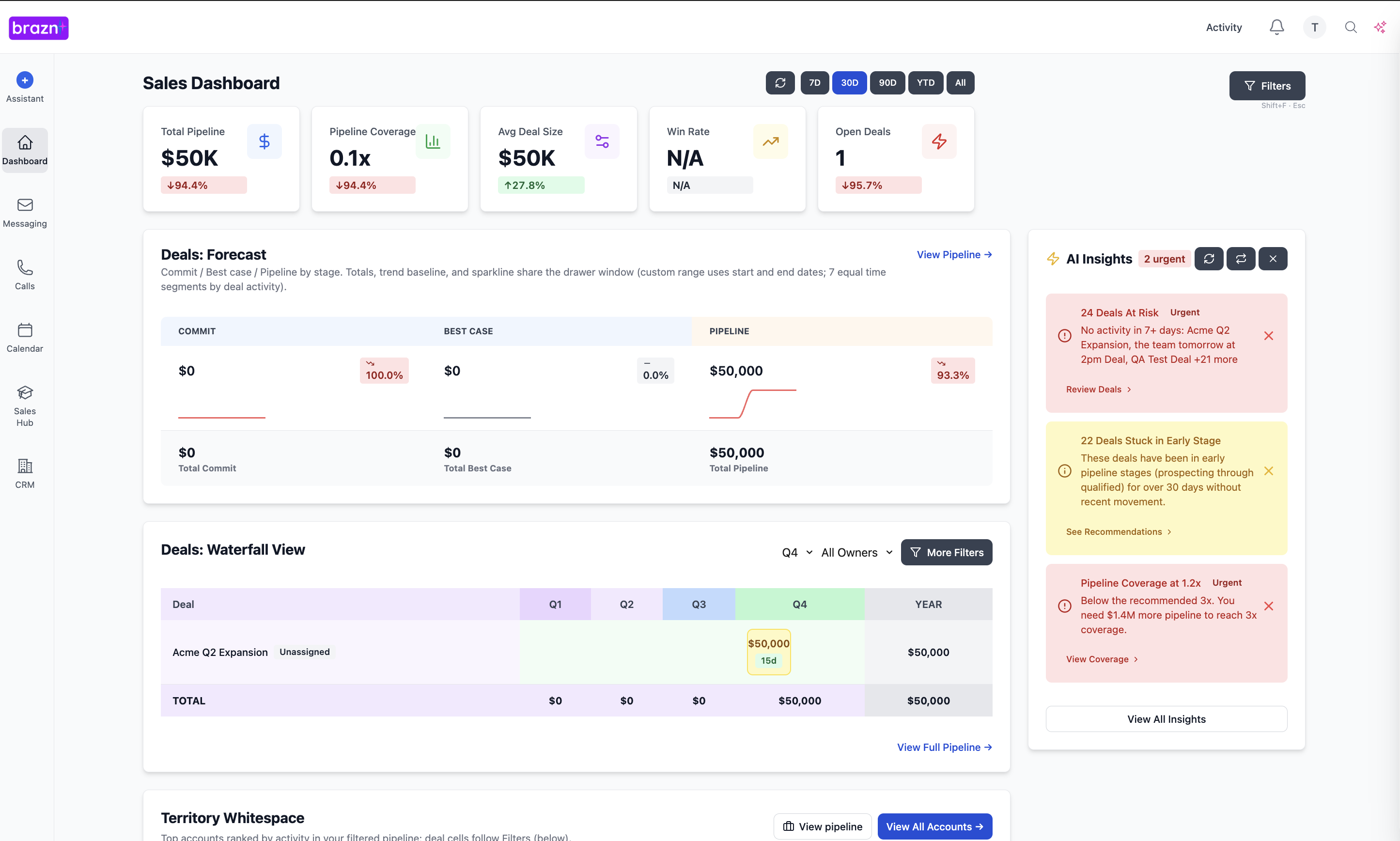
How Brazn Supports Frontline Coaching
Brazn surfaces deal-level and rep-level signals in one place:
- MEDDPICC completeness per deal and per rep.
- Deal score trends that flag risk before pipeline reviews.
- Call and activity patterns that show who's working the right accounts in the right way.
The manager's weekly routine shifts from "what's in the pipeline?" to "where do I coach and where do I get out of the way?"
---
####
Book a demo to see how Brazn AI fits into your sales stack.

About the Author
Alex Margarit, Sales AI Expert, SaaS Sales Leader, BMC, ServiceNow, Docusign — 25+ years in SaaS sales.