
What Is a Sales Operating Cadence? (And How It’s Different from a Sales Cadence)
A sales operating cadence is the structured rhythm of recurring meetings, reviews, and checkpoints that a sales organisation uses to manage performance, communicate priorities, align on strategy, and drive accountability across the team. It is the operational heartbeat of a sales organisation — the regular schedule of interactions between individuals, teams, and leadership that determines how information flows, how decisions are made, how performance is monitored, and how coaching happens consistently rather than sporadically.
---
Why Operating Cadence Matters
Without a defined operating cadence, a sales organisation operates reactively. Managers deal with escalations. Reviews happen when something goes wrong. Coaching occurs when a rep asks for it. Forecasting is a quarterly scramble. Performance issues surface at the end of the quarter when there is no time to address them.
A well-designed operating cadence reverses this. It creates a predictable structure in which problems surface early, performance is monitored continuously, coaching happens regularly, and the entire organisation is aligned on what matters this week, this month, and this quarter. The cadence doesn't eliminate surprises — but it dramatically reduces the number of surprises that arrive too late to act on.
---
The Core Components of a Sales Operating Cadence
A full sales operating cadence operates at multiple time horizons simultaneously:
Daily cadence — rep activity.The daily rhythm of a rep's working life: prospecting blocks, call blocks, CRM updates, follow-up execution, and cadence step completion. Not a meeting — a personal operating structure that keeps reps focused on the activities that generate pipeline and advance deals. Teams that define and coach the daily rhythm outperform those that leave it entirely to individual rep discretion.
Weekly cadence — team and individual alignment.- 1:1 rep-to-manager. 30–45 minutes per rep, focused on deal inspection, coaching, pipeline health, and weekly priorities. The most important recurring meeting in a sales manager's calendar. When skipped or run as a status update, performance suffers.
- Team standup or pipeline review. 15–30 minutes to align the team on weekly priorities, surface wins and blockers, and share relevant market or competitive updates.
- Forecast call. A structured review of the team's committed pipeline for the current period — deals in forecast, deals at risk, and the specific actions needed to protect the number.
Monthly cadence — performance and pipeline review.- Monthly business review (MBR). A deeper review of team performance against targets — pipeline generation, conversion rates, win/loss analysis, rep-level attainment, and the adjustments needed for the following month. More strategic than the weekly forecast call.
- Pipeline health review. A structured assessment of the full pipeline — not just current-quarter deals but the entire opportunity set — to identify coverage gaps, stale deals, and the actions required to build adequate pipeline for the following quarter.
Quarterly cadence — strategy and planning.- Quarterly Business Review (QBR). A comprehensive review of the quarter's performance — what worked, what didn't, what changed in the market — and the strategic priorities, targets, and resource allocation for the coming quarter.
- Territory and quota review. Assessment of territory fairness, quota attainability, and headcount adequacy for the coming quarter based on the capacity model.
- Enablement planning. What skills gaps have emerged over the quarter? What training, content, or tools investments are required for the next period?
---
The Operating Cadence Across Seniority Levels
A sales operating cadence is not a single meeting schedule — it is a nested structure of rhythms that operate at different levels of the organisation:
| Level | Daily | Weekly | Monthly | Quarterly |
| --- | --- | --- | --- | --- |
| Rep | Prospecting, follow-up, CRM updates | 1:1 with manager, team standup | MBR with manager | QBR, territory review |
| Manager | Pipeline monitoring, deal coaching | 1:1s with reps, forecast call | MBR with director | QBR, headcount planning |
| Director | Team performance monitoring | Forecast roll-up, leadership alignment | MBR with VP | QBR, strategy review |
| VP / CRO | Executive reporting, deal escalations | Executive forecast call | Board/investor update | Annual planning, org design |
Each level of the cadence feeds the next. The rep's 1:1 surfaces deal risks that inform the manager's forecast call. The manager's forecast call informs the director's pipeline roll-up. The roll-up informs the VP's executive forecast. When one level of the cadence breaks down, the accuracy and quality of every level above it degrades.
---
Common Operating Cadence Failures
Meetings without structure. A weekly pipeline review that runs as a freeform conversation is not a cadence component — it is a meeting that consumes time without producing output. Every cadence meeting should have a defined agenda, specific inputs that are prepared in advance, and specific outputs (decisions, actions, updates) that result from it. 1:1s that become status updates. The most common failure in the weekly cadence. When a manager's 1:1 with a rep is consumed by "what's the status of this deal?" rather than "what's your strategy on this deal and how can I help?", it stops being a coaching meeting and starts being a reporting meeting. The rep gets no development value and the manager gets information they could have found in the CRM. Skipping cadence when the quarter is busy. The instinct to cancel reviews and 1:1s in the final weeks of a quarter — when there is "real selling to do" — is exactly backwards. The final weeks of a quarter are when the cadence matters most: deals are at critical junctures, forecast accuracy is being tested, and the coaching moments that determine whether the quarter closes cleanly are happening right now. Over-meeting. A cadence with too many meetings creates its own dysfunction. Reps who are spending 30–40% of their week in internal meetings are not spending that time selling. Every meeting in the cadence should be evaluated regularly: does this produce value commensurate with the time it consumes?---
How AI Enhances Operating Cadence Quality
The quality of every cadence meeting depends on the quality of the information going into it. A 1:1 powered by real-time deal intelligence — MEDDPICC gaps surfaced automatically, Champion engagement scored, close date consistency checked — is a fundamentally different meeting from one where the manager is relying on the rep's verbal summary of what they remember about their deals.
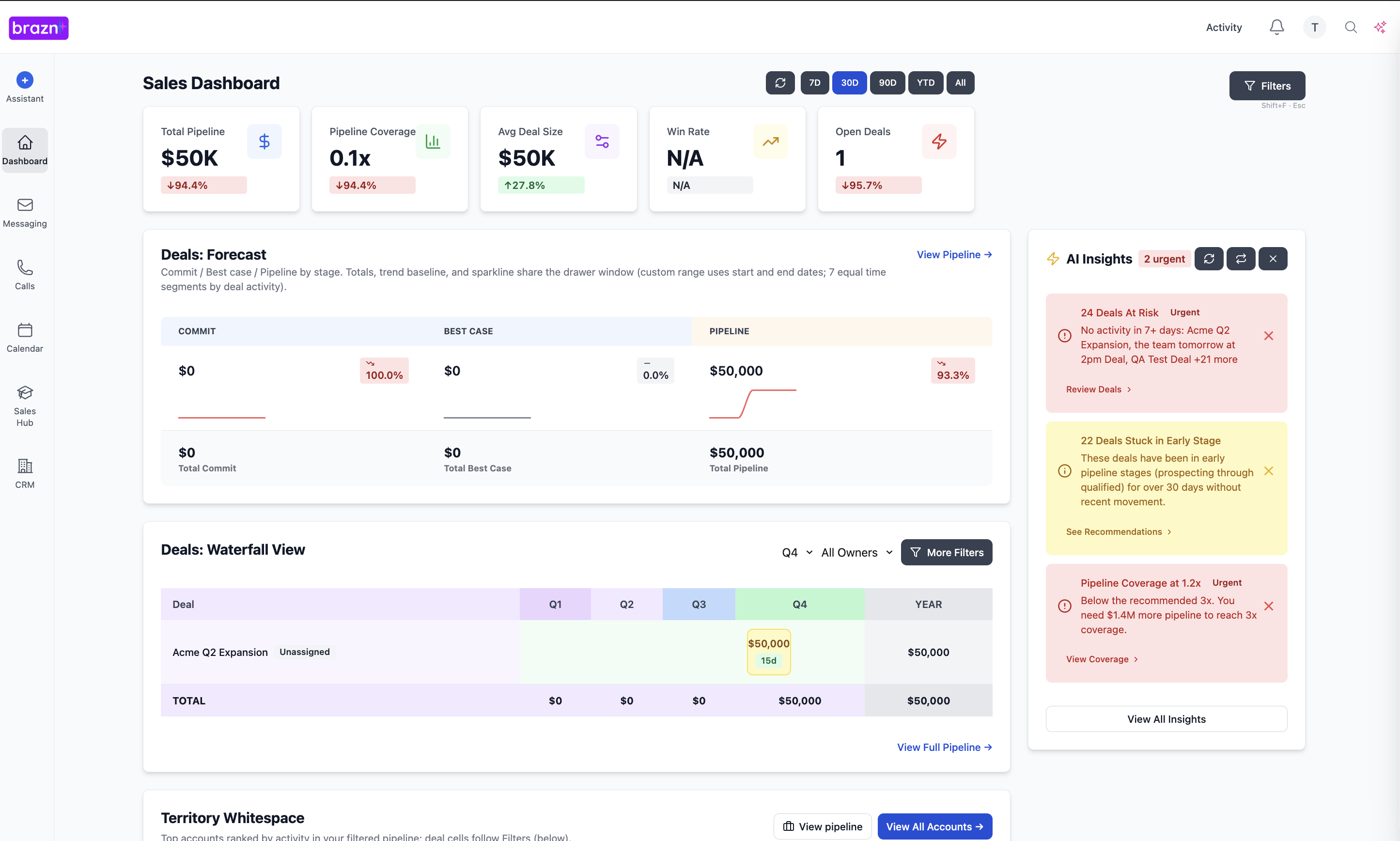
Brazn prepares every cadence meeting automatically — generating deal inspection summaries before 1:1s, pipeline health reports before forecast calls, and performance analytics before MBRs. Managers spend their cadence time on strategy, coaching, and decisions — not on gathering the information those conversations depend on.
This raises the quality of the entire operating cadence without adding to the administrative burden of the people running it.
---
The Bottom Line
A sales operating cadence is the operational infrastructure of a high-performing sales organisation. Built well — with the right meetings at the right frequency, with structure and preparation, and with a genuine commitment to coaching as well as reporting — it creates the conditions for consistent execution, early risk identification, and continuous team development. The organisations that operate with cadence discipline outperform those that don't — not because of individual talent, but because the system they operate within makes excellence more likely and problems more visible.
---
See How Brazn Prepares Every Cadence Meeting Automatically
Brazn surfaces deal intelligence, MEDDPICC gaps, and pipeline health signals before every 1:1, forecast call, and pipeline review — so your cadence drives performance, not just conversation.
---
Book a demo to see how Brazn AI fits into your sales stack.

About the Author

Alex Margarit, Sales AI Expert, SaaS Sales Leader, BMC, ServiceNow, Docusign — 25+ years in SaaS sales.