

What Is a Multi-Threaded Deal?
A multi-threaded deal is a sales opportunity in which the selling team has built active relationships with multiple stakeholders inside the buying organisation — not just a single contact. Multi-threading is the deliberate practice of ensuring that no single relationship, conversation, or piece of internal advocacy is carrying the weight of an entire deal. In complex B2B sales, it is one of the most reliable predictors of whether a deal closes.
Why Single-Threading Kills Deals
Most reps, left to their own preferences, will single-thread. They find one person who is responsive, engaged, and easy to talk to — and they build the deal around that person. This feels like progress. It is actually a concentration of risk so severe that it functions as a structural deal flaw.
Single-threaded deals die in four specific ways:
The contact leaves. In today's SaaS market, the average tenure of a VP of Sales is under 18 months. When your main contact changes roles, goes on leave, or is let go, a single-threaded deal effectively starts over. A multi-threaded deal survives personnel changes because the relationship exists with the organisation, not just one person in it. The contact lacks authority. Many reps single-thread to a manager-level champion who has enthusiasm but no budget authority. The deal stalls permanently because the rep has no direct access to the Economic Buyer who actually controls the decision. The contact is overruled internally. Even strong champions get overruled. If a VP of Engineering wants your product but the CFO hasn't been engaged, a budget review can kill the deal — and the rep had no visibility into the risk. The contact goes quiet. When a single-threaded contact disengages — stops responding, becomes less available, delays decisions — the rep has no fallback. There is no alternative access point into the account. The deal quietly dies.---
What Multi-Threading Looks Like in Practice
A multi-threaded deal has active, purposeful relationships across three dimensions:
Vertical threading — Engagement at multiple seniority levels. The champion is often a director or VP. But the rep also has a relationship with the Economic Buyer above them and understands the end-user perspective below. Vertical threading ensures the business case is sound at every layer of the buying organisation. Horizontal threading — Engagement across multiple functions. In a SaaS deal, the Champion might be in Sales Operations, but the Economic Buyer is in Finance, the primary user is in Sales, and the security/legal review sits with IT. A rep who has only talked to Sales Operations has threaded one department. A multi-threaded rep has relationships — or at least established contact — across all the relevant functions. Executive alignment — For larger deals, executive-to-executive relationships between the selling company and buying company significantly reduce deal risk. When the buyer's CRO has spoken to the selling company's CRO or CEO, the deal has a different quality of sponsorship than one managed entirely at the rep level.---
Multi-Threading and MEDDPICC
Multi-threading is not a standalone tactic — it is built into MEDDPICC. Several MEDDPICC elements directly depend on the rep having multiple relationships inside the account:
- Economic Buyer — You cannot qualify the EB without talking to them directly. A rep relying on their Champion to relay EB information is not qualified on this dimension.
- Champion — A real Champion has internal influence. To assess that influence accurately, the rep needs enough context about the organisation's dynamics to evaluate whether the Champion's advocacy will actually move things.
- Decision Process — Understanding who is involved in the decision, what their criteria are, and how they will vote requires access to multiple stakeholders. A champion's version of the decision process is filtered through their perspective. Multiple stakeholder conversations create a more accurate picture.
- Competition — Competitive intelligence is richer when it comes from multiple internal sources. Different stakeholders may have different preferences for competing vendors — knowing this early allows the rep to address it before it becomes a surprise in late-stage negotiation.
---
How to Build Threads Into a Deal
Multi-threading should start early — not as a rescue effort when the primary contact goes quiet, but as a deliberate opening strategy from the first discovery conversation.
Ask your Champion to make introductions. A Champion who is genuinely invested in the success of the project should be willing to introduce the rep to other relevant stakeholders. If they resist, that resistance is itself a signal worth examining. Go top-down in parallel. Use executive contacts, referrals, or outbound to establish independent access to senior stakeholders early. Executive relationships create deal momentum and reduce dependence on a single thread. Map the buying committee explicitly. Know who is involved, what their role in the decision is, and what their current disposition toward the deal is. A stakeholder map identifying supporters, neutrals, and blockers is a working document — not a one-time exercise. Create touchpoints for every key stakeholder. Executive briefings, product workshops, ROI reviews — each is an opportunity to build an independent relationship with a stakeholder who would otherwise only know the rep through the Champion's description.---
How AI Supports Multi-Threading
Multi-threading is hard to sustain manually across a large pipeline. Reps forget to follow up with secondary stakeholders. Threads go cold. Contact changes go unnoticed.
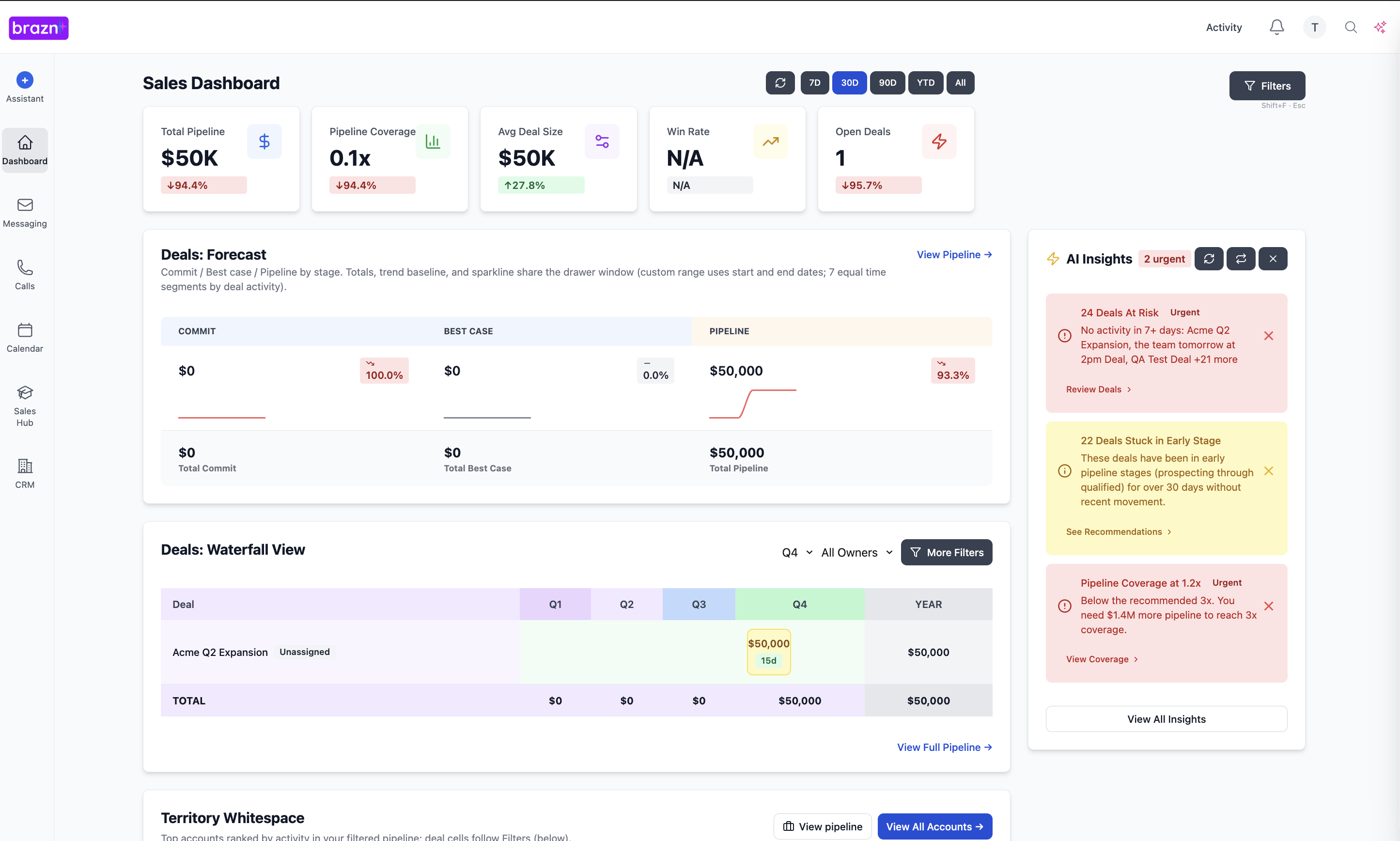
AI platforms like Brazn track multi-thread coverage as a dimension of deal health — monitoring which stakeholders have been contacted, when they last engaged, and whether key roles like the Economic Buyer have been touched recently. When a deal is single-threaded or when a key thread has gone cold, the system flags it with a specific recommended action.
This makes multi-threading a managed discipline rather than an individual rep habit — which means it actually happens consistently across the team, not just for the reps who are naturally good at stakeholder navigation.
---
The Bottom Line
In enterprise SaaS sales, a single-threaded deal is a fragile deal. It will close some of the time — when things go perfectly, when the contact stays, when no one internal pushes back. But it will fail more often than it should, and the failure will feel unexpected because the rep never saw the risk coming.
The reps who consistently close large deals build wide in every account from day one — treating stakeholder coverage as a core part of their craft, not an afterthought.
---
See AI-Powered Deal Coverage Tracking in Action
Brazn monitors stakeholder engagement across every deal, flags single-threaded risk, and surfaces specific actions to build coverage before it becomes a problem.
---
Book a demo to see how Brazn AI fits into your sales stack.

About the Author

Alex Margarit, Sales AI Expert, SaaS Sales Leader, BMC, ServiceNow, Docusign — 25+ years in SaaS sales.