
What Is a Sales Playbook?
A sales playbook is a documented, practical guide that equips a sales team with the frameworks, processes, messaging, tools, and plays they need to sell effectively and consistently. It is the single source of truth for how the team sells — from how to qualify an opportunity to how to handle a competitor objection to what the ideal discovery call looks like. A playbook does for sales what a technical specification does for engineering: it captures institutional knowledge, creates consistency across the team, and gives new reps a structured on-ramp to full productivity rather than leaving them to reinvent the wheel.
---
What a Sales Playbook Contains
A comprehensive SaaS sales playbook typically covers six domains:
1. ICP and target account profile.Who the team sells to — the ideal customer profile defined by firmographics (company size, industry, growth stage, tech stack), technographics (tools in use that indicate fit or urgency), and behavioural signals (triggers that indicate a prospect is ready to buy). A playbook that is vague on ICP produces outbound that reaches the wrong people, demos that don't convert, and pipeline that doesn't close.
2. Sales methodology and qualification framework.How the team qualifies and advances deals. For most enterprise SaaS teams, this means MEDDPICC — with clear definitions of each element, example discovery questions for each, and guidance on how to assess whether a deal is qualified at each stage gate. The playbook makes the methodology operational rather than theoretical.
3. Discovery framework.The questions, structure, and objectives of a great discovery call. What the rep is trying to learn, how they sequence the conversation, how they quantify pain, and how they connect the prospect's situation to the value proposition. A strong discovery framework is one of the highest-leverage sections of any playbook — the quality of every downstream conversation depends on the quality of the discovery.
4. Messaging and positioning.The core narrative — how to articulate the problem, the solution, the differentiated value, and the business outcomes in language that resonates with each buyer persona. The elevator pitch. The executive value narrative. The technical buyer message. The ROI framing. Battle cards and kill sheets are typically linked here.
5. Objection handling.A library of the most common objections the team faces — by persona, by deal stage, by competitor — with specific, tested responses. "It's too expensive." "We already use [competitor]." "We don't have budget until next year." "We need to involve IT before we can go further." Every objection the team hears more than once should be in the playbook with a clear response.
6. Plays — situational guides for specific scenarios.Pre-defined action sequences for specific sales situations: how to re-engage a stalled deal, how to multi-thread into an account where the rep only has one contact, how to handle a competitive displacement, how to navigate a security review, how to run an executive briefing. Plays are the playbook's most tactically useful section — they tell reps exactly what to do when a specific situation arises, rather than relying on experience or instinct.
---
Playbook vs Sales Methodology vs Sales Process
| Concept | What It Is | Example |
| --- | --- | --- |
| Sales Methodology | The intellectual framework for selling | MEDDPICC, Challenger Sale |
| Sales Process | The defined stages a deal moves through | Discovery → Demo → Proposal → Close |
| Sales Playbook | The documented, practical guide for executing both | Everything the rep needs to run the methodology within the process |
A methodology without a playbook is a framework that reps know in training and forget in the field. A playbook operationalises the methodology — turning abstract principles into specific behaviours, questions, and actions that reps can execute in real deals.
---
The Living Playbook: Why Static Playbooks Fail
Most playbooks are built once and never updated. They are created during a GTM buildout, shared as a 60-page Google Doc, used enthusiastically for the first few months, and then quietly ignored as the market, the product, and the competitive landscape evolve past them.
A playbook that is more than twelve months old without a structured review is almost certainly outdated in at least three critical areas: competitor positioning, objection responses, and ICP definition. Markets move. Products evolve. New competitors emerge. The playbook needs to evolve with them.
The most effective sales organisations treat the playbook as a living document — maintained by sales enablement in collaboration with the reps who are closest to what is actually working in deals, updated on a quarterly cadence, and versioned so the team always knows what has changed and why.
---
How AI Is Changing the Playbook Model
The traditional playbook is a static reference document. AI is changing this by making playbook intelligence dynamic and contextual — surfacing the right play at the right moment in the right deal, rather than requiring reps to remember which section of a document to consult.
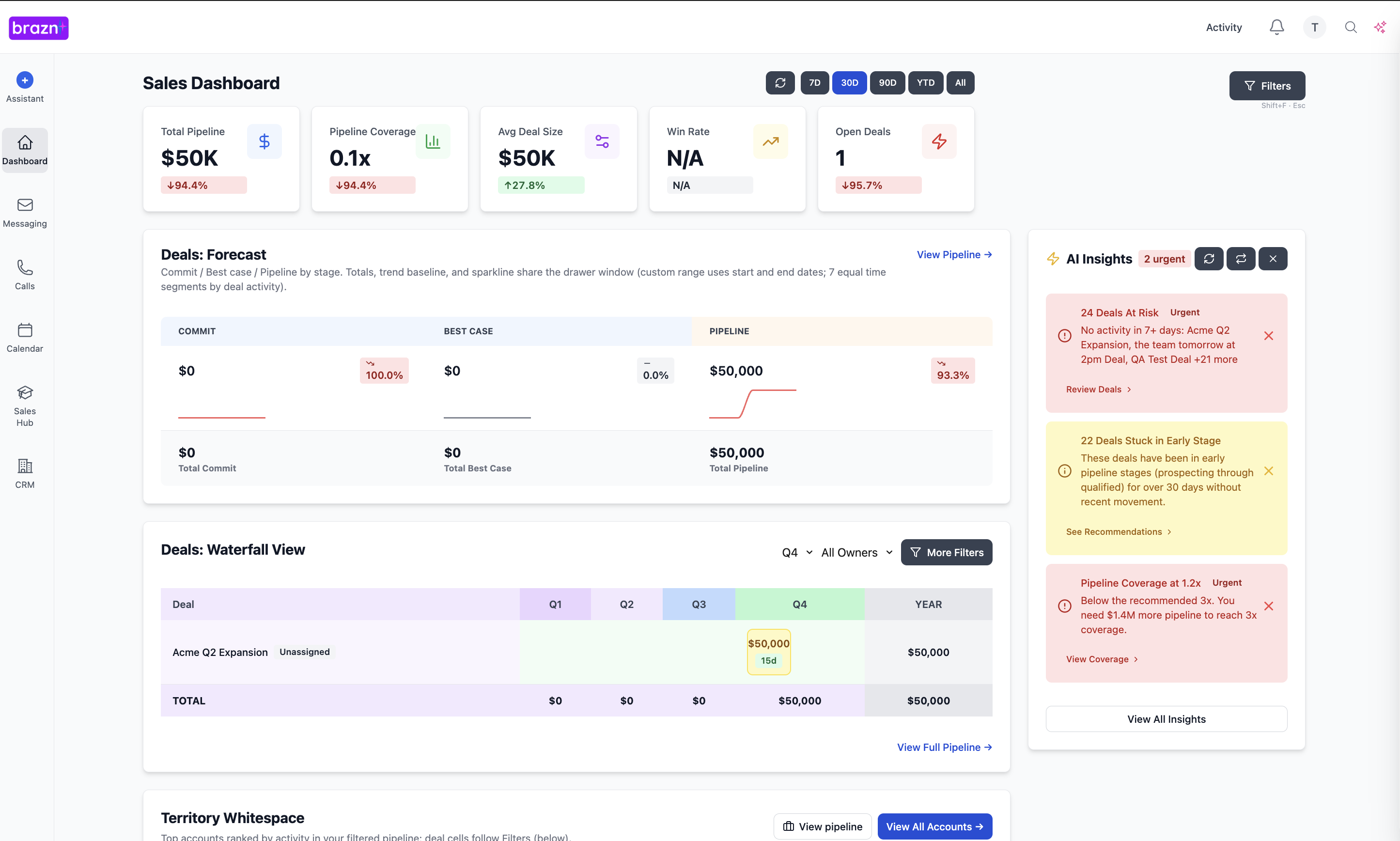
Brazn embeds playbook intelligence directly into the rep's workflow. When a deal enters a specific stage, the relevant plays surface automatically. When a competitor is logged, the battle card and competitive messaging appear in context. When a discovery call ends with specific pain themes, the follow-up template and next-step recommendations are generated from the playbook logic — without the rep having to navigate to a document, remember which section applies, and translate the guidance into action.
This shifts the playbook from a document reps consult when they remember to into a system that actively guides every rep through every deal — making playbook adoption a function of the workflow rather than a function of individual discipline.
---
The Bottom Line
A sales playbook is the most scalable investment a sales leader can make in team performance. It captures the best of what the team knows, makes it available to every rep at every stage of the sales cycle, and creates the consistency that allows the organisation to coach, measure, and improve systematically rather than relying on individual rep talent.
Built well, kept current, and embedded into the tools reps use every day, the playbook is the foundation on which a repeatable, scalable sales organisation is built.
---
See How Brazn Brings Your Playbook to Life in Every Deal
Brazn surfaces the right plays, the right messaging, and the right coaching at the right moment — turning your playbook from a reference document into a live deal intelligence layer your reps actually use.
---
Book a demo to see how Brazn AI fits into your sales stack.

About the Author

Alex Margarit, Sales AI Expert, SaaS Sales Leader, BMC, ServiceNow, Docusign — 25+ years in SaaS sales.