How SaaS AEs Can Cut Admin Time in Half with an AI Sales Assistant
Ask any SaaS AE what they wish they had more of and the answer is almost always the same.
Not more leads. Not a better product. Not a higher commission rate. Time.
Specifically: time to actually sell. Time to be in front of buyers, building relationships, running discovery, advancing deals, doing the work that their job description says they do and that their quota assumes they're doing all day.
The reality is different. Study after study on sales rep time allocation produces roughly the same finding — the average sales rep spends between 35% and 40% of their working week on administrative tasks that have nothing to do with selling. CRM updates. Research prep. Writing follow-ups. Logging activity. Preparing for pipeline reviews. Managing sequence steps.
For a SaaS AE working a standard week, that's fourteen to sixteen hours. Nearly two full working days. Gone to admin.
An AI sales assistant doesn't just shave a bit off the edges. It systematically eliminates the biggest time sinks — and gives the rep back a substantial portion of those fourteen hours every single week. Here's exactly where the time goes and how AI gets it back.
The Admin Audit: Where the Hours Actually Go
Before we talk about the solution, let's do the uncomfortable maths. Break down a typical SaaS AE week and see where the time actually lands.
CRM updates and logging: 4–6 hours per weekThis is the biggest single category. After every call, the rep needs to update the opportunity record — deal stage, MEDDPICC fields, next steps, contact activity, call notes. For an AE with four calls a day, this is fifteen to twenty minutes per call, adding up to over an hour a day and five to six hours across the week.
Add to that the periodic hygiene sessions — updating close dates that have slipped, refreshing deal narratives before pipeline reviews, fixing fields that RevOps has flagged as incomplete — and the true CRM time is consistently at the high end of that range.
Pre-call research: 3–4 hours per weekFour calls a day, thirty to forty-five minutes of research per call for the ones that matter, fifteen minutes for the rest. This is the hidden time cost that reps rarely count because it feels like "working" — but it's working that AI can do faster and better.
Writing follow-ups and proposals: 2–3 hours per weekPost-call follow-up emails. Proposal drafts. One-pagers tailored to specific stakeholders. Summary emails after demos. Re-engagement messages for deals that have gone quiet. For a busy AE, this is two to three hours a week of writing — most of which is templatable from call context.
Pipeline review preparation: 1–2 hours per weekReviewing every open deal before the weekly pipeline review. Refreshing deal narratives. Updating MEDDPICC notes so they don't look empty in front of the manager. Preparing talking points for each opportunity. A process that takes longer the worse the underlying CRM data is — which, as established, is often pretty bad.
Sequence management: 1–2 hours per weekReviewing which sequence steps are due. Writing personalised additions to template steps. Logging completed touchpoints. Managing replies and adjusting sequences accordingly. Identifying accounts that need a manual touch versus an automated step.
Ad hoc admin: 1–2 hours per weekScheduling meetings. Processing expense reports. Responding to internal Slack requests. Updating forecast categories. Fixing data issues flagged by RevOps. The miscellaneous overhead that accumulates throughout the week.
Total: 12–19 hours per week on non-selling activity.For a rep who works fifty hours a week, that's between a quarter and nearly 40% of their time. For a rep working forty hours, it's between 30% and nearly half. Either way — it's an enormous proportion of a professional's working week spent on work that generates zero direct revenue.
The AI Sales Assistant Intervention — Task by Task
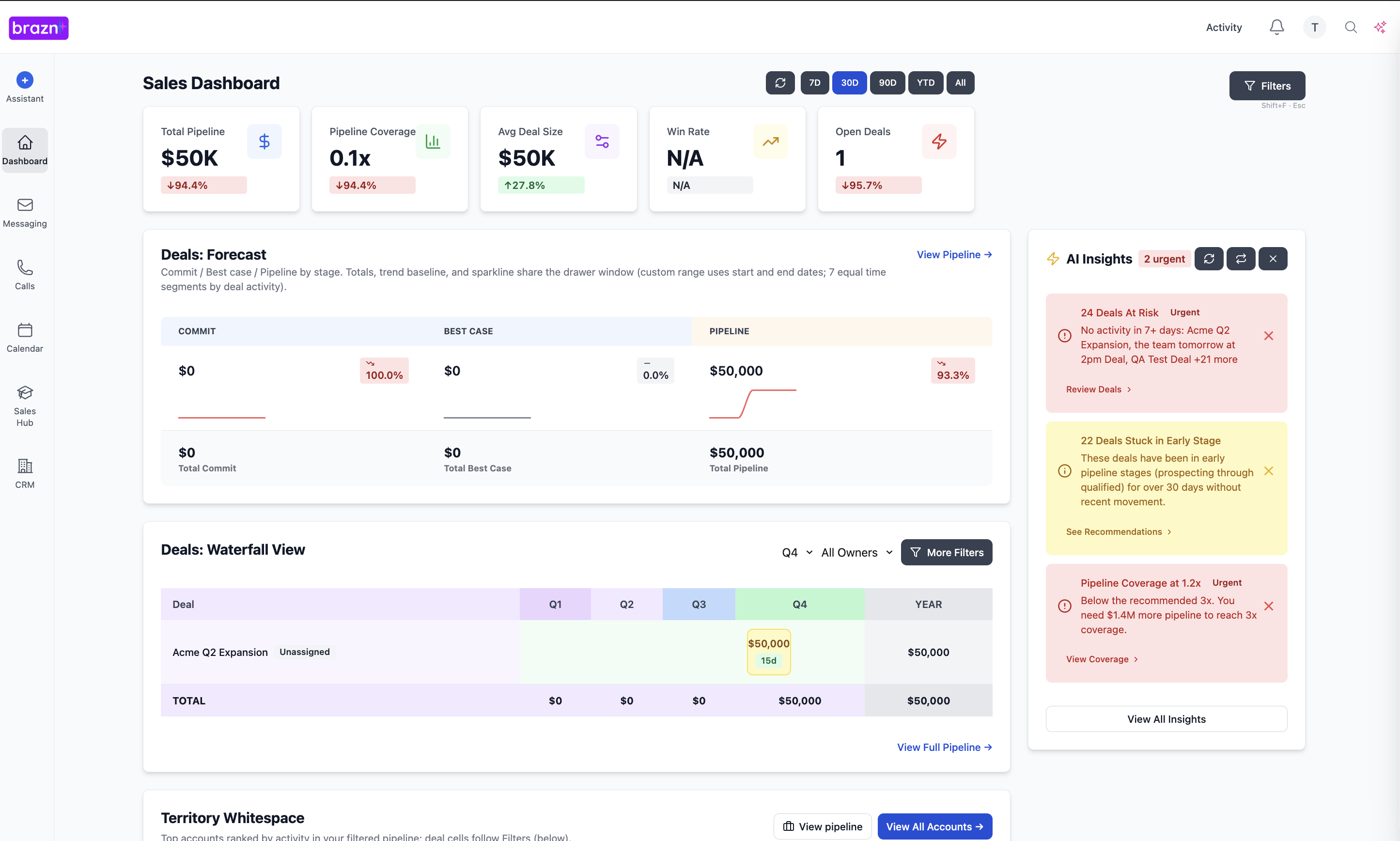
Here's exactly what changes when Brazn enters the workflow.
CRM Updates: From 5 Hours to 30 Minutes
This is the biggest single win and the one with the most immediate impact on rep experience.
After every call, Brazn reads the Gong or Chorus transcript and updates Salesforce automatically. MEDDPICC fields refreshed. Deal stage updated where appropriate. Next steps logged as tasks with due dates. Contact activity recorded. New stakeholders added to the record. Call summary attached to the opportunity.
The rep gets a Slack or email notification: "Here's what I've updated on [Account] — review and confirm." They spend sixty to ninety seconds looking at it, make any adjustments, and approve. Done.
The periodic hygiene sessions disappear entirely — because the CRM is being maintained continuously, after every interaction, rather than in retrospective batch updates.
Time saved: 4–5 hours per week.Pre-Call Research: From 3–4 Hours to 20–30 Minutes
Brazn builds a research brief for every upcoming call — account context, trigger events, strategic priorities, technology stack, stakeholder background, MEDDPICC gaps, suggested questions — and delivers it thirty minutes before the call starts.
The rep reads for four to six minutes. They walk in fully prepared. The forty-five-minute manual research session is replaced by a four-minute review of a brief that's more comprehensive than anything they would have assembled manually.
Time saved: 2.5–3.5 hours per week.Follow-Up Writing: From 2–3 Hours to 20 Minutes
After every call, Brazn drafts the follow-up email. Not a template — a genuine personalised message that references what was specifically discussed, confirms the next steps agreed, and includes any relevant resources or information the prospect asked for.
The rep reviews, adjusts tone if needed, adds anything personal, and sends. Average time per follow-up: two to three minutes of review instead of ten to fifteen minutes of writing.
For proposals and one-pagers, Brazn drafts the structure and core content from call context. The rep reviews and customises. A document that previously took ninety minutes to produce takes twenty minutes to review and finalise.
Time saved: 1.5–2.5 hours per week.Pipeline Review Preparation: From 90 Minutes to 10 Minutes
Brazn generates a pre-review deal brief for every open opportunity automatically. By the time the pipeline review starts, every deal record is current, every MEDDPICC field is populated, and every risk is already flagged with a suggested next action.
The rep's preparation is reading Brazn's briefs — ten minutes — rather than frantically updating Salesforce from memory and hoping the manager doesn't ask the wrong question.
Time saved: 1–1.5 hours per week.Sequence Management: From 1–2 Hours to 15 Minutes
Brazn monitors every active sequence, identifies the steps due today, drafts each one with personalised context, and queues them for the rep's morning approval. The rep reviews the queue, approves what looks right, adjusts anything that needs a personal touch.
Reactivation triggers fire automatically. Engaged prospects get priority flagged. The sequence management overhead collapses into a fifteen-minute morning review session.
Time saved: 45 minutes to 1.5 hours per week.The Numbers
Let's add this up.
| Admin Task | Before Brazn | After Brazn | Weekly Saving |
| --- | --- | --- | --- |
| CRM updates & logging | 5 hrs | 30 mins | 4.5 hrs |
| Pre-call research | 3.5 hrs | 25 mins | 3 hrs |
| Follow-up writing | 2.5 hrs | 20 mins | 2 hrs |
| Pipeline review prep | 1.5 hrs | 10 mins | 1.25 hrs |
| Sequence management | 1.5 hrs | 15 mins | 1.25 hrs |
| Total | 14.5 hrs | ~1.5 hrs | ~13 hrs |
Thirteen hours a week. That's not a rounding error. That's not a productivity tweak. That's a structural transformation of how a SaaS AE's week is allocated.
What Do Reps Do With 13 Hours Back?
This is the question that matters most — and the one that separates a genuine ROI conversation from a time-saving talking point.
Thirteen hours a week returned to a SaaS AE is thirteen hours that can go to:
More discovery calls. The rep who was physically capped at four calls a day because the admin after each one ate the rest of the afternoon can now run five or six. More discovery calls means more pipeline. More pipeline means more closed revenue. Deeper account penetration. Multi-threading — the discipline of building relationships across multiple stakeholders in a deal — is the thing that most reps know they should do and never find time for. Thirteen extra hours a week is plenty of time to research and reach new stakeholders, develop the champion, build the EB relationship, and run a genuinely multi-threaded enterprise deal. More proactive prospecting. The rep who had to choose between prospecting and admin now doesn't have to choose. Outbound pipeline generation — the activity that fills the funnel for next quarter — gets the attention it deserves instead of being squeezed into whatever's left after the admin is done. Better deal strategy. With more time to think, reps make better decisions. They spend more time on competitive positioning. They prepare more thoroughly for objections. They think more carefully about deal strategy before important calls rather than going in with whatever they managed to pull together in fifteen minutes between meetings. Recovery and sustainability. This one doesn't show up in pipeline metrics but it matters enormously for retention and performance longevity. Reps who aren't grinding through admin for two days a week are less burned out. They stay sharper for longer. They stay at the company longer. The hidden cost of admin overload — attrition, performance degradation, rep burnout — is one of the least-discussed ROI factors in sales tool investment."But Will Reps Actually Use It?"
This is the adoption question that every sales leader asks — and rightly so. The graveyard of sales tools is full of platforms that had strong demos and poor adoption.
The honest answer is that Brazn is designed to solve this problem structurally rather than relying on habit change.
Brazn works through the surfaces reps already use — Slack, email, the CRM they're already in. It doesn't ask reps to log into a new platform every morning. It doesn't require them to change their workflow. It delivers value through their existing channels: a brief lands in their inbox, a confirmation notification arrives in Slack, the CRM gets updated without them touching it.
The adoption curve is minimal because the behaviour change is minimal. The rep does what they always did. Brazn handles what happens around it. The relief is immediate and noticeable from day one — which is the only adoption mechanism that actually works at scale.
Reps don't adopt tools that make their job harder. They adopt tools that make their day easier. Brazn makes the first week noticeably easier. That's how you get adoption that sticks.
The Manager's Perspective
One final frame worth adding — because this isn't just a rep-level productivity story.
When AI handles the admin layer, the entire management dynamic changes.
The manager's pipeline review stops being a data extraction exercise and becomes a coaching conversation. The rep isn't spending Sunday evening in Salesforce — which means they arrive at Monday's pipeline review fresher and more strategically oriented. The CRM reflects reality, which means forecast conversations are grounded in actual qualification data rather than rep optimism.
The manager gets a team that spends more time selling, maintains better pipeline hygiene, and is less burned out. That compounds over a quarter — and over a year — in ways that show up unmistakably in the revenue numbers.
Cutting admin time in half isn't a quality-of-life benefit with a vague revenue link. It's a direct, measurable input to pipeline generation, deal velocity, close rate, and rep retention. Every hour returned to selling is an hour that was previously lost. Multiply that by a team of fifteen AEs and thirteen hours a week and you have a number that makes the ROI conversation very short.
---
Ready to give your reps their selling time back?The Brazn team will show you exactly where your team's hours are going and what changes when Brazn handles the admin layer.
---
####
Book a demo to see how Brazn AI fits into your sales stack.

About the Author
Alex Margarit, Sales AI Expert, SaaS Sales Leader, BMC, ServiceNow, Docusign — 25+ years in SaaS sales.