How to Use LinkedIn for B2B Prospecting
LinkedIn has 900 million members, the majority of them business professionals with their current role, company, tenure, and career history publicly available. For B2B sales, this is the most precise contact and account database available — and the only one where the data is continuously updated by the contacts themselves.
Used well, LinkedIn is a prospecting engine — a structured way to identify, research, and engage the exact decision-makers in the exact accounts that match your ICP. Used badly, it's a connection request machine that generates a growing network of unqualified contacts who ignore every subsequent message.
The difference is strategy: a clear ICP definition, a systematic search methodology, a relevance-first engagement approach, and the discipline to invest in relationship before pitch.
---
Step 1: Define the ICP in LinkedIn Search Terms
Before opening LinkedIn, translate the ICP definition into specific LinkedIn search parameters:
- Title keywords: VP Sales, Head of Revenue, Chief Revenue Officer, Director of Sales Operations, VP RevOps — the specific titles of the people who own the problem your product solves
- Company size: Headcount range filters in Sales Navigator (e.g., 100–500, 501–1000)
- Industry: The specific verticals that match your ICP
- Geography: The regions your team covers
- Company growth signals: Headcount growth rate in Sales Navigator — accounts that are growing are more likely to be in buying mode
- Seniority level: Individual contributor, Manager, Director, VP, C-Suite — match to the actual buyer level
The more precisely the ICP is translated into search parameters, the higher the quality of the resulting prospect list — and the more relevant the outreach.
---
Step 2: Build the Target Account List
LinkedIn Sales Navigator's Account Search is the starting point for account-level prospecting:
Account search filters to use:- Industry + company size (headcount)
- Headcount growth (companies growing >10% YoY are stronger targets)
- Technology used (if your product integrates with or replaces a specific tool)
- Geography
- Recent activity: companies that have posted content recently, indicating active leadership presence
Signals to prioritise accounts:- New executive hire in the relevant function (new VP Sales in the last 90 days)
- Recent funding announcement (Crunchbase integration in Sales Navigator)
- Company is hiring aggressively in the function your product serves
- Decision-maker has published content on a topic directly relevant to your product's value proposition
Build a target account list of 100–200 accounts per rep per quarter — enough to run a focused, high-quality outreach motion without spreading efforts too thin.
---
Step 3: Identify the Right Contacts
For each target account, identify 2–3 contacts to engage:
1. The primary buyer: The most senior person who owns the problem your product solves — VP Sales, Head of RevOps, CRO. This person is the Economic Buyer or closest to it.
2. The champion candidate: A manager or director-level person in the relevant function who is likely to feel the pain most directly and has enough seniority to drive an evaluation internally.
3. The technical evaluator (if relevant): For products with significant technical integration requirements — the RevOps Manager, Salesforce Admin, or Head of Sales Operations who will own the technical evaluation.
Multi-threading from first outreach — engaging multiple contacts at the same account simultaneously — increases the probability of getting a response and reduces the dependency on any single contact's responsiveness.
---
Step 4: Engage Before You Pitch
The most common LinkedIn prospecting mistake is connecting and immediately pitching. The second most common mistake is connecting and waiting indefinitely before pitching, producing a large first-degree network of people who have no context for any subsequent message.
The engagement-before-pitch approach:
Follow before connecting. Follow the target's LinkedIn activity for 1–2 weeks. Identify content they've published or engaged with. Look for opinions, priorities, or challenges they've expressed publicly. Engage with their content. A thoughtful comment on a post the target published — demonstrating that you read and understood it — is more effective than any connection request message. It creates a touchpoint based on their content, not your pitch. Connect with specific context. When you send the connection request, reference the content engagement: "I read your post on [topic] and your point about [specific point] resonated with how I think about [related topic] — would value connecting."This approach produces significantly higher connection acceptance rates and creates a warm context for the subsequent outreach.
---
Step 5: The LinkedIn Outreach Message Framework
After connecting, the first outreach message should be:
- Specific to the recipient: References their company, role, or content — not a template that could go to anyone
- Relevant to their world: Opens with their situation, not your product
- Brief: 5–6 sentences maximum. LinkedIn messages are read on mobile; long messages are not read
- Without a pitch in the first message: The first message earns the right to a conversation; it doesn't make the pitch
Template structure: Subject (if InMail): [Specific relevance hook] "[Name] — [specific observation about their company or content that demonstrates you've done the work]. Based on [what you know about their situation], I'm curious whether [specific challenge] is something you're actively working on. I work with [role equivalent] at [relevant company type] on [specific problem]. Happy to share what we've seen work — no agenda beyond a useful conversation if the timing is right. Worth a 20-minute call?"The message demonstrates research, creates relevance, and makes a low-friction ask — a 20-minute conversation, not a commitment to an evaluation.
---
Step 6: LinkedIn Social Selling — The Long Game
For strategic target accounts where immediate outreach isn't the right move, LinkedIn enables a long-game relationship-building approach:
Build presence in their feed. Publish content consistently on topics relevant to your ICP's challenges. Every post that appears in a target's feed is a non-intrusive touchpoint that builds familiarity and positions you as a knowledgeable voice in the space. Engage with their network's content. Comments on posts by people in the target's network surface your name in their peripheral awareness — especially when the comments add genuine value rather than generic affirmation. Share relevant content directly. When a genuinely relevant piece of content — a case study, a report, a framework — would be valuable to a specific target, share it with a brief note: "Thought of you when I read this — the section on [specific topic] matches what you described in your post last month."This approach takes more time per prospect than volume outreach — but produces significantly higher conversion rates among strategic accounts where the relationship foundation justifies the investment.
---
LinkedIn Sales Navigator: The Essential Features
For teams making LinkedIn a primary prospecting channel, Sales Navigator is a necessary investment:
- Advanced search: More precise filtering than free LinkedIn, including headcount growth, technology used, and recent activity
- Saved searches with alerts: Get notified when new accounts or contacts match your saved search criteria — enabling continuous list building without manual repetition
- Lead and account lists: Organise prospects into lists by territory, segment, or campaign
- CRM sync: Push leads and account data directly to Salesforce or HubSpot
- InMail: Reach contacts you're not connected to — with a 50–70% higher open rate than cold email for well-crafted messages
- Buyer intent data (Sales Navigator Advanced Plus): G2 buyer intent integrated directly into the platform
---
How Brazn Enhances LinkedIn Prospecting
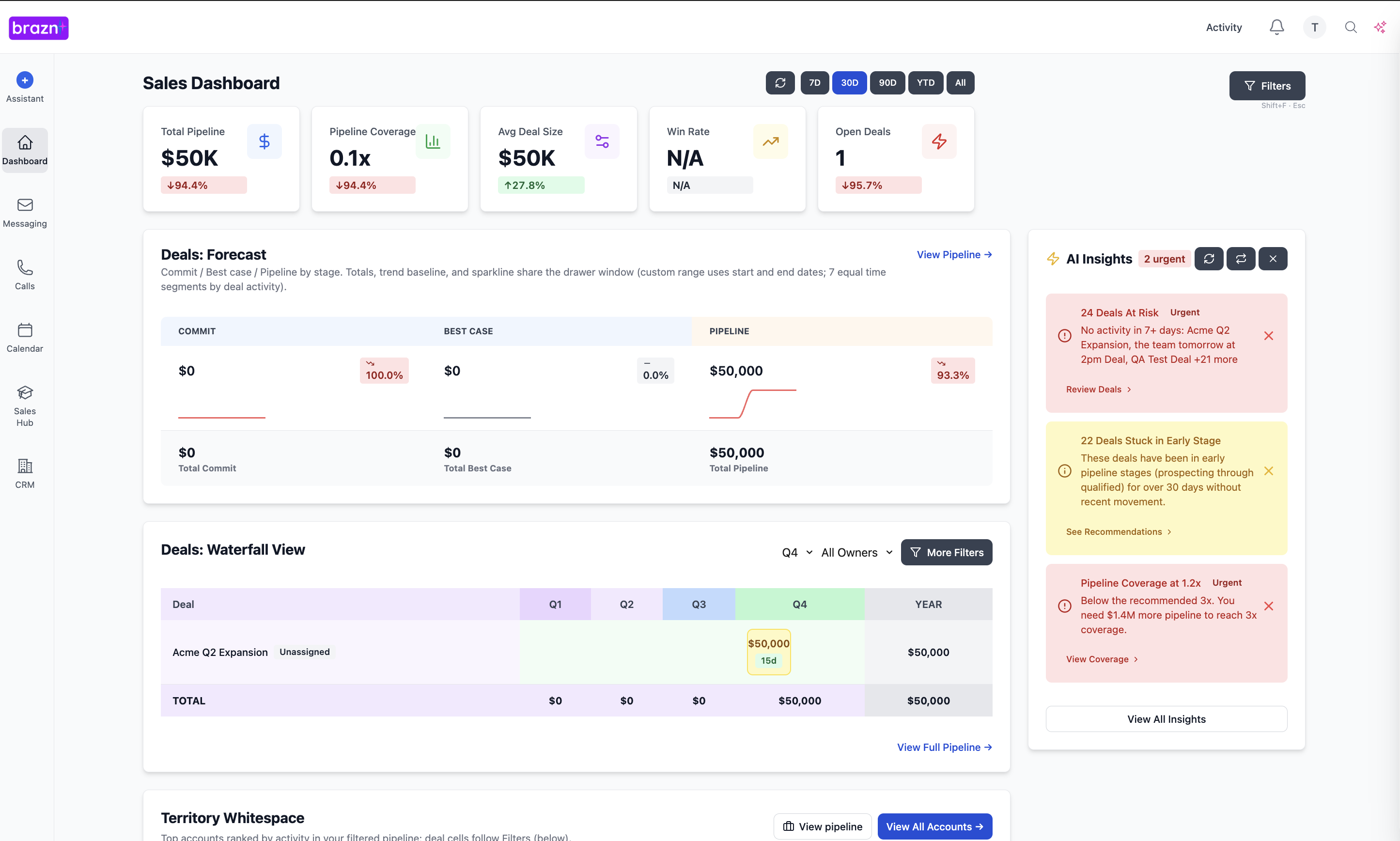
Brazn integrates LinkedIn contact and company data into the account research brief — pulling recent LinkedIn activity, career history, and company news signals into the pre-outreach profile that reps review before writing their first message. For reps building LinkedIn prospecting into their daily workflow, Brazn eliminates the manual research step that makes LinkedIn outreach time-intensive, enabling genuine personalisation at scale without the 30-minute-per-prospect research investment.
---
####
Book a demo to see how Brazn AI fits into your sales stack.

About the Author
Alex Margarit, Sales AI Expert, SaaS Sales Leader, BMC, ServiceNow, Docusign — 25+ years in SaaS sales.