How to Prepare for a SaaS Discovery Call
Discovery is the most important call in the SaaS sales cycle. Not the demo, not the commercial negotiation, not the executive business review — the discovery call. Everything that happens in the subsequent stages depends on the quality of the information gathered in discovery: the business case, the personalised demo, the MEDDPICC qualification, the champion development, the competitive positioning.
A discovery call that surfaces genuine pain, quantifies the business impact, identifies the right stakeholders, and establishes the decision context is a foundation. A discovery call that stays at the surface — generic questions, feature-level answers, no quantification, no political understanding — is a wasted hour that produces a deal with a shallow qualification and a high probability of stalling in Stage 3.
Preparation is what separates the two.
---
The Research Layer: What to Know Before the Call
Company research (20 minutes)Before the call, know the following:
Business model and GTM: How does this company sell? Outbound-led, inbound-led, channel-led, enterprise direct? Understanding the GTM motion tells you which of your product's capabilities are most relevant and which pain points are most likely. Company stage and growth signals: Funding status, headcount trajectory, recent hires (especially in Sales, RevOps, CS). A Series B company that has doubled headcount in 12 months has scaling pain. A pre-seed company with 5 reps has different problems. Recent news: Funding announcements, product launches, leadership changes, expansions. These are context setters and personalisation triggers. Tech stack: What CRM are they on? What sales engagement platform? Call recording? Knowing the stack shapes the integration conversation and identifies replacement opportunities. ICP fit assessment: Before the call, confirm this is a genuinely qualified opportunity — right company size, right market, right function. Discovery time spent on unqualified prospects is time not spent on pipeline. Contact research (10 minutes)For each person on the call:
LinkedIn profile: Current role, tenure, career history, recent posts. New in role (<6 months) means they're actively assessing the current state. Long tenure means deep organisational knowledge. Previous companies tell you if they've used your product or competitors before. Shared connections: Any mutual connections or companies that provide a warm context anchor. Published content: Any articles, posts, or talks that reveal their perspective on relevant topics. A VP Sales who has posted about forecast accuracy in the last month is primed for a specific conversation. MEDDPICC hypothesisBefore every discovery call, build a MEDDPICC hypothesis — a provisional picture of what each element is likely to be, based on the research:
- Metrics: What quantifiable problems does a company at this stage, in this GTM motion, typically have? What would the business impact of solving them likely be?
- Economic Buyer: Who is likely the EB based on the org structure and deal size? Are they on this call?
- Decision Criteria: What does a company in this evaluation typically care about? What criteria does their ICP usually apply?
- Champion: Is the person on this call likely to be the champion? What signals would confirm or disconfirm that?
- Compelling event: Is there a known triggering event — Q3 planning, a new CRO hire, a competitor threat — that is driving urgency?
The hypothesis isn't a script. It's a mental model that makes it easy to recognise relevant signals when they appear in the conversation and to ask follow-up questions that go below the surface.
---
The Discovery Call Question Architecture
Discovery questions are not a list to work through — they're a structured exploration. The architecture has three layers:
Layer 1: Situation questionsEstablish the current state. What does the environment look like today?
- "Can you walk me through how your sales team is currently structured — headcount, segments, whether you're more inbound or outbound?"
- "What tools are the team using today for [relevant function]? How long have you been on [CRM]?"
- "How are you currently managing [specific process relevant to your product]?"
These questions establish context. Keep them concise — the answers to situation questions are the foundation for problem questions, not the destination.
Layer 2: Problem questionsSurface the pain. What isn't working? What is the gap between current state and desired state?
- "What's the biggest challenge you're running into with [current state process]?"
- "Where do deals most commonly stall or slow down in your pipeline?"
- "How confident are you in your forecast today — if you had to put a number on forecast accuracy, what would it be?"
- "When you look at the deals you've lost in the last two quarters — is there a pattern?"
- "What does your CRM data quality look like honestly? Is it something you trust for reporting?"
These are the highest-value questions in discovery. Listen actively. The answer to a problem question contains the pain that the business case will be built on.
Layer 3: Implication questionsQuantify and intensify the impact of the problem. Why does this problem matter at a business level?
- "When forecast accuracy is off by [X]% — what does that mean for planning decisions? For headcount? For the board conversation?"
- "You mentioned deals going dark after demo. If you could recover even half of those — what does that mean in revenue terms?"
- "How many hours per week do you estimate your reps spend on CRM updates rather than selling? Across [N] reps, that's [X] hours per week — have you costed that out?"
Implication questions convert problem awareness into business case components. They also establish the urgency that drives decision timelines — a problem that costs $400K a year has a different priority than a problem that is merely inconvenient.
Layer 4: MEDDPICC-specific questionsLayered throughout the conversation, not asked as a block:
Metrics: Covered in implication questions above. Economic Buyer: "For a decision like this — new tooling for the revenue team — who would typically be involved in approving that? Is that something [title of person on call] would own, or does it go higher?" Decision Criteria: "When you've evaluated tools like this before — what have been the deciding factors? What would make one solution clearly better than another for your team?" Decision Process: "If everything aligns — what does the decision process typically look like? Is there a formal evaluation, a proof of concept, a budget approval step? How long has that taken in the past?" Compelling Event: "Is there a timing driver for this — a planning cycle, a quarter milestone, something that makes solving this more urgent now than it was six months ago?" Champion signals: Observe throughout — who is volunteering information, who is asking specific product questions, who appears most personally invested in the outcome.---
Pre-Call Setup with AI
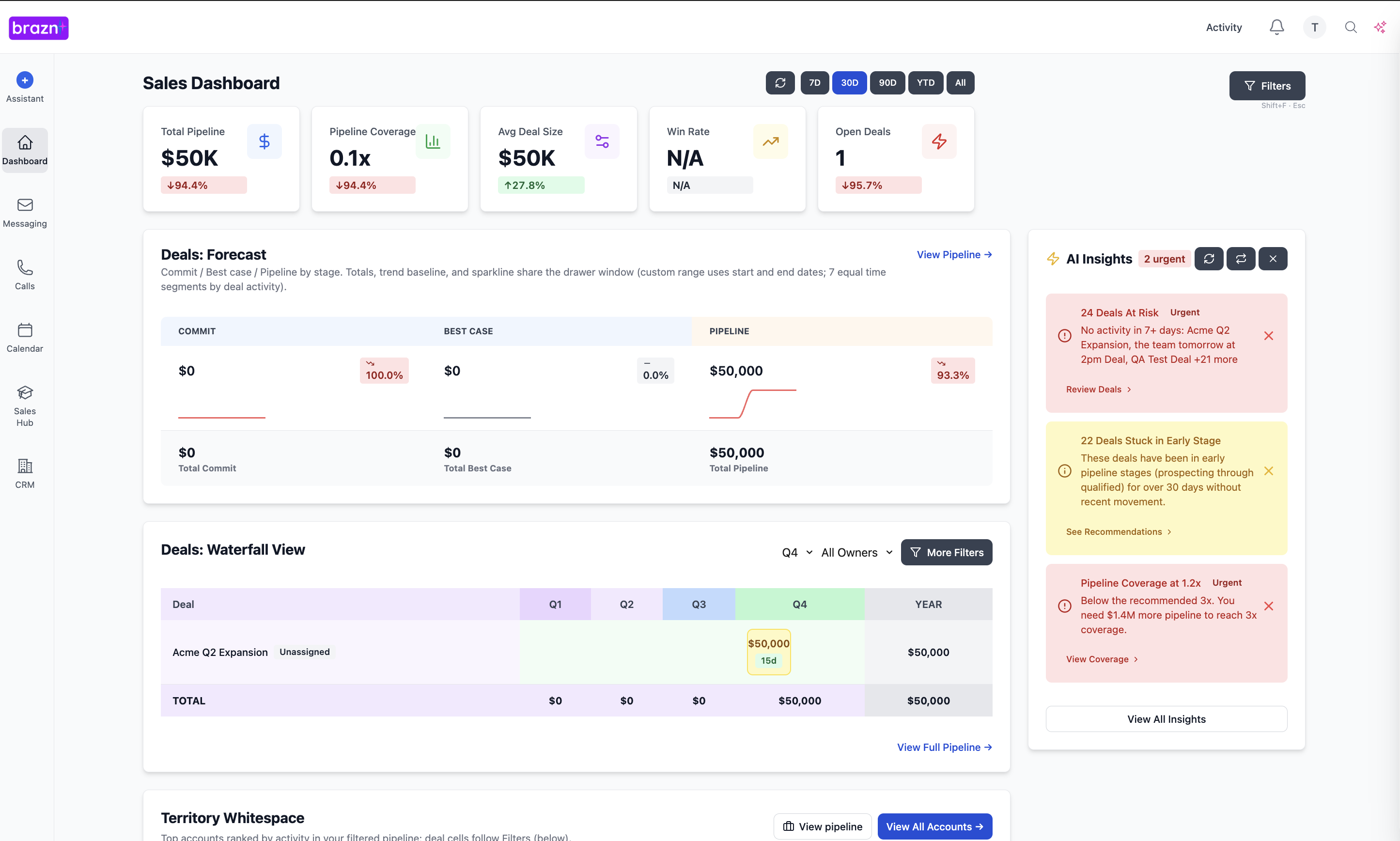
Brazn generates a pre-call brief for every scheduled discovery call — structured around the specific attendees, the company context, and the most likely pain points based on the company's profile.
The brief includes:
- Company summary with relevant signals (funding, headcount, news, tech stack)
- Stakeholder profiles with LinkedIn context
- MEDDPICC hypothesis — the provisional picture of each element
- Recommended opening question sequence based on the company's likely pain profile
- Suggested implication questions tailored to this company's business model
- Competitive context if any competitor signals have been detected
- Key things to listen for — phrases or responses that signal a strong or weak qualification
Reviewing this brief takes 10 minutes and replaces 30–45 minutes of manual research. More importantly, it ensures the preparation happens consistently — not just for the accounts the rep is excited about.
---
What to Do in the First 5 Minutes
The first 5 minutes of a discovery call set the tone for everything that follows. The framework:
1. Establish the agenda explicitly. "Here's how I'd suggest we use the next 45 minutes: I'll start with a few questions about [specific area] to make sure I understand your situation — then, if it makes sense, I can share specifically how other teams like yours have approached this. Does that work for you?"Setting the agenda establishes that this is a structured conversation with a purpose — not an open-ended chat.
2. Confirm the time available. "You've got the full 45 minutes?" Always confirm. If they only have 30, restructure immediately — prioritise the most important questions, not the ones on your list in order. 3. Use the personalised opener.One specific, prepared observation that demonstrates research: "I saw you posted about [topic] last week — that's actually directly relevant to what I want to explore with you today." Or: "Congratulations on [funding / news item] — I was thinking about that in the context of the conversation we're about to have."
This signals preparedness and establishes immediate rapport.
---
The Post-Discovery Protocol
Within 1 hour: Update the CRM with everything established — pain, stakeholders, MEDDPICC elements, next steps. With Brazn, this is done automatically from the call transcript. Within 24 hours: Send the follow-up email that:- Summarises the key points from the conversation (demonstrates listening)
- Provides one specific resource relevant to the primary pain discussed
- Confirms the agreed next step with a specific date
- Asks one follow-up question that extends the discovery — something the call surfaced but didn't fully explore
Before the next call: Review the discovery call summary in the Brazn brief, identify the MEDDPICC gaps to address in the demo, and build the demo narrative around what this call established.---
How Brazn Supports Discovery Preparation
Brazn's pre-call brief for discovery calls combines account intelligence, contact research, and MEDDPICC hypothesis generation into a single document available before every call. Post-call, Brazn's transcript analysis extracts every MEDDPICC element established, scores the discovery quality, and identifies the specific questions that surfaced the strongest qualification signals — enabling coaching conversations that improve discovery quality at the team level over time.
---
####
Book a demo to see how Brazn AI fits into your sales stack.

About the Author
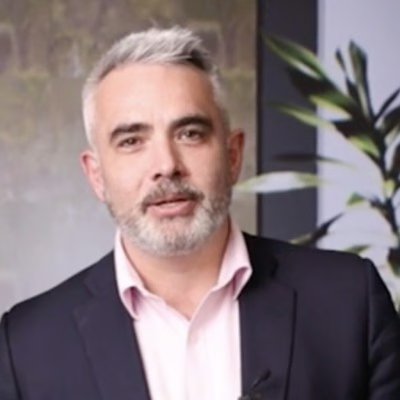
Alex Margarit, Sales AI Expert, SaaS Sales Leader, BMC, ServiceNow, Docusign — 25+ years in SaaS sales.