
How to Identify a Stalled Deal (and What to Do About It)
A stalled deal is not a dead deal — but it will become one if left untreated. The problem with stalled deals is that they're often invisible: they sit in the pipeline looking like active opportunities, consuming forecast space and rep attention, while quietly drifting toward a slip that nobody saw coming because nobody looked hard enough.
Identifying stalled deals early — before the quarter-end scramble reveals them — is one of the most valuable disciplines in pipeline management. The earlier a stall is identified, the more options exist to address it. A deal identified as stalled at Week 4 of the quarter has five viable interventions. A deal identified as stalled at Week 11 has one: discount and pray.
---
The Signals of a Stalling Deal
Signal 1: Days in stage anomalyEvery stage in a healthy pipeline has a typical duration. When a deal has been in a stage significantly longer than the team median for that stage — say, 50% longer — it is a stall candidate. This signal is mechanical and requires no rep judgment: it's in the CRM data.
Brazn flags this automatically. A rep who argues that Stage 3 usually takes 3 weeks but this deal has been there for 7 weeks needs to explain why this deal is different — and the explanation needs to be evidence-based.
Signal 2: Declining engagement velocityMeeting frequency, email reply rate, and call connection rate are all declining. Three weeks ago there were two calls per week; now there have been no meetings in ten days and two emails have gone unanswered.
Engagement decline is the earliest warning signal and the most recoverable — because the decline is happening before the deal has formally stalled, while the rep still has relationship capital to draw on.
Signal 3: Close date repeatedly movedA close date that has been pushed forward more than once without a specific, documented reason is a stall signal. Close dates move for one of two reasons: either the deal is genuinely progressing but slower than expected (acceptable if documented), or the rep is managing their pipeline's appearance rather than the deal's reality (a forecast integrity problem).
Signal 4: Missing MEDDPICC elements at an advanced stageA deal in Stage 4 without established EB engagement, without a documented decision process, or without an identified compelling event is not progressing on a foundation that can support a close. The missing elements are the stall — they just haven't surfaced yet as visible friction.
Signal 5: Champion activity has decreasedThe champion is responding more slowly, providing less information than before, and has stopped proactively updating the rep on internal developments. This is often the first visible signal of a change in internal dynamics — the champion is facing internal resistance, has lost sponsorship from above, or has deprioritised the initiative.
Signal 6: Last meaningful interaction is more than two weeks ago"Last activity date" in the CRM often reflects automated emails or voicemails. The meaningful question is: when was the last substantive, two-way interaction where real information was exchanged? If that's more than two weeks ago on a deal with a close date in the current quarter, it's stalled.
---
The Stall Diagnostic
Before choosing a play, diagnose the root cause using the MEDDPICC framework:
| MEDDPICC Element | Diagnostic Question | Stall Implication |
| --- | --- | --- |
| Metrics | Has the business impact been quantified? | No Metrics = no business case = no urgency |
| Economic Buyer | Has the EB been engaged directly? | No EB = deal can't advance past champion level |
| Decision Criteria | Have evaluation criteria been explicitly agreed? | No DC = prone to late-stage surprises |
| Decision Process | Is the paper process mapped? | No DP = close date is aspirational |
| Identify Pain | Is the pain specific and acute at EB level? | Weak pain = insufficient urgency to act |
| Champion | Is the champion active and politically capable? | Weak champion = no internal advocacy |
| Competition | Is competitive position understood? | Unknown competition = ambush risk |
| Paper Process | Are procurement steps and timeline mapped? | Unmapped PP = late-stage process risk |
The stall is almost always traceable to one or two missing elements. The play that restarts the deal addresses those specific gaps — not the symptoms.
---
The Plays by Stall Type
Stall Type 1: Champion has gone quietThe champion was responsive and engaged; now they're not. Something has changed internally.
Plays:
- Direct, honest outreach to the champion: "I want to be straightforward — I've noticed our conversations have slowed. Has something changed internally that I should know about? I'd rather understand what's happening than guess."
- Multi-thread to another internal contact: reach out to a secondary stakeholder the rep has met before with a business-relevant reason to reconnect.
- Executive outreach: the AE's manager contacts the champion's manager — not as pressure, but as executive sponsorship signalling the vendor's commitment.
Stall Type 2: EB hasn't been engaged and champion can't deliver the introductionThe deal has reached a stage where the Economic Buyer must be involved, but the champion either lacks the access or the willingness to make the introduction.
Plays:
- Help the champion build the internal case first: sometimes the champion needs more ammunition before they can get EB time. Provide the executive-level business case, ROI model, and peer reference connections.
- LinkedIn connection to the EB directly: the AE or AE's manager requests a connection with a brief, relevant note — not a sales pitch, but a business-relevant observation.
- Executive-to-executive outreach: the CRO or VP Sales reaches out directly to the EB's equivalent at the vendor.
Stall Type 3: Procurement / legal is the blockerThe deal has verbal agreement but is stuck in the contract and compliance process.
Plays:
- Activate the Paper Process play from Article 1 of this batch — direct legal engagement, proactive vendor package, security questionnaire pre-completion.
- EB escalation: ask the EB to prioritise the contract with their legal team directly.
- MAP-based accountability: if a MAP is in place with procurement milestones, use it to have a specific conversation about which step is blocked and what it needs to move.
Stall Type 4: No compelling event / no urgencyThe deal is friendly but drifting because there's no deadline that makes acting now more important than acting later.
Plays:
- Return to implication discovery: "We're six weeks past when we originally hoped to have this in place. What has the continued impact of [specific pain] been? What does another quarter without a solution mean for [specific objective]?"
- Create a forward-looking compelling event: connect the purchase to an upcoming milestone — a planning cycle, a board review, a competitive deadline.
- If no compelling event can be found or created: park the deal and move on. Nurture it until the triggering event arrives.
---
The Weekly Stall Review
Stall identification should be a standing component of the weekly pipeline review — not a quarterly emergency response. The weekly review asks, for every deal:
1. When was the last meaningful two-way interaction?
2. Has the close date moved? If yes, why and what's the new milestone?
3. Has the MEDDPICC score changed? Up, down, or flat?
4. Is there a specific next step with a date and an owner?
Deals that can't answer all four questions clearly are stall candidates. Identify them weekly and triage immediately.
---
How Brazn Identifies Stalled Deals
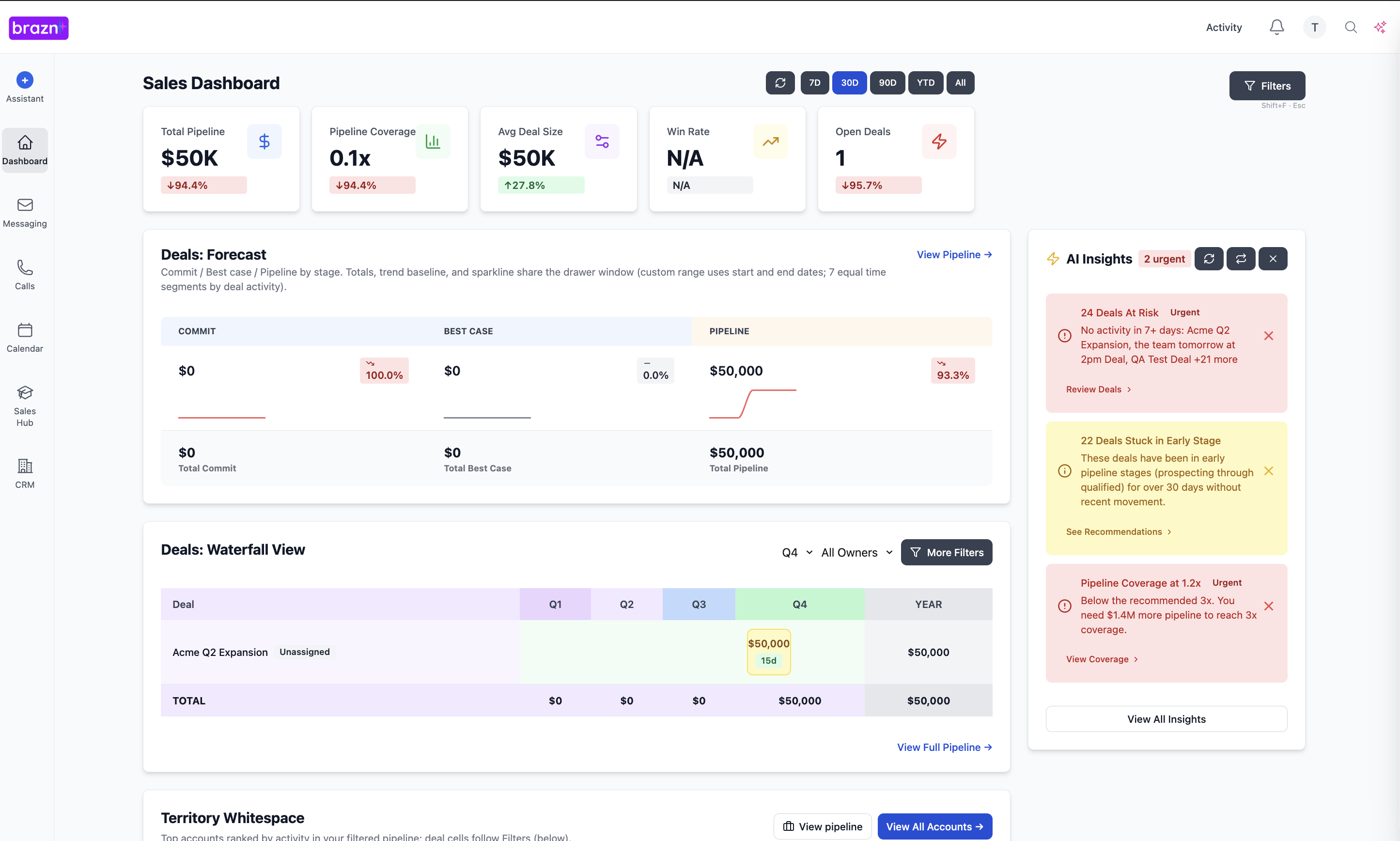
Brazn monitors stall signals across every deal in real time — combining days-in-stage data, engagement velocity trends, MEDDPICC completeness scores, and champion activity patterns into a composite stall risk score. Deals whose stall risk score exceeds a defined threshold are surfaced in the weekly pipeline review automatically — giving managers the specific evidence they need to have targeted coaching conversations rather than relying on rep self-reporting of pipeline health.
---
####
Book a demo to see how Brazn AI fits into your sales stack.

About the Author

Alex Margarit, Sales AI Expert, SaaS Sales Leader, BMC, ServiceNow, Docusign — 25+ years in SaaS sales.