
How to Build a Sales Tech Stack on a Budget
The enterprise SaaS sales technology market is enormous and aggressive in its sales motion. Every category has multiple vendors with sophisticated products and sales teams who will tell you their tool is essential. The result for most growing SaaS teams is a stack that's overspent, underused, and poorly integrated — tools that were bought to solve a problem, configured incompletely, and quietly abandoned while the licence continues to be paid.
Building a sales tech stack on a budget is not about buying inferior tools. It's about buying the right tools at the right stage, in the right sequence, and ensuring each tool is actually used before the next one is added.
The Principles of Budget-Conscious Stack Building
Buy for the problem you have, not the problem you might have. Enterprise tools built for 200-rep organisations are not better for a 10-rep team — they're more expensive, harder to implement, and full of features you won't use for two years. Buy for current scale. One tool per job. Every tool in the stack should own a distinct, non-overlapping function. If two tools both do call recording, you're paying for the same capability twice. Audit for overlap before adding anything new. Integration before breadth. A stack of three well-integrated tools that share clean data is more valuable than a stack of eight tools that are siloed. Integration quality should be a primary evaluation criterion. Measure adoption, not capability. The most expensive line item in any sales tech stack is the capability that nobody uses. Before renewing any tool, verify its actual usage rate — active users, features accessed, data generated. Free tiers and trials are real. HubSpot's free CRM, Apollo's free prospecting tier, Fathom's free call recording, and LinkedIn's free profile research are genuinely useful. Use them until they're limiting, then upgrade.The Stack by Stage
Pre-product-market-fit (0–5 customers, founder selling)| Function | Tool | Cost |
| --- | --- | --- |
| CRM | HubSpot Free | Free |
| Email | Gmail / Outlook | Existing |
| Calendar scheduling | Calendly Free | Free |
| Call recording | Fathom | Free |
| Prospecting | LinkedIn + Apollo Free | Free |
Total cost: £0–£50/month. At this stage, the goal is learning — every call recorded and every contact logged. No investment in automation or intelligence until the sales motion is understood.
Early traction (5–20 customers, 1–3 AEs)| Function | Tool | Cost (approx) |
| --- | --- | --- |
| CRM | HubSpot Starter or Salesforce Essentials | £40–£80/month |
| Prospecting + sequencing | Apollo Pro | £80/month per user |
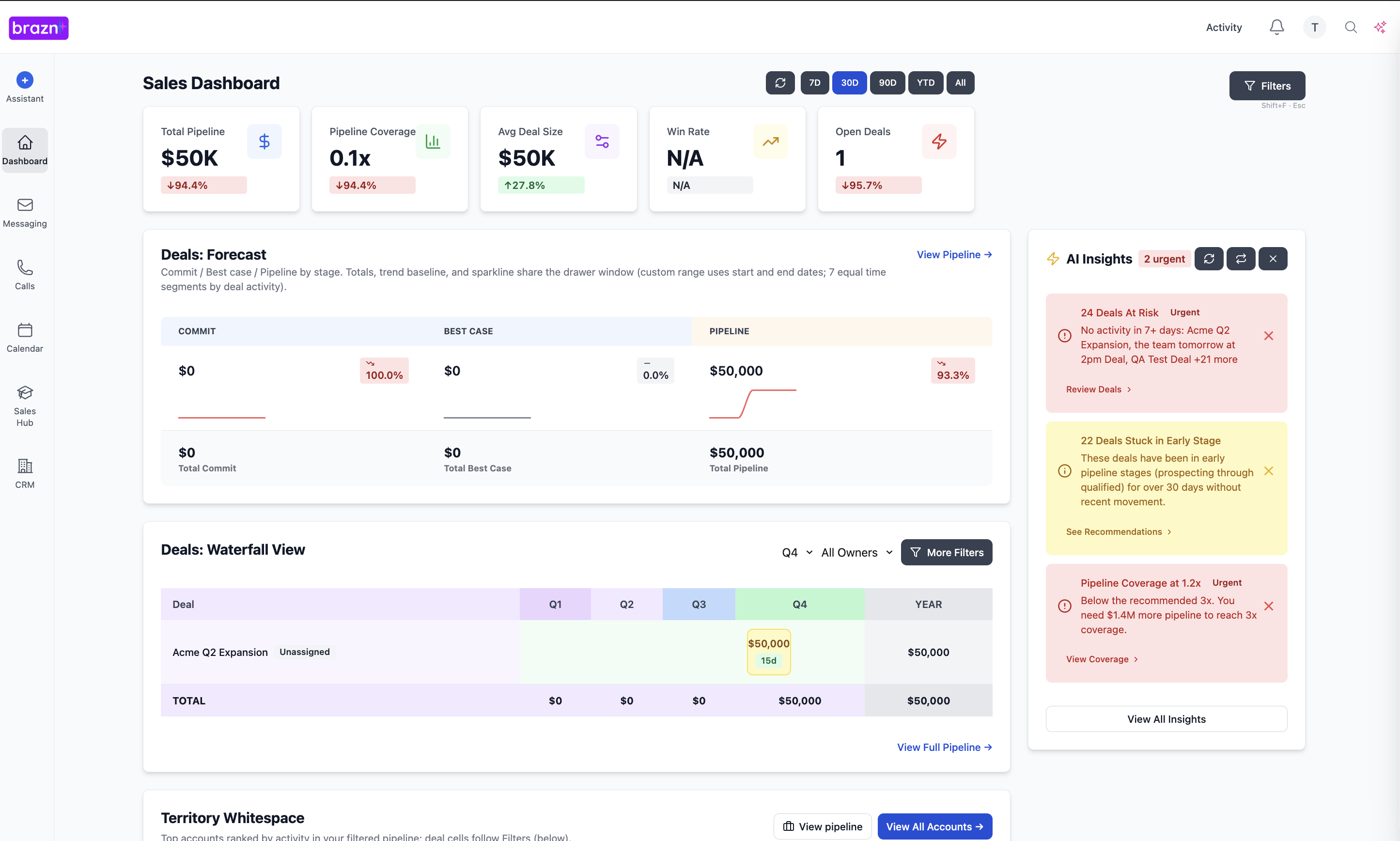
| Deal intelligence + call recording | Brazn | Brazn pricing |
| LinkedIn Sales Navigator | LinkedIn Sales Navigator Core | £80/user/month |
Total cost: £300–£500/month for a 2-AE team. At this stage, the stack covers the three most important functions: CRM data, outbound prospecting, and deal qualification intelligence.
Why Brazn at this stage: MEDDPICC discipline established from the first qualified opportunity is far easier to maintain than retroactively introducing it to a team that has been selling without a methodology. The habit is cheaper to build early.
Growth stage (20–100 customers, 5–20 AEs)| Function | Tool | Cost (approx) |
| --- | --- | --- |
| CRM | Salesforce Professional or HubSpot Sales Pro | £75–£150/user/month |
| Sales engagement | Salesloft or Outreach | £100–£125/user/month |
| Prospecting data | Apollo or Cognism | £60–£120/user/month |
| Deal intelligence | Brazn | Brazn pricing |
| LinkedIn Sales Navigator | Team | £70/user/month |
| Revenue analytics (optional) | Salesforce native or Looker | £0–£80/user/month |
Total cost: £400–£600/user/month for a full-stack growth-stage rep. This is the point where the stack is most important to get right — the habits and workflows established at this stage are difficult to change as the team scales further.
Scale stage (100+ customers, 20+ AEs)At scale, additional layers become justified:
Clari or Gong Forecast for enterprise-level forecast management
Gong for supplementary conversation AI at volume
ZoomInfo for deeper firmographic and technographic data
Seismic or Highspot for content management and sales enablement
DocuSign or Ironclad for contract lifecycle management
These tools are expensive and require RevOps resource to manage. They are not justified until the team has outgrown the growth-stage stack above.
The Five Most Common Budget Mistakes
1. Buying Salesforce Enterprise before you need it.HubSpot or Salesforce Essentials handles 90% of what a sub-20-AE team needs. The enterprise tier's value is in its configurability and integration depth — which requires RevOps to exploit. Buy it when you have RevOps, not before.
2. Buying a separate call recording tool when your deal intelligence tool already does it.Brazn records calls. Salesloft Conversations records calls. Gong records calls. Choose one and turn the others off.
3. Buying enrichment tools with overlapping databases.Apollo, ZoomInfo, and Cognism all have contact databases. Buying two of them produces marginal incremental coverage improvement for double the cost. Choose based on your primary market and commit.
4. Buying enterprise-tier Sales Navigator before your team can use its features.Sales Navigator Advanced adds TeamLink, CRM sync, and advanced alerts. For a team of 3 AEs, Core is sufficient. The step-up pays for itself at 5+ reps.
5. Failing to negotiate.Every SaaS sales tool has pricing flexibility. Annual contracts produce 15–25% discounts on most platforms. Multi-seat deals compress per-seat pricing further. Never pay list price at first renewal.
The Non-Negotiables at Every Stage
Regardless of budget, three functions cannot be skipped:
A CRM. Without a system of record, there is no pipeline visibility, no forecast, and no learning from what's happening in deals. HubSpot Free is sufficient to start. A call recording and intelligence tool. Without recorded calls, coaching is based on memory and anecdote. Free Fathom is sufficient to start; Brazn when qualification intelligence matters. A prospecting data source. Without accurate contact data, outbound is guesswork. Apollo's free tier covers initial list-building; upgrade when volume or compliance requirements demand it.---
####
Book a demo to see how Brazn AI fits into your sales stack.

About the Author

Alex Margarit, Sales AI Expert, SaaS Sales Leader, BMC, ServiceNow, Docusign — 25+ years in SaaS sales.