How to Build a SaaS Sales Team from Scratch
Building a SaaS sales team from scratch is the defining operational challenge for most founders and early-stage revenue leaders. Hire too fast and you'll spend the next year managing underperformers and firefighting process failures. Hire too slowly and you'll leave growth on the table. Hire the wrong profile and you'll build a culture and motion that's expensive to unwind.
The sequence of hiring matters as much as the individual hires. A SaaS sales team is a system — and like any system, the order in which components are introduced determines whether the whole thing works.
Before the First Hire: Founder-Led Sales
The most important phase of building a sales team is the one before there is a sales team. Every founder should sell their product personally before hiring a salesperson — not because founders are better salespeople, but because the learning that happens in founder-led sales is irreplaceable.
Founder-led sales produces:
ICP validation: Which companies are actually willing to pay? Which personas are the real decision-makers? Which use cases drive urgency? Messaging foundation: What language resonates? What objections come up? What analogies make the product click? Process primitives: What does a typical sales cycle look like? How many conversations does it take to close a deal? What's the natural sequence of events? Reference customers: The first 5–10 customers who believe in the product enough to become references and case studies.A founder who hires a sales rep before completing this work is giving them an impossible job: sell a product whose market fit, messaging, and process are still undefined.
The Hiring Sequence
Hire 1: First AE (Founder + 1)The first sales hire should be an experienced AE who can run a full sales cycle independently — not someone who needs extensive training or management. They should be able to sell the product with light process support, work in ambiguity, and help refine the playbook rather than just execute it.
What to look for: 3–7 years SaaS AE experience, a history of quota attainment above 100%, genuine curiosity about the product and market, and comfort operating without the infrastructure that exists in larger companies.
What to avoid: Enterprise AEs who have only ever worked with full SDR support, marketing backing, and established playbooks. They often struggle in the "figure it out" environment of early-stage.
Hire 2: SDR (when inbound pipeline exists)Once the AE is closing deals and the product is validated, the SDR role makes sense. SDRs require management — call coaching, sequence review, pipeline review. Without a manager capable of providing this, SDR performance degrades quickly.
At this stage, the founder or first AE typically serves as the de facto SDR manager while carrying quota. This is sustainable for 3–6 months before a dedicated manager is needed.
Hire 3: Second AEOnce the first AE has been in role long enough to validate that the sales process is repeatable (typically 6–12 months, minimum 3 closed deals), a second AE can be hired. The first AE's motion — discovery approach, objection handling, demo structure, close process — becomes the input for onboarding the second.
Hire 4: Sales Manager / VP of SalesWhen the team reaches 3–4 AEs and 2–3 SDRs, dedicated sales management becomes essential. The transition from founder-managed to professionally managed sales is the highest-stakes organisational transition in early-stage SaaS. The right first sales leader:
Has managed a team of AEs at a comparable company stage before.
Can build process while maintaining momentum — not just manage an existing motion.
Understands how to develop reps through coaching rather than just through instruction.
Can own the forecast and be accountable to a number.
Hire 5–N: Scaling AEs and SDRsWith a sales manager in place and a repeatable process documented, the team can scale. The ratio of AEs to SDRs depends on the outbound vs inbound mix, but a common growth-stage ratio is 2–3 AEs per SDR.
Building the Playbook Alongside the Team
Every hire is an opportunity to document what's working. The sales playbook should be built incrementally as the team produces evidence — not written from scratch as a theoretical document before any deals are closed.
After the first 10 deals, document:ICP definition with firmographic and behavioural criteria.
The sales stages and the exit criteria for each.
The discovery framework — the questions that reliably uncover pain and qualify the deal.
The most common objections and how they've been handled successfully.
The competitive positioning against the two or three competitors that appear most often.
After the first 25 deals, add:Win/loss patterns — what the won deals had in common.
The MEDDPICC element most commonly missed in lost deals.
The demo structure that produces the highest Commit-to-close rate.
The Mutual Action Plan template calibrated for your typical deal complexity and length.
After the first 50 deals, formalise:A full onboarding programme for new AEs built from the playbook.
A call certification process using Brazn's coaching analytics.
A formal qualification review process for pipeline reviews.
A competitive battlecard for each primary competitor.
Compensation Design
Compensation design at the team's founding stage sets the culture and expectation framework for the whole sales organisation. Key principles:
Variable compensation should be meaningful but achievable. A 50/50 base-to-variable split is standard in SaaS. Variable should be achievable at quota (100% OTE), with upside for overperformance (120–150%+ OTE for elite performers). Quota should be set at 3–4x the AE's OTE. A rep with $120K OTE should carry a $360K–$480K quota. Below 3x, the economics don't work. Above 5x at early stage, quota becomes demoralising. Avoid individual metrics that conflict with team behaviour. Commission plans that incentivise deal volume over deal quality produce pipeline inflation. Include a quality metric (forecast accuracy, deal retention) alongside revenue attainment. SDR comp should be primarily base with a meaningful meetings/pipeline bonus. SDRs are not yet running full sales cycles — their variable should reflect their actual contribution without creating perverse incentives for booking unqualified meetings.The Technology Foundation for a New Team
A new SaaS sales team needs a minimal, well-integrated stack — not every tool that exists, but the right tools at each layer:
CRM: Hubspot at early stage (free to low cost, fast to implement), Salesforce when complexity justifies it (typically 15+ AEs or when sales cycle complexity requires it). Prospecting: Apollo for contact data and sequencing at early stage — one tool for both reduces integration complexity. Deal intelligence: Brazn from the first AE hire — MEDDPICC tracking from day one creates the qualification discipline that makes the team scalable and the playbook documentable. Communication: Zoom or Google Meet for calls, Gmail or Outlook for email — both integrated to CRM.Avoid adding tools that require dedicated RevOps to maintain before RevOps exists. Every tool in the early-stage stack should be manageable by a founder or sales manager alongside their other responsibilities.
How Brazn Accelerates New Team Development
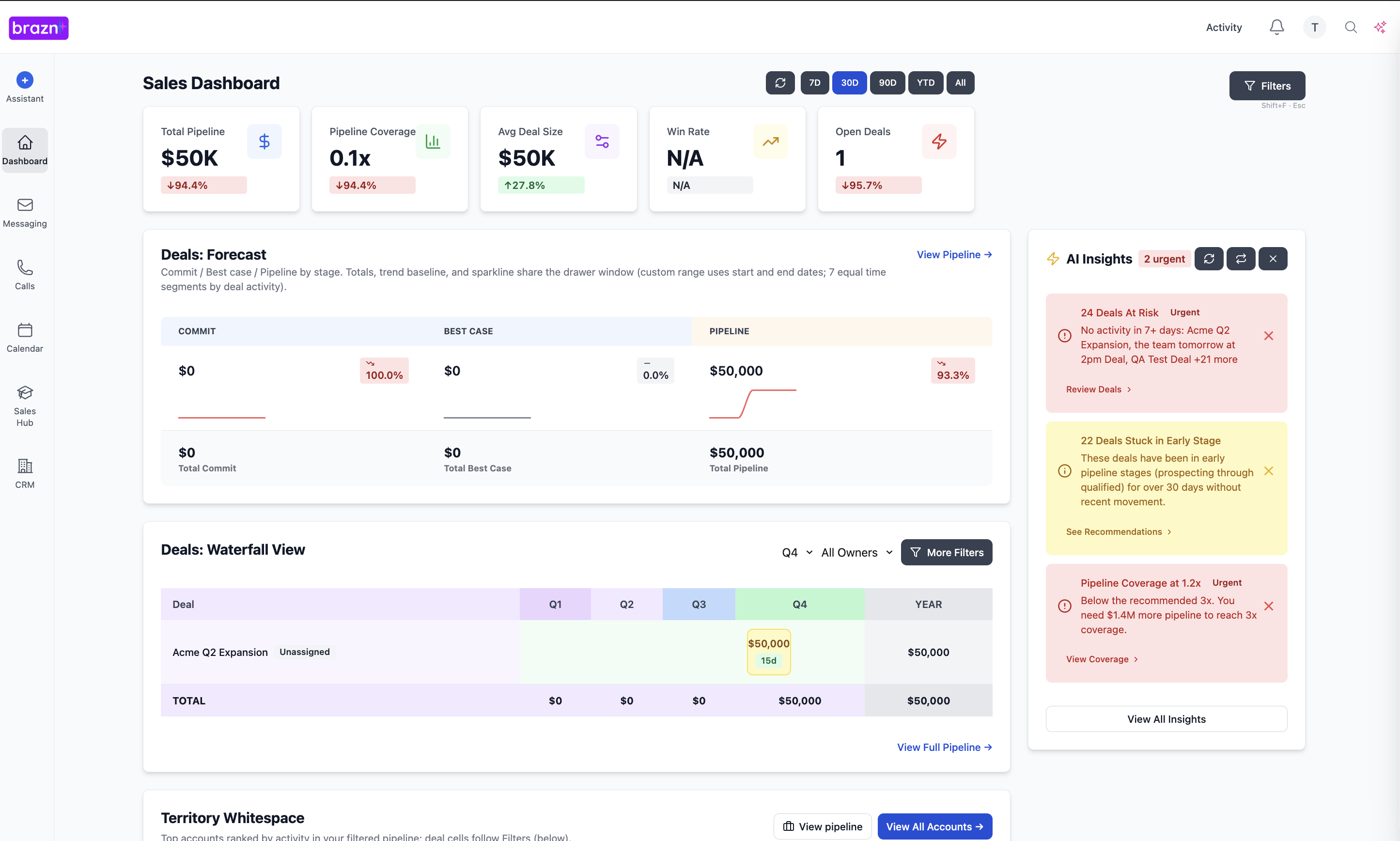
For a SaaS sales team being built from scratch, Brazn's qualification tracking and coaching analytics accelerate the two hardest parts of team development: establishing MEDDPICC discipline from the first hire, and giving managers objective coaching input before they have months of deal history to draw on. New reps who can see their own qualification gaps in Brazn's dashboard develop faster than those receiving only manager feedback.
---
####
Book a demo to see how Brazn AI fits into your sales stack.

About the Author
Alex Margarit, Sales AI Expert, SaaS Sales Leader, BMC, ServiceNow, Docusign — 25+ years in SaaS sales.