How to Build a B2B Sales Process
A B2B sales process is a defined sequence of stages, activities, and exit criteria that moves a prospect from first contact to signed customer. Without one, every rep invents their own motion. With one, the team has a shared language, a predictable pipeline, and the ability to diagnose and improve conversion at each stage.
Building a sales process is not a one-time project. It's an ongoing system that improves as you accumulate data on what works in your specific market, with your specific ICP, for your specific product.
The Foundation: What a Sales Process Needs
Before defining stages, four foundational elements need to be clear:
ICP (Ideal Customer Profile)Who is the process designed to sell to? Company size, industry, geography, growth stage, technical environment, and the specific business problem your product solves. A process designed for 50-person software companies is different from one designed for 500-person financial services firms.
Qualification criteriaWhat must be true about a deal to advance from one stage to the next? This is the most frequently missing element in poorly designed sales processes. Stage names without exit criteria produce pipelines where reps advance deals based on optimism rather than evidence.
Buyer journey alignmentYour sales stages should map to the buyer's decision stages — not to the seller's internal milestones. A stage called "Demo Complete" reflects what the seller did, not where the buyer is. A stage called "Compelling Event Established" reflects buyer progress.
Sales methodology MEDDPICC, Challenger, SPICED, or another framework provides the qualification language that populates each stage's exit criteria. Without a methodology, exit criteria are generic and subjective. With one, they're specific and verifiable.A Six-Stage B2B SaaS Sales Process
Stage 1: Prospect / Target What it is: Accounts identified as ICP-fit but not yet contacted. Exit criteria to Stage 2: Contact identified, outreach initiated. Primary activities: Account research, contact data sourcing, sequence enrolment. Tools: Apollo, Cognism, ZoomInfo, LinkedIn Sales Navigator. Stage 2: Engaged What it is: Prospect has responded to outreach and initial qualification has begun. Exit criteria to Stage 3: BANT-level initial qualification complete — identified pain, potential budget, right persona, rough timeline. Discovery meeting scheduled. Primary activities: SDR qualification call, pain identification, meeting booking. Tools: Apollo/Outreach/Salesloft sequences, CRM. Stage 3: Discovery What it is: AE has conducted structured discovery with the prospect. Exit criteria to Stage 4: Metrics quantified, pain confirmed at business level, champion identified, decision process understood at initial level, EB identified (not necessarily engaged). Primary activities: Multi-call discovery, stakeholder mapping, business case foundation. Tools: Brazn (MEDDPICC tracking, pre-call brief, call recording). Stage 4: Solution / Evaluation What it is: Prospect is actively evaluating the solution — demos, proof of concept, references. Exit criteria to Stage 5: Decision criteria established, proof of value delivered, EB engaged (at minimum one touchpoint), competition identified. Primary activities: Product demonstration, POC/pilot, competitive positioning, EB introduction. Tools: Brazn (stakeholder gap detection, deal scoring), CRM. Stage 5: Proposal / Negotiation What it is: Commercial proposal delivered, negotiation underway. Exit criteria to Stage 6: Verbal agreement reached, legal and procurement process initiated, champion confirmed and actively sponsoring. Primary activities: Commercial proposal, legal review, pricing negotiation, mutual action plan. Tools: Brazn (paper process tracking, deal risk monitoring), CRM. Stage 6: Closing What it is: Contract in legal/procurement, approaching signature. Exit criteria to Closed Won: Contract signed, payment terms agreed. Primary activities: Contract finalisation, procurement navigation, signature. Tools: DocuSign/CLM tools, Brazn (paper process monitoring).Defining Exit Criteria: The Most Important Step
The most common failure in sales process design is defining stages without exit criteria. Exit criteria are the specific, verifiable conditions that must be true before a deal can move to the next stage.
Bad exit criteria: "Rep feels the deal is ready to advance." Good exit criteria: "Prospect has confirmed a quantified business impact of at least $X. The primary decision-maker (EB) has been identified by name and title. A mutual action plan has been agreed with a signed-off timeline."Exit criteria should be:
Specific — unambiguous enough that two different managers would reach the same stage assessment. Buyer-verifiable — based on something the prospect has said or done, not something the rep believes. MEDDPICC-aligned — each stage's criteria should map to the MEDDPICC elements appropriate to that stage of the sale.Embedding the Process in AI Tools
A sales process that exists only in a slide deck is not operational. To make it real:
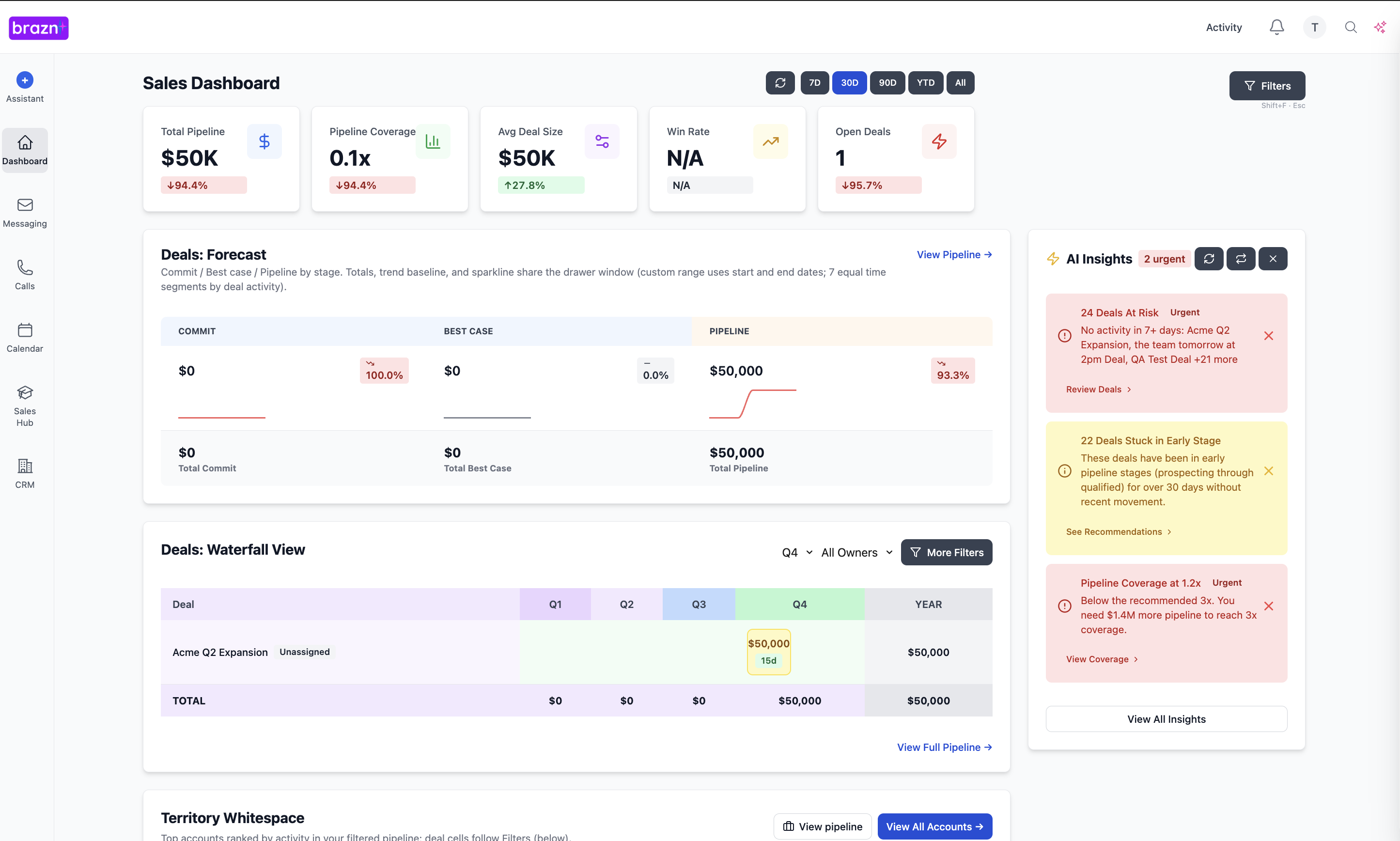
Map exit criteria to CRM fields — each exit criterion should have a corresponding required CRM field that must be populated before stage advancement. Use AI to enforce completion — Brazn tracks MEDDPICC completeness per deal and flags stages where required elements are missing, making exit criteria machine-readable rather than manager-enforced. Build pipeline reports around stage criteria — pipeline reviews should inspect exit criteria completeness, not just deal stage. Analyse conversion rates by stage — where is pipeline consistently stalling? That's where the process has a gap, the criteria need refinement, or reps need coaching.Iterating the Process
The first version of your sales process is a hypothesis. The second version — built from 3–6 months of data on where deals are stalling, why they're being lost, and which criteria are predictive of wins — is the beginning of a real system.
Review your sales process formally every quarter: update exit criteria based on win/loss analysis, adjust stage definitions based on where pipeline is pooling, and add or remove criteria based on what the data shows is actually predictive of close.
---
####
Book a demo to see how Brazn AI fits into your sales stack.

About the Author
Alex Margarit, Sales AI Expert, SaaS Sales Leader, BMC, ServiceNow, Docusign — 25+ years in SaaS sales.