How AI Summarises Sales Calls
Manual call notes are one of the most time-consuming and unreliable parts of a sales rep's workflow. After a 45-minute discovery call, writing a quality summary — capturing what was discussed, what was uncovered, what was agreed, and what the next steps are — takes 15–30 minutes. That time compounds across a full pipeline.
More problematically, manual notes are selective. Reps record what stood out to them and what confirmed their existing view of the deal. Sales qualification gaps, risk signals, and stakeholder concerns that didn't fit the narrative often don't make it into the CRM.
AI call summarisation solves both problems: it saves time and produces more complete, less biased records of what actually happened.
How AI Call Summarisation Works: The Technical Process
Step 1: Audio capture and speaker diarisationThe AI system joins the call as a bot participant (or ingests a recording from Zoom, Teams, or Google Meet). It captures audio from all speakers and uses speaker diarisation — a process that separates the audio into distinct speaker tracks — to identify who said what throughout the conversation.
Step 2: TranscriptionThe audio for each speaker is converted to text using automatic speech recognition (ASR) models. Modern ASR models have high accuracy for standard English in business contexts. Quality varies for accents, technical vocabulary, and lower-quality audio. The best tools allow custom vocabulary to improve accuracy for industry-specific terms and product names.
Step 3: Transcript processingThe raw transcript — a time-stamped text record of everything said — is processed by a large language model (LLM). The LLM applies understanding of business context, conversation structure, and the specific use case (sales discovery, demo, QBR, negotiation) to interpret what was discussed.
Step 4: Summary generationThe LLM generates a structured summary, typically including:
Overview — a 2–3 sentence description of what the call covered. Key topics discussed — the main themes and issues explored. Pain points uncovered — problems the prospect identified. Objections raised — concerns or resistance expressed. Next steps — specific actions agreed by each party, with owners and dates. Buyer sentiment — the prospect's apparent engagement and interest level. Follow-up questions — areas that need further exploration. Step 5: CRM population and deliveryThe summary is delivered to the rep within minutes of the call ending — in the conversation intelligence platform, in CRM, and/or by email. Many tools also auto-populate specific CRM fields (next step activity, close date, notes fields) directly from the summary.
What Good AI Call Summaries Look Like
The difference between a useful AI summary and an unhelpful one comes down to structure and specificity.
Useful summary characteristics:Captures specific things the prospect said — not generic paraphrases.
Identifies specific pain points in the prospect's language, not summarised as "they have a pain."
Records specific next steps with owners and timelines — not "follow up."
Surfaces qualification signals — budget language, timeline mentions, decision process details, champion behaviour.
Is concise — 300–600 words for a 45-minute call.
Unhelpful summary characteristics:Generic descriptions ("we discussed the product and they seemed interested").
Missing next steps or vague next steps ("rep will follow up").
No specific prospect quotes or language.
Padding and filler rather than signal extraction.
Inaccurate attribution of statements to the wrong speaker.
Methodology-Aware Summaries: The Next Level
Standard AI call summaries capture what was said. Methodology-aware summaries map what was said to a qualification framework — identifying which MEDDPICC elements were addressed in the call and which remain open.
A methodology-aware summary for a discovery call might include:
MEDDPICC update from this call:• Metrics: ✅ Prospect confirmed $2M annual revenue impact if current forecast error rate is resolved.
• Economic Buyer: ⚠️ CFO mentioned but not engaged — rep needs to request EB introduction.
• Decision Criteria: ✅ Three criteria confirmed: GDPR compliance, Salesforce integration, ease of onboarding.
• Decision Process: ⚠️ Not fully established — prospect said "legal will need to review" but no process detail given.
• Champion: ✅ VP RevOps is actively engaged and asked for business case template.
This moves the summary from a record of what happened to an actionable qualification status update — directly useful for the manager's next pipeline review and the rep's preparation for the next call.
How Brazn Generates Call Summaries
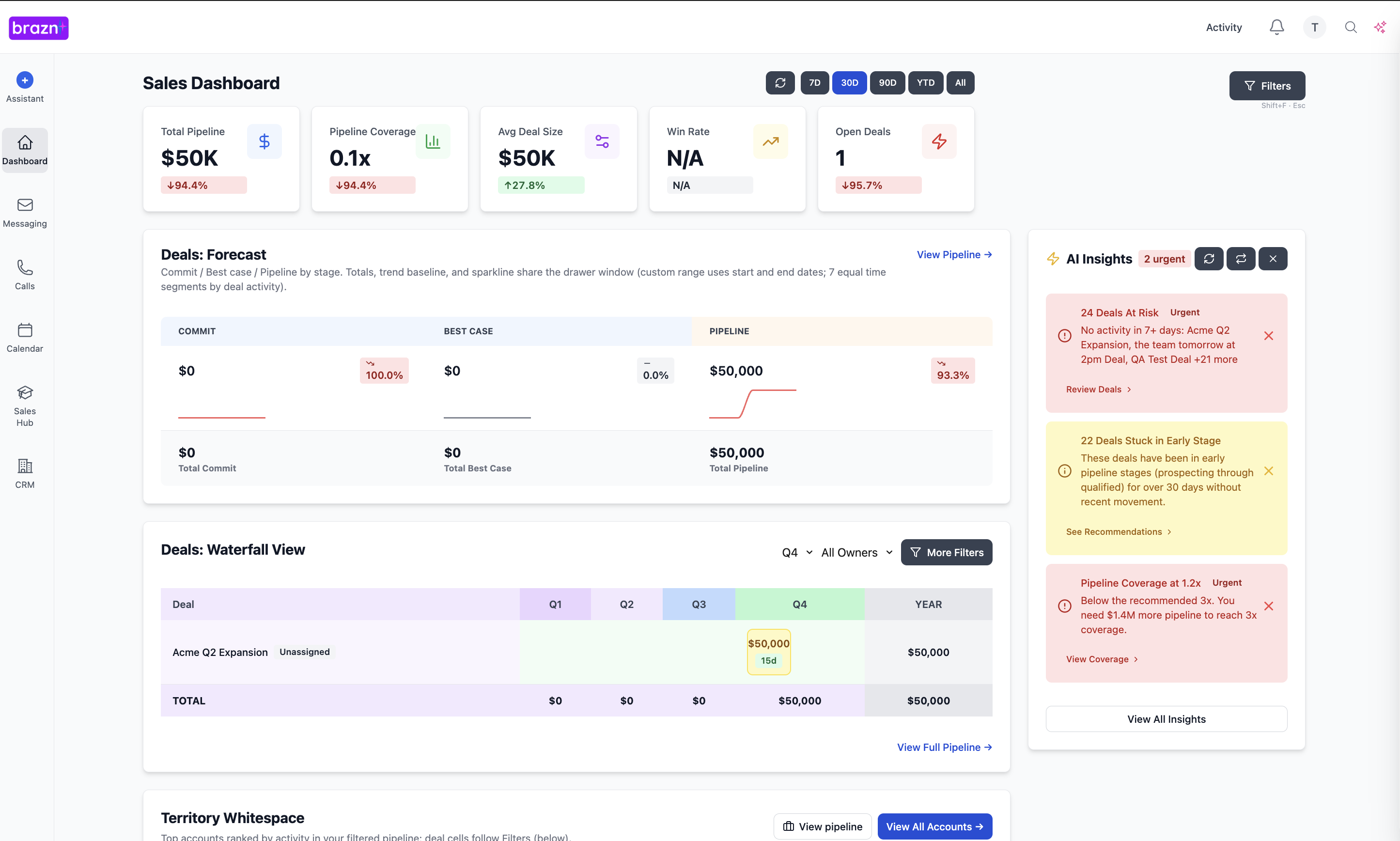
Brazn generates AI call summaries that are MEDDPICC-aware by design — every summary includes a qualification status update mapped to the eight MEDDPICC elements, updated after each call. Summaries auto-populate CRM qualification fields without rep action, ensuring deal records reflect current qualification reality rather than what the rep last remembered to update.
---
####
Book a demo to see how Brazn AI fits into your sales stack.

About the Author
Alex Margarit, Sales AI Expert, SaaS Sales Leader, BMC, ServiceNow, Docusign — 25+ years in SaaS sales.