
Gong vs Salesloft: Intelligence vs Engagement
Gong and Salesloft are the two most mature platforms in enterprise SaaS sales technology — and they are frequently compared by revenue leaders trying to decide where to invest. The comparison is understandable: both involve calls, both involve pipeline, both claim to improve sales performance. But they solve fundamentally different problems.
Gong is a revenue intelligence platform. Its job is to tell you what is happening in your deals and why. Salesloft is a sales engagement platform. Its job is to ensure your reps are executing the right actions with the right buyers at the right time.
Understanding this distinction is the prerequisite for building a stack that doesn't have expensive gaps or redundant overlaps.
What Gong Is Built to Do
Gong's starting point is the conversation — recording, transcribing, and analysing every call between your reps and your prospects. From that foundation, it has built outward into deal intelligence, forecast management, and coaching automation.
The core Gong value proposition: you can't improve what you can't see. Gong makes every sales conversation visible, searchable, and analytically actionable. A manager can review every call a rep had last week, identify the moment a deal went sideways, see which competitors are appearing in conversations, and understand which discovery questions are correlated with wins.
At the deal level, Gong aggregates engagement signals across calls, emails, and meetings to build a deal health picture — identifying deals with declining engagement, single-threaded relationships, or velocity changes that signal risk.
At the forecast level, Gong's AI model predicts which deals will close based on conversation and engagement patterns — giving CROs a signal-based forecast alongside rep self-reporting.
Gong is strongest for: managers and revenue leaders who want to understand what is actually happening in their pipeline from objective data rather than rep updates.What Salesloft Is Built to Do
Salesloft's starting point is the rep workflow — ensuring that every action a rep should take with every prospect is organised, prioritised, and executed at the right moment.
The core Salesloft value proposition: revenue is the result of the right actions taken consistently. Salesloft gives reps a structured, prioritised daily workflow and gives managers visibility into whether those actions are being taken.
At the outreach level, Salesloft's Cadences manage multi-step, multi-channel sequences — email, calls, LinkedIn, SMS — with conditional branching and step-level analytics. Reps execute from a unified inbox that surfaces the right task at the right time without context-switching across tools.
At the deal level, Salesloft's Deals view shows pipeline engagement — last activity, response rates, meeting frequency — alongside CRM stage. Managers can see at a glance which deals are going quiet.
At the forecast level, Salesloft's Forecast module provides rep-level and team-level roll-up with AI-assisted category assignments — informed by engagement patterns but ultimately requiring rep input for accuracy.
Salesloft is strongest for: managers who want to ensure rep execution is consistent and structured, and for AEs who need a single place to manage every buyer interaction.Side-by-Side Feature Comparison
| Capability | Gong | Salesloft |
| --- | --- | --- |
| Call recording and transcription | ✅ Core capability | ✅ Built-in (Conversations) |
| AI call analysis depth | ✅ Market-leading | ✅ Good |
| Email sequencing / cadences | ❌ Not designed for this | ✅ Enterprise-grade |
| Multi-channel outreach | ❌ | ✅ Email, call, LinkedIn, SMS |
| Rep task management | ❌ | ✅ Core capability |
| Deal health — engagement-based | ✅ Strong | ✅ Good |
| Deal health — qualification-based | ❌ | ❌ |
| Forecast management | ✅ Gong Forecast module | ✅ Built-in |
| Coaching automation | ✅ Advanced | ✅ Good |
| Rep performance analytics | ✅ Deep | ✅ Strong |
| CRM activity logging | ✅ Auto | ✅ Auto |
| AI-generated next steps | ✅ | ✅ |
| Sequence A/B testing | ❌ | ✅ |
| Revenue roll-up dashboards | ✅ Strong | ✅ Good |
| EU data residency | ➖ Available, config | ➖ Available, config |
| Pricing | ➖ Enterprise ($1,200–1,600/user) | ➖ Enterprise |
Where the Tools Overlap
Both tools now have call recording, both have pipeline views, and both have some level of AI-generated insight after a call. This overlap creates the perception that they're duplicative — but the depth and design intent behind each overlapping feature is different.
Salesloft's Conversations is a solid call intelligence product. It is not designed to be the centre of a revenue intelligence strategy — it's designed to be sufficient for teams already using Salesloft for engagement who don't want to add a separate call tool. Gong's call intelligence is its foundational capability, and everything else — deal intelligence, forecasting, coaching — is built on top of it.
Similarly, Gong has a pipeline view. But it is not designed to be the centre of rep execution management. It surfaces deal signals; it does not organise the rep's workflow or ensure they take the right actions.
The Sequencing Question
The most practical operational difference: Salesloft runs sequences. Gong does not. If your team needs a structured outreach engine — SDR cadences, AE follow-up sequences, multi-channel automation — Salesloft provides this natively and Gong does not.
This is rarely discussed in Gong vs Salesloft comparisons because both tools position themselves as "sales platforms" — but the absence of sequencing in Gong is a significant capability gap for teams with active outbound motions.
When Teams Use Both
Many enterprise SaaS revenue organisations use both. The motion:
Salesloft for execution: all outbound sequences, daily rep workflows, task management, and multi-channel touchpoints. Gong for intelligence: call analysis, deal health monitoring, coaching automation, and AI-powered forecast. CRM as the shared system of record that both tools read from and write to.This stack eliminates the capability gaps in each tool without meaningful duplication. The combined cost is significant — which is why teams at earlier stages typically choose one and add the other as they scale.
Where Brazn Fits
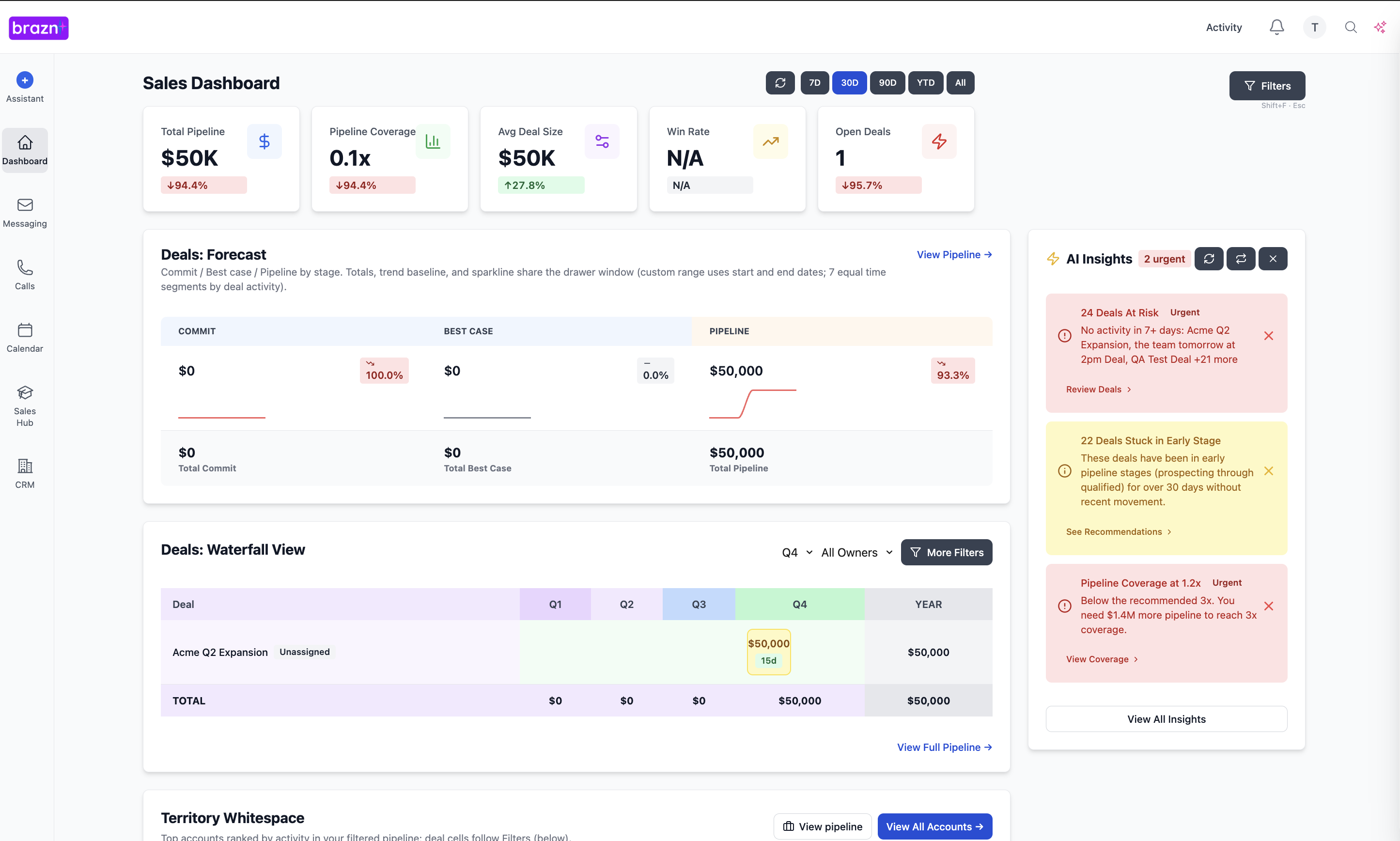
Both Gong and Salesloft leave a gap at the qualification layer. Neither provides MEDDPICC-native deal scoring, stakeholder gap detection, or a forecast built on qualification adherence rather than engagement activity. Brazn addresses that gap — sitting between the engagement layer (Salesloft) and the intelligence layer (Gong) to provide the qualification intelligence that determines which deals are real.
---
####
Book a demo to see how Brazn AI fits into your sales stack.

About the Author

Alex Margarit, Sales AI Expert, SaaS Sales Leader, BMC, ServiceNow, Docusign — 25+ years in SaaS sales.