
GDPR and AI Sales Tools: What SaaS Teams Need to Know
AI sales tools handle some of the most sensitive personal data in a commercial organisation: prospect contact information, call recordings of business conversations, email content, stakeholder engagement data, and CRM records spanning entire deal relationships.
For SaaS companies operating in or selling into the EU and UK, every AI sales tool in the stack is a data processor — and the obligations that creates are non-trivial. Getting this right isn't just legal hygiene; it's increasingly a commercial requirement, as enterprise buyers routinely audit vendor data practices as part of procurement.
The Core GDPR Framework for AI Sales Tools
Data controller vs data processorUnder GDPR, your company is the data controller — you determine the purposes for which personal data is processed. Every AI sales tool you use is a data processor — it processes data on your behalf, under your instruction. This means:
You are responsible for ensuring your data processors comply with GDPR.
You must have a Data Processing Agreement (DPA) with every AI sales tool that processes personal data.
If a tool can't produce a DPA, it cannot legally process EU personal data on your behalf.
Lawful basis for processingEvery processing activity needs a lawful basis. For B2B sales, the most commonly used bases are:
Legitimate interest — processing contact data to send relevant business communications to people in roles at companies that plausibly benefit from your product. This must be documented and must pass a balancing test against the data subject's rights. Contract performance — processing data necessary to fulfil a contract. Consent — explicit consent to receive marketing. Less commonly used in B2B cold outreach because it requires opt-in before contact.For cold outreach specifically, legitimate interest is the most practical basis — but it must be documented, and the processing must be genuinely proportionate to the business purpose.
What to Check for Each AI Sales Tool
Data Processing AgreementAsk every vendor for their DPA before signing. Review it for: the scope of processing permitted, sub-processor lists, security obligations, breach notification timelines, and data deletion procedures.
Data residencyWhere is your data stored and processed? For EU customers processing EU personal data, storage in the EU or in a country with an adequacy decision is required. Some US-headquartered tools store data in the US by default — which requires additional safeguards (Standard Contractual Clauses or equivalent).
Sub-processorsYour AI sales tool almost certainly uses sub-processors — LLM providers, cloud infrastructure, transcription engines. Each sub-processor that handles personal data must be listed in the vendor's DPA and must themselves comply with GDPR transfer requirements.
Data retention and deletionHow long does the vendor retain your data? What happens to data when you terminate the contract? Can you exercise right-to-erasure requests across all integrated systems?
Call recording consentCall recording tools process special-category data in some interpretations. At minimum, two-party consent requirements vary by jurisdiction: the UK, Ireland, and most EU countries require informing all parties that a call is being recorded before recording begins. Most call intelligence tools include automated disclosure messages — verify this is enabled and compliant in your jurisdictions.
AI model training on your dataSome AI tools use customer data to train or improve their AI models. This may be in the terms of service rather than the DPA. Review whether your call recordings, emails, or deal data are used for model training — and whether you can opt out.
Tool-Specific GDPR Considerations
Prospecting data tools (Apollo, ZoomInfo, Cognism)The data these tools provide was sourced from third parties. Your obligation is to verify that the data was lawfully sourced and that the lawful basis for your use of it is documented.
Cognism's data sourcing compliance posture is the strongest in the market — individual verification and DNC suppression across EU markets. Apollo and ZoomInfo have compliance documentation available but require more careful due diligence for EU-primary teams.
Call recording tools (Gong, Chorus, Salesloft Conversations)All major call intelligence tools have EU data residency options — but they may not be the default configuration. Ensure EU residency is activated at contract time, not assumed. Review sub-processor lists for LLM providers used for transcription and analysis.
CRM-integrated AI toolsAI tools that read from and write to Salesforce or HubSpot are processing the most comprehensive personal data in your stack — full deal histories, contact records, and communication logs. DPA coverage must explicitly include CRM integration as a permitted processing activity.
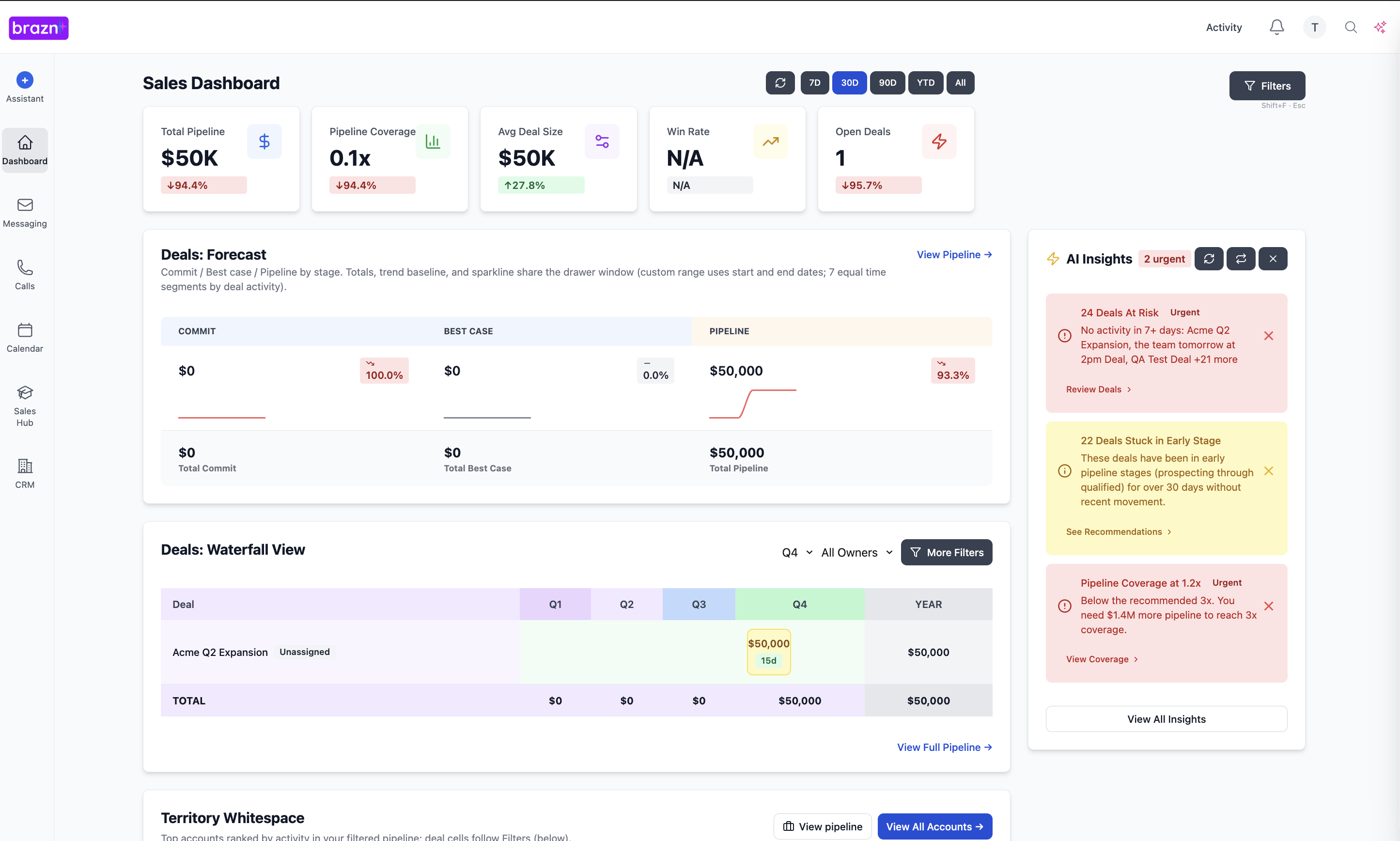
BraznBrazn is built with EU GDPR compliance as a default. EU data residency, DPA readily available, legitimate interest documentation for B2B processing, and no use of customer data for model training outside contracted scope. For SaaS teams with EU compliance as a hard requirement, Brazn's posture reduces the due diligence burden.
Practical Steps for GDPR Compliance in Your AI Sales Stack
Audit your current stack. List every tool that processes personal data — CRM, email, sequencing, call recording, enrichment, and AI tools. Collect DPAs. Ensure you have signed DPAs with every data processor. Store them centrally. Review sub-processors. For each tool, review the sub-processor list and flag any data transfers to non-adequate countries. Verify data residency. Confirm that EU personal data is stored within the EU or under adequate safeguards. Document lawful basis. For each processing activity, document the lawful basis in a Records of Processing Activities (ROPA). Check call recording consent. Verify that every call recording tool in the stack discloses recording at the start of each call. Review AI training terms. Read vendor terms carefully for data use in model training and opt out where available. Create a data retention schedule. Align vendor retention periods with your internal data minimisation policy.A Note on UK GDPR
Post-Brexit, the UK operates under UK GDPR — substantively similar to EU GDPR but a separate regime. UK SaaS companies selling into the EU must comply with both. Data transfers between the UK and EU are currently covered by an adequacy decision, but this should be monitored. The practical implication: if your AI sales tools have EU data residency, verify that UK-to-EU data transfers are also covered under the tool's DPA.
---
####
Book a demo to see how Brazn AI fits into your sales stack.

About the Author

Alex Margarit, Sales AI Expert, SaaS Sales Leader, BMC, ServiceNow, Docusign — 25+ years in SaaS sales.