
What Is a Sales Cadence? Guide for SaaS SDRs and AEs
A sales cadence is a structured, multi-step sequence of outreach touchpoints — emails, calls, LinkedIn messages, voicemails, and other contact methods — executed in a defined order, at defined intervals, over a defined period of time, with the goal of engaging a prospect and generating a qualified conversation. For SaaS SDRs and AEs, the cadence is the operational backbone of prospecting: it removes the guesswork of "when should I follow up?" and replaces it with a systematic, repeatable process.
---
Why Cadences Matter
The average B2B buyer requires between 8 and 12 touchpoints before responding to a cold outreach sequence. Most reps give up after two or three attempts. The gap between those two numbers — the attempts reps make versus the attempts required — is where pipeline disappears.
A cadence solves this by building persistence into the system rather than depending on individual rep discipline. When the sequence is defined in advance and executed through a sales engagement platform, the rep isn't deciding whether to follow up — they are executing a step in a process they have already agreed is the right one. This removes the emotional resistance to follow-up, increases touchpoint consistency across the team, and creates a measurable framework for testing and improving outreach performance.
---
The Anatomy of a SaaS Sales Cadence
A SaaS outbound cadence for SDRs typically runs 10–15 steps over 2–4 weeks. The specific structure varies by target persona, deal type, and channel mix, but a standard enterprise-focused outbound cadence might look like this:
| Step | Day | Channel | Description |
| --- | --- | --- | --- |
| 1 | Day 1 | Email | Personalised first-touch — specific trigger or insight |
| 2 | Day 2 | LinkedIn | Connection request with personalised note |
| 3 | Day 3 | Call + VM | Cold call — leave voicemail if no answer |
| 4 | Day 5 | Email | Follow-up referencing voicemail |
| 5 | Day 7 | LinkedIn | Engage with content or send InMail |
| 6 | Day 10 | Call | Second call attempt |
| 7 | Day 12 | Email | Value-add email — case study, relevant insight |
| 8 | Day 14 | Call + VM | Final call attempt |
| 9 | Day 17 | Email | Break-up or "last attempt" email |
Each step in a well-designed cadence has a specific purpose. Early steps establish the context and the why. Middle steps deliver value and build familiarity. Later steps create urgency and offer an easy out — which paradoxically often generates responses from prospects who weren't ready earlier.
---
SDR Cadences vs AE Cadences
SDR and AE cadences serve different commercial purposes and should be designed differently:
| Dimension | SDR Cadence | AE Cadence |
| --- | --- | --- |
| Goal | Generate a qualified first meeting | Advance an active deal or re-engage a stalled one |
| Audience | Cold or warm outbound prospects | Known contacts within active opportunities |
| Length | 10–15 steps over 2–4 weeks | 5–8 steps, shorter duration |
| Tone | Introductory, value-proposition focused | Relationship-aware, deal-specific |
| Personalisation | Account and persona level | Contact and deal-context level |
| Trigger | Account enters target list | Deal enters a specific stage or goes dark |
AEs run cadences too — but their cadences are typically shorter, more contextualised, and triggered by specific deal events: a prospect going quiet after a demo, a close date approaching without a signed MAP, a key stakeholder who hasn't engaged in two weeks.---
What Makes a Cadence High-Performing
Not all cadences are equal. The difference between a cadence that generates pipeline and one that generates unsubscribes comes down to five factors:
Personalisation depth. A generic five-line email sent to 500 people is not a cadence — it is a mass email with better software. High-performing cadences are personalised at the account level (specific company trigger, relevant industry context) and at the contact level (role-specific pain, relevant content). The first line of every email in the sequence should be specific enough that it could not have been sent to anyone else. Channel mix. Email-only cadences significantly underperform multi-channel ones. Research consistently shows that combining email, phone, and LinkedIn increases response rates substantially. Different prospects respond to different channels — a cadence that uses only one is excluding a portion of the addressable audience by design. Step timing. The interval between steps matters. Early steps can be close together — days 1 and 3 — because the prospect's memory of the previous touchpoint is fresh and the step feels like a natural follow-up. Later steps should be spaced further apart to avoid feeling harassing. Value density. Every step should deliver something — an insight, a relevant case study, a data point, a thought-provoking question. Steps that exist purely to say "just checking in" train prospects to ignore the sequence. Every touchpoint should give the prospect a reason to engage. A clear exit. A cadence without a defined end creates awkward, indefinite outreach. The final step should acknowledge the situation honestly — "I've reached out several times and haven't heard back — I'll stop reaching out for now, but if things change, here's how to find me" — and close the loop. This kind of break-up email generates more responses than almost any other step in a sequence.---
How AI Transforms Cadence Performance
The traditional approach to cadences — pre-written templates executed on a schedule — is being replaced by AI-native outreach that adapts each touchpoint to the specific context of the account and contact.
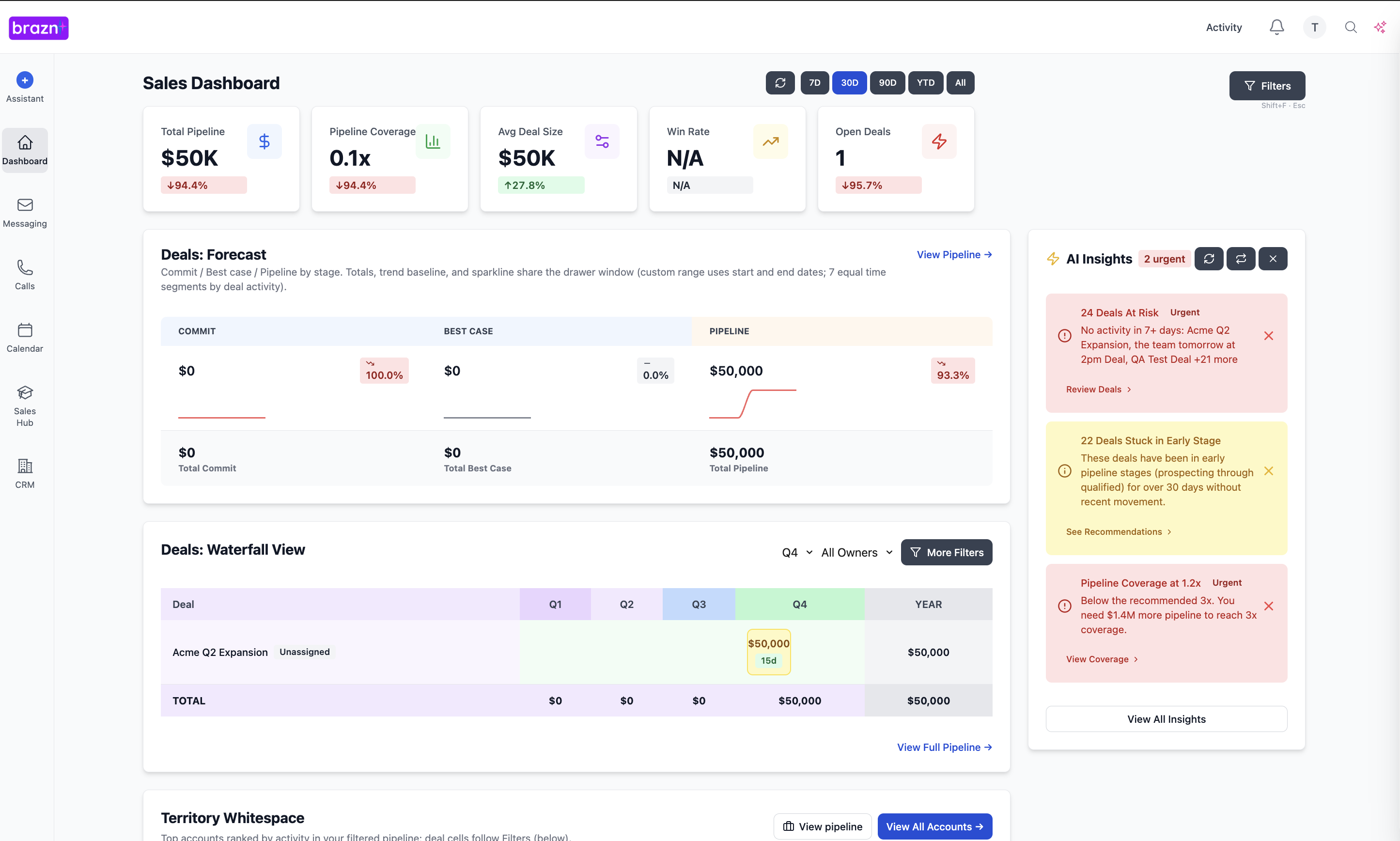
Brazn generates personalised cadence steps dynamically for each prospect — pulling company news, contact LinkedIn activity, technographic signals, and CRM history to create touchpoints that feel like research-based outreach rather than automated sequences. The result is emails that read like a rep spent twenty minutes writing them, executed at the scale of hundreds of prospects simultaneously.
Beyond generation, AI also analyses cadence performance — identifying which steps, subject lines, CTAs, and personas are generating the highest engagement rates, and surfacing specific recommendations for optimising the sequence based on actual performance data rather than best-practice assumptions.
---
The Bottom Line
A cadence is the infrastructure of prospecting. Built well — with the right number of steps, the right channel mix, genuine personalisation, and a consistent value proposition — it is the most reliable mechanism an SDR or AE has for generating pipeline from cold. The teams that outperform on pipeline generation are almost always the ones with the best cadence discipline: better sequences, more consistent execution, and a continuous improvement process informed by data.
---
See How Brazn Powers Personalised Outbound at Scale
Brazn generates research-backed, personalised cadence steps for every prospect — so your reps send better outreach in less time, and your pipeline reflects it.
---
Book a demo to see how Brazn AI fits into your sales stack.

About the Author

Alex Margarit, Sales AI Expert, SaaS Sales Leader, BMC, ServiceNow, Docusign — 25+ years in SaaS sales.