The Single-Page Board Update That Replaces Your 40-Slide Deck
Quarterly board meetings are a source of immense anxiety for Revenue Leaders. In an attempt to demonstrate control and comprehensive knowledge, CROs often create massive, 40-slide decks filled with dense charts, complex pipeline waterfalls, and endless bullet points. The result? The board is overwhelmed with data but starved of insight.
The problem? a 40-slide deck invites micro-management. It forces the board to dig into the weeds of conversion rates and individual deal updates, rather than focusing on the strategic direction of the company. It turns a strategic advisory session into a tactical interrogation.
This article introduces the 'Single-Page Board Update'—a radically simplified, high-impact framework that forces clarity, elevates the conversation, and gives the board exactly what they need to know, without the fluff.
What We'll Cover
In this article, we will cover:
- Why dense slide decks destroy strategic board conversations
- The psychology of executive communication and cognitive load
- The 4 essential quadrants of the Single-Page Board Update
- How to synthesize complex data into a single strategic narrative
- Handling the 'appendix' and anticipating deep-dive questions
Understanding the Approach
The Single-Page Board Update is a constrained communication framework that forces a CRO to distill the entire GTM motion into four core elements: Performance against Plan, Key Learnings, Strategic Adjustments, and Asks for the Board. In the context of RevOps, this means shifting from reporting 'what happened' (data) to explaining 'why it matters and what we're doing about it' (insight).
Example: Instead of 5 slides detailing pipeline generation by channel, the Single-Page Update has one bullet under 'Key Learnings': 'Outbound pipeline generation dropped 15%; we're shifting $50k from SDR tools to intent-based advertising to compensate.' This provides the insight and the action in one sentence.
Why This Matters
Adopting a single-page format is critical for CROs who want to maintain control of the board narrative and leverage the board's expertise effectively.
- Before: Board meetings are consumed by tactical questions about specific slides, leaving no time for strategy. After: The board quickly grasps the current state and spends 80% of the meeting advising on strategic challenges.
- Before: RevOps spends two weeks manually pulling data and formatting 40 slides. After: RevOps populates a standardized one-page template in a few hours, freeing up time for actual analysis.
- Before: The CRO appears defensive, trying to justify every data point. After: The CRO appears confident and in control, presenting a clear, synthesized narrative.
The Complete Guide
H3 Quadrant 1: The Scorecard (The 'What')
Objective: Provide a no-nonsense view of performance against the agreed-upon plan.
Actionable Advice: Include only the top 4-5 macro metrics: ARR vs. Plan, Net Retention Rate (NRR), CAC Payback Period, and Pipeline Coverage. Use a simple Red/Yellow/Green color coding.
Best Practices: Do not include vanity metrics. If a metric is red, own it immediately.
H3 Quadrant 2: Key Learnings (The 'Why')
Objective: Explain the drivers behind the scorecard, demonstrating that you understand the mechanics of your revenue engine.
Actionable Advice: List 2-3 concise bullet points explaining what went right and what went wrong. (e.g., 'Win rates in the enterprise segment increased by 12% due to the new ROI calculator.')
Best Practices: Focus on systemic learnings, not individual deal anecdotes.
H3 Quadrant 3: Strategic Adjustments (The 'Now What')
Objective: Outline the specific actions you're taking based on your learnings.
Actionable Advice: Detail 2-3 major initiatives for the upcoming quarter designed to fix the reds and accelerate the greens. (e.g., 'Re-allocating 2 SDRs to focus exclusively on the high-performing healthcare vertical.')
Best Practices: Ensure these adjustments directly correlate to the 'Key Learnings' from the previous quadrant.
H3 Quadrant 4: Asks for the Board (The 'Help')
Objective: Leverage the board's network and expertise to solve specific problems.
Actionable Advice: Be highly specific. Don't ask for 'help with hiring.' Ask for 'introductions to VP of Sales candidates with experience scaling from $10M to $30M in the cybersecurity space.'
Best Practices: If you have no asks, state 'No specific asks this quarter.' Do not invent busywork for the board.
How to Implement This
RevOps is responsible for generating the 'Scorecard' quadrant automatically from the CRM, ensuring there is a single source of truth. The CRO must own the narrative in the other three quadrants. To operationalize this, the CRO should draft the Single-Page Update a week before the meeting and circulate it to the board as a 'pre-read.' The actual meeting should then focus entirely on discussing the 'Strategic Adjustments' and the 'Asks.'
Next Steps
Complexity is easy; simplicity requires deep understanding. By forcing yourself to condense your GTM update into a single page, you elevate your own strategic thinking and command the respect of your board.
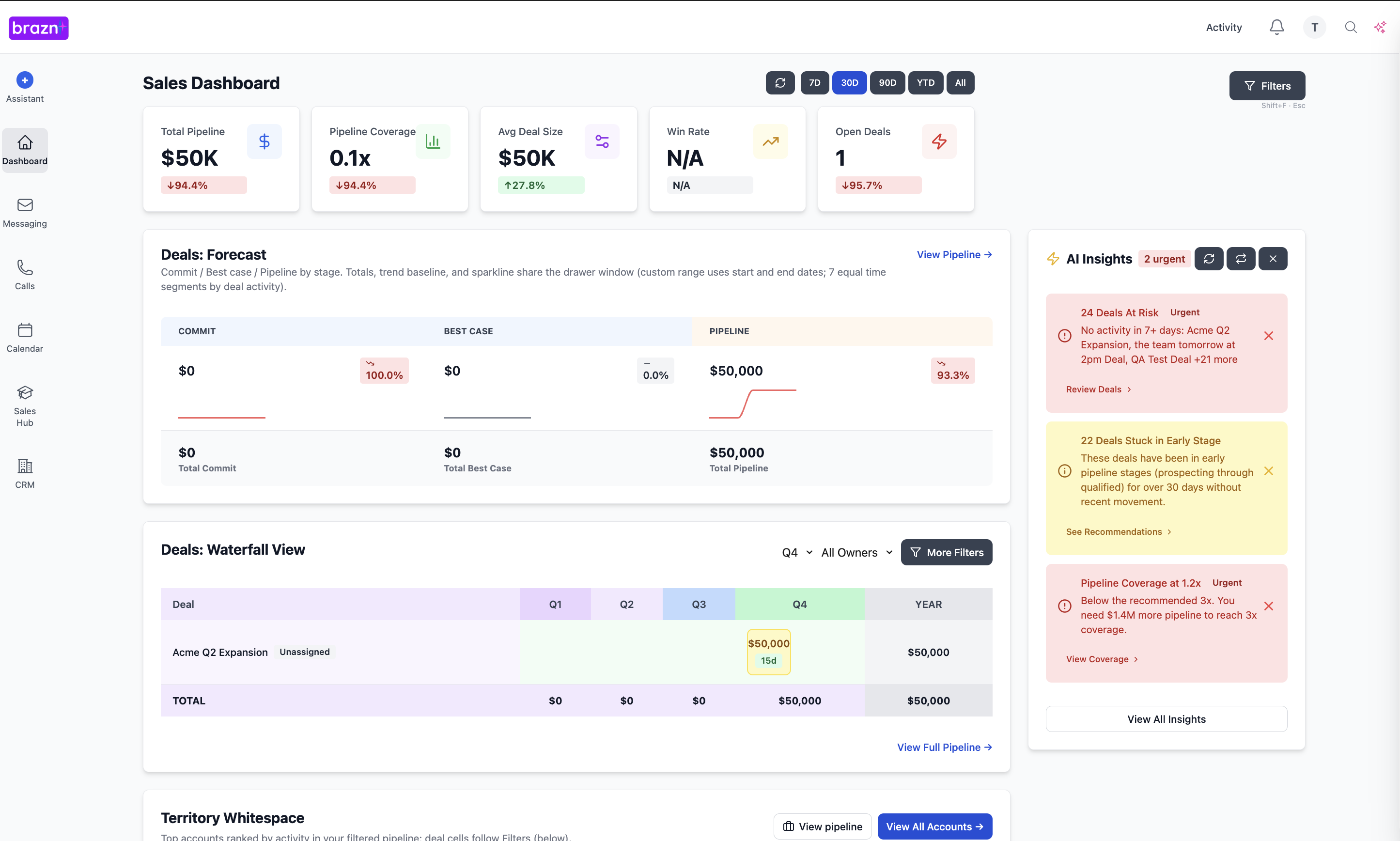
For your next board meeting, challenge yourself to create the Single-Page Update. You can keep your 40-slide deck in the appendix as a safety blanket, but present only the single page. You will be amazed at how much the quality of the conversation improves. Ready to simplify your revenue reporting? See how Brazn's executive dashboards provide single-page clarity.
Book a demo to see how Brazn AI fits into your sales stack.

About the Author
Alex Margarit, Sales AI Expert, SaaS Sales Leader, BMC, ServiceNow, Docusign — 25+ years in SaaS sales.