
The CRO + CXO Playbook for Orchestrating Revenue With AI Agents
The integration of AI into the revenue organization is no longer a localized experiment; it's a strategic imperative that requires executive alignment. When the Chief Revenue Officer (CRO) and the Chief Experience Officer (CXO) operate in silos, the customer journey fractures. Sales uses AI to push deals faster, while CS uses AI to deflect support tickets, resulting in a disjointed, frustrating experience for the buyer.
The problem? AI agents are incredibly powerful execution engines. If they're executing misaligned strategies, they will scale dysfunction faster than ever before.
This article provides the playbook for CROs and CXOs to orchestrate a unified revenue strategy using AI agents. We will detail how to align these powerful tools across the entire customer lifecycle, from initial outreach to renewal and expansion.
What We'll Cover
In this article, we will cover:
- The danger of siloed AI deployments in Sales and CS
- The concept of the 'Unified Revenue Journey'
- How CROs and CXOs must align on data and strategy
- Specific AI plays that bridge the pre- and post-sale gap
- Building a shared tech stack for continuous revenue generation
Understanding the Approach
"Orchestrating Revenue with AI Agents" means deploying AI not as isolated point solutions, but as a coordinated system that guides the customer seamlessly from prospect to advocate. In a GTM context, it requires the CRO (owning acquisition) and the CXO (owning retention/expansion) to operate from a single source of truth and a shared set of objectives.
Example: Instead of Sales using an AI tool to promise custom features to win a deal, and CS using a different AI tool to tell the customer those features don't exist, a unified approach uses a single AI agent to capture the exact requirements during discovery and automatically build the onboarding plan for the CS team.
Why This Matters
Executive alignment on AI is critical for maximizing Customer Lifetime Value (LTV) and preventing churn. It ensures that the promises made during the sales cycle are actually delivered during the customer experience.
- Before: The SDR-to-AE and AE-to-CS handoffs are manual, prone to data loss, and frustrating for the customer. After: AI agents automate the handoffs, ensuring context is preserved and the customer feels known and valued.
- Before: Sales and CS use different data sets, leading to conflicting strategies. After: Both teams operate from a unified data model, enabling seamless cross-selling and proactive churn prevention.
- Before: AI is used to optimize departmental silos. After: AI is used to optimize the entire customer journey.
The Complete Guide
1. The Shared Data Foundation
Objective: Ensure Sales and CS are looking at the same reality.
Actionable Advice: The CRO and CXO must mandate a single source of truth for customer data. Integrate CRM, product usage telemetry, and support ticketing systems. AI agents can't orchestrate a seamless journey if they're operating on fragmented, siloed data.
Best Practices: RevOps must own this unified data layer, ensuring it's clean, accurate, and accessible to both teams.
2. The Automated Pre-to-Post Sale Handoff
Objective: Eliminate the "information black hole" when a deal closes.
Actionable Advice: Deploy an AI agent to monitor the CRM. When a deal moves to "Closed-Won," the agent automatically synthesizes the discovery notes, the business case, and the promised deliverables into a comprehensive "Customer Brief." This brief is instantly pushed to the assigned Customer Success Manager (CSM).
Best Practices: The AI should also draft the introductory email from the AE to the CSM, introducing them to the client and summarizing the goals.
3. The 'Early Warning' Churn Predictor
Objective: Shift CS from reactive support to proactive retention.
Actionable Advice: Use AI to analyze product usage patterns, support ticket sentiment, and engagement with marketing materials. Create an automated alert system that notifies both the CSM and the original AE when a customer exhibits behavior highly correlated with churn (e.g., a 50% drop in login frequency).
Best Practices: The alert should include an AI-generated recommended play for re-engaging the customer.
4. The 'White Space' Expansion Play
Objective: Coordinate cross-sell efforts between Sales and CS.
Actionable Advice: Use AI to map your existing customer base against your full product suite to identify "white space" (opportunities for cross-selling). The AI agent should alert the CSM when a customer achieves a specific success milestone, prompting them to introduce the complementary product, and seamlessly looping in an AE if a new contract is required.
Best Practices: Ensure the compensation models for both Sales and CS incentivize this collaborative expansion motion.
5. The Joint Quarterly Business Review (QBR)
Objective: Maintain executive alignment on the customer journey.
Actionable Advice: The CRO and CXO should hold a joint QBR focused specifically on the friction points in the customer lifecycle. Use AI to analyze the transcripts of all lost deals and churned accounts to identify systemic issues (e.g., "Sales is selling to the wrong ICP" or "Onboarding is taking too long").
Best Practices: Make this a data-driven problem-solving session, not a finger-pointing exercise.
How to Implement This
Revops is the critical bridge between the CRO and CXO. They are responsible for building the shared data foundation, configuring the AI agents that handle the handoffs, and creating the dashboards that track the unified revenue metrics (like LTV to CAC ratio).The CRO and CXO must present a united front to the company. If the CRO incentivizes reps to close bad-fit deals just to hit quota, the CXO's AI retention tools will fail. Alignment starts at the executive level and is enforced through RevOps infrastructure.
Next Steps
AI agents will expose the cracks in your Go-to-Market motion faster than ever before. By aligning the CRO and CXO around a unified revenue strategy, you can use AI to seal those cracks and build a seamless, highly profitable customer journey.
Schedule a 1:1 between the CRO and CXO this week. Review the exact process of how a deal transitions from "Closed-Won" to "Onboarding." Identify one manual step that can be automated by AI. Ready to unify your revenue engine? Discover how Brazn orchestrates the entire customer lifecycle.
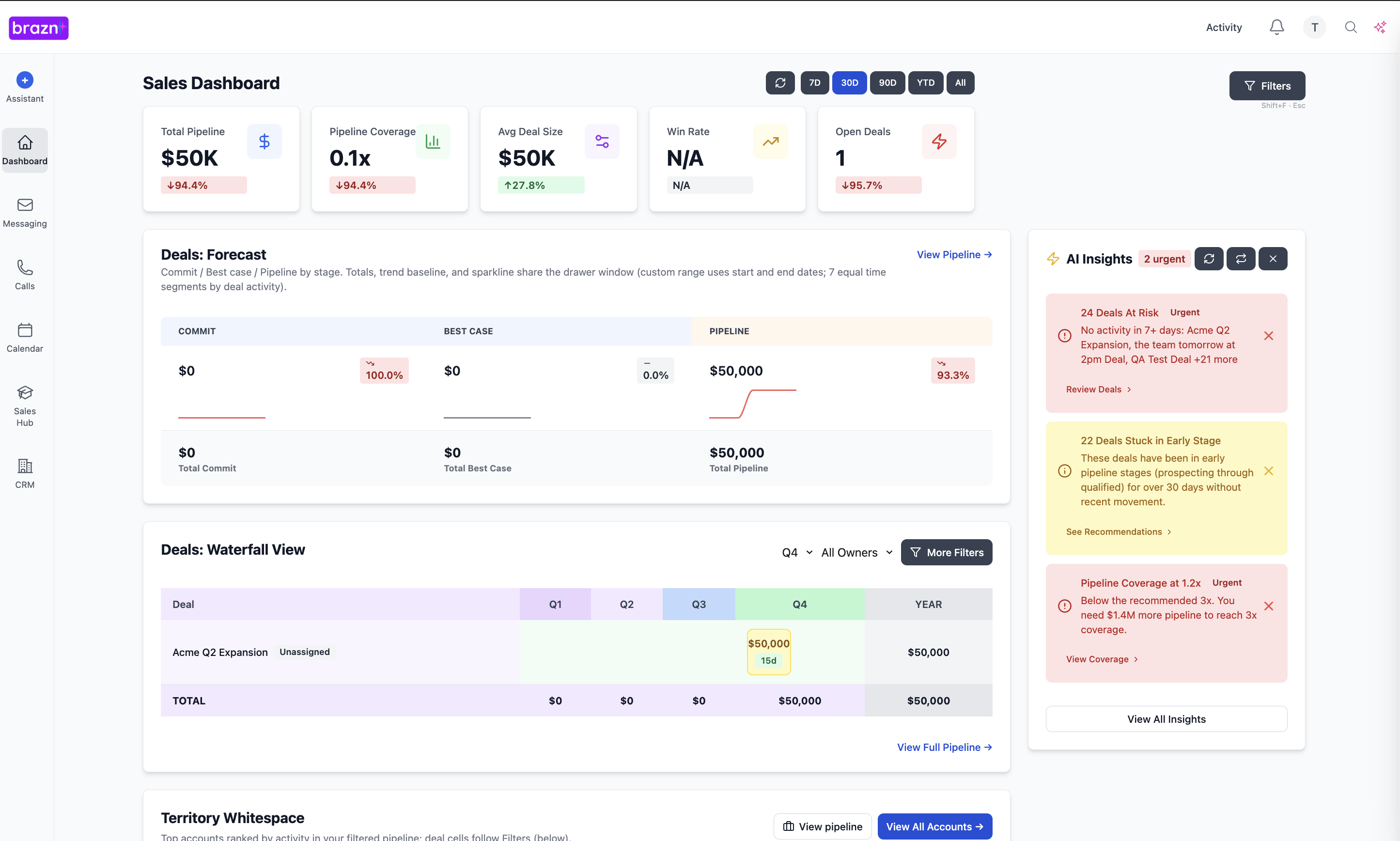
Book a demo to see how Brazn AI fits into your sales stack.

About the Author
Alex Margarit, Sales AI Expert, SaaS Sales Leader, BMC, ServiceNow, Docusign — 25+ years in SaaS sales.