

The Anatomy of a CRO’s Best Week
The life of a Chief Revenue Officer is often defined by chaos. Between reacting to lost deals, managing internal politics, and putting out fires in the tech stack, the week quickly slips away. The problem? when a CRO spends their entire week in reactive mode, they fail to execute their primary responsibility: steering the strategic direction of the revenue engine. They become highly paid firefighters rather than strategic architects.
To drive predictable growth, a CRO must intentionally design their week to balance operational execution with strategic planning. They must create a cadence that forces them to look up from the daily grind. This article dissects the 'Anatomy of a CRO's Best Week,' providing a blueprint for how elite revenue leaders structure their time to maximize impact.
What We'll Cover
In this article, we will cover:
- Why reactive leadership stalls revenue growth
- The concept of 'Calendar Architecture' for executives
- The 4 core zones of a CRO's week
- A day-by-day breakdown of an optimized schedule
- How to protect your strategic time blocks
Understanding the Approach
The 'Anatomy of a CRO's Best Week' is a structured scheduling framework that intentionally allocates time across four critical zones: Strategy, Team Execution (Forecasting/Pipeline), Customer Engagement, and Cross-Functional Alignment. In a GTM context, it ensures the CRO isn't just managing the current quarter, but actively building the Sales Pipeline for the next three.
Example: Instead of allowing their calendar to be filled with ad-hoc internal meetings, a CRO blocks Monday mornings exclusively for reviewing leading indicators and adjusting strategy, ensuring the rest of the week's execution is aligned with the latest data.
Why This Matters
A structured week is the difference between a CRO who survives the quarter and a CRO who dominates the year.
- Before: The CRO's week is dictated by other people's emergencies, leaving no time for strategic planning. After: The CRO controls their calendar, ensuring high-leverage activities always take precedence.
- Before: Forecast calls are interrogations that happen too late in the week to affect change. After: Pipeline reviews happen early, allowing the team time to execute mitigation plays before Friday.
- Before: The CRO rarely speaks to customers unless a deal is escalating. After: Dedicated 'Customer Engagement' blocks ensure the CRO is constantly gathering market intelligence and building executive relationships.
The Complete Guide
H3 Zone 1: The Strategic Pulse (Monday Morning)
Objective: Set the direction for the week based on hard data.
Actionable Advice: Block the first two hours of Monday for 'Deep Work.' Review the 9 leading indicators, analyze the previous week's performance, and define the 3 'Must-Win' objectives for the current week. Do not open email or Slack during this time.
Best Practices: Share these 3 objectives with your GTM leadership team immediately after this block to ensure alignment.
H3 Zone 2: Team Execution & Pipeline (Monday/Tuesday)
Objective: Ensure the sales organization is executing the strategy.
Actionable Advice: Schedule forecast and pipeline hygiene reviews early in the week. Shift the focus from 'What is the number?' to 'What is the strategy to close the gap?' Use these meetings to unblock managers and allocate resources to critical deals.
Best Practices: Require managers to submit their numbers and risk assessments before the meeting, so the time is spent on problem-solving, not data gathering.
H3 Zone 3: Customer & Market Engagement (Wednesday/Thursday)
Objective: Stay connected to the buyer and support high-value deals.
Actionable Advice: Dedicate at least 20% of your week to external meetings. This includes joining late-stage deal negotiations as the executive sponsor, conducting win/loss interviews, and meeting with current customers to understand their evolving needs.
Best Practices: Don't just join calls to 'say hello.' Have a specific, strategic role defined by the AE before you join the meeting.
H3 Zone 4: Cross-Functional Alignment (Friday)
Objective: Ensure Sales, Marketing, and CS are moving in the same direction.
Actionable Advice: Use Fridays for 1:1s with your peers (CMO, CCO, Product leadership). Review shared KPIs, address any friction in the handoff processes, and align on upcoming product launches or marketing campaigns.
Best Practices: End the week by sending a concise 'Friday Update' to the CEO and Board, summarizing the week's wins, risks, and the focus for next week.
How to Implement This
The CRO must be ruthless in defending this architecture. The Executive Assistant (EA) plays a crucial role here, acting as the gatekeeper to ensure ad-hoc meetings don't overwrite strategic blocks. The CRO must also train their direct reports (VP of Sales, Marketing leaders) to respect this cadence, ensuring they come to scheduled meetings prepared, rather than relying on constant, disruptive 'quick questions' throughout the week.
Next Steps
You can't build a predictable revenue engine if your own schedule is unpredictable. By intentionally designing your week, you elevate your leadership from reactive management to strategic orchestration.
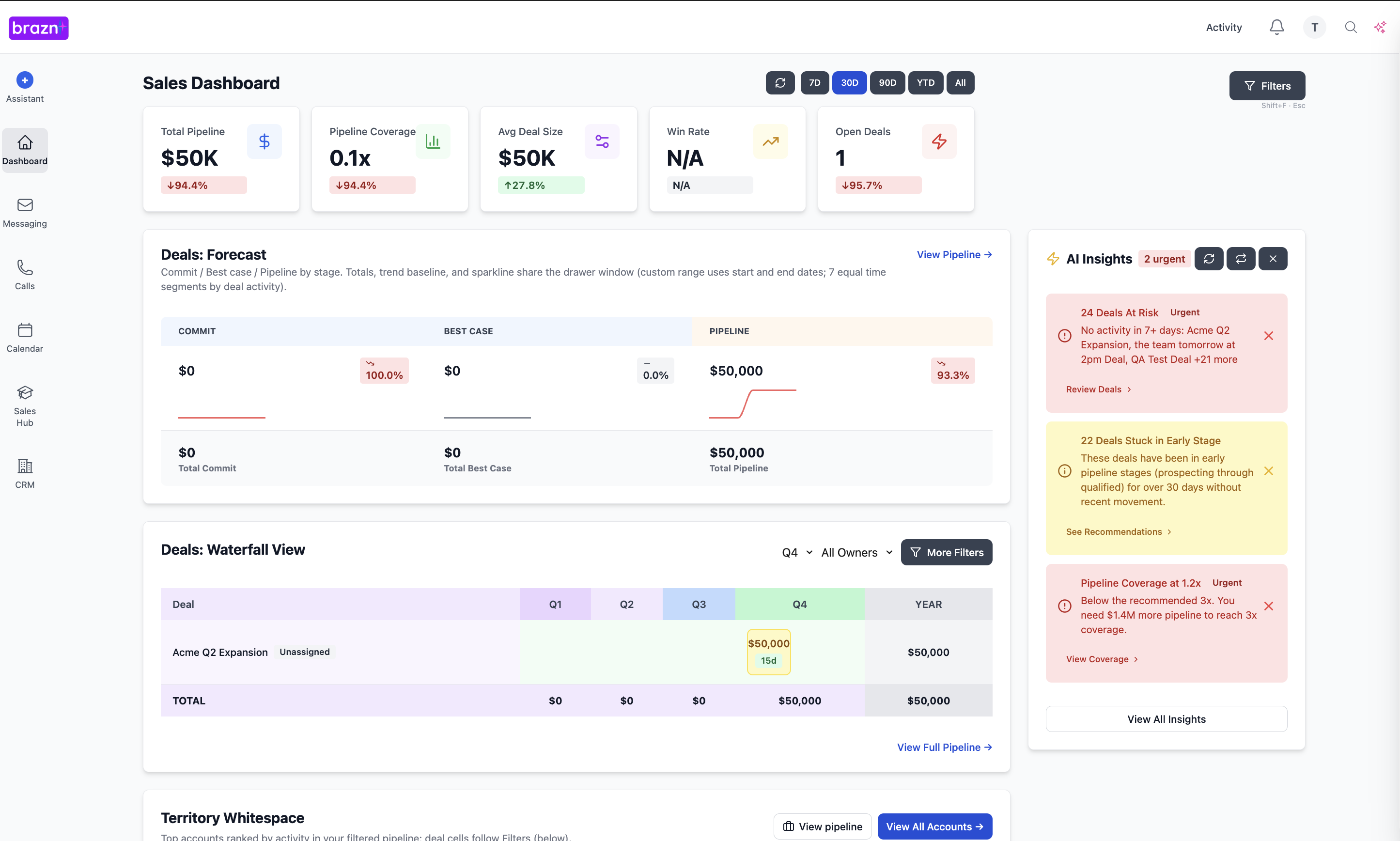
Start small: Block out the first two hours of next Monday morning as 'Strategic Pulse' time. Defend it fiercely and see how it changes the trajectory of your week. Ready to get the data you need for your Monday review? See how Brazn's executive dashboards provide instant clarity. If you're running your GTM team in Salesforce, make sure these metrics are surfaced in a single place.
Book a demo to see how Brazn AI fits into your sales stack.

About the Author

Alex Margarit, Sales AI Expert, SaaS Sales Leader, BMC, ServiceNow, Docusign — 25+ years in SaaS sales.