

Risk-First Deal Reviews as a Default Cadence
The weekly deal review is a staple of sales management, yet it's widely considered the least productive hour of a rep's week. The traditional format involves a manager scrolling through a CRM list view, asking the rep for a status update on every deal. The rep, eager to avoid scrutiny, paints a rosy picture ("they're highly engaged," "budget is approved"), and the manager, lacking objective data, is forced to accept the narrative. This subjective "interrogation" doesn't uncover true risk and rarely changes the trajectory of a deal.
To drive actual pipeline velocity, sales leaders must fundamentally restructure the deal review. This article details how to move away from rep-driven narratives and rebuild the deal review process around objective, AI-surfaced risk telemetry, transforming the meeting from a status update into a strategic intervention.
What We'll Cover
In this article, we will cover:
- Why the traditional "status update" deal review is broken
- The shift from subjective narrative to objective risk telemetry
- 3 specific AI risk signals that should drive the review agenda
- A new 30-minute agenda for the AI-augmented deal review
- How managers must change their coaching style to adapt
Understanding the Approach
An AI-augmented deal review abandons the practice of reviewing every deal sequentially. Instead, it uses AI to analyze CRM data, email velocity, and conversation transcripts to generate a "Risk Score" for every opportunity. The manager then uses these objective scores to build the meeting agenda, focusing entirely on the deals where the AI has flagged a discrepancy between the rep's "Commit" status and the actual behavioral data.
Example: Instead of asking, "How is the Acme deal going?", the manager starts the review by saying, "I see you have Acme in Commit for this month, but the AI flagged that email velocity has dropped by 60% in the last two weeks, and we haven't spoken to the economic buyer since the demo. Let's build a plan to address those two specific risks today."
Why This Matters
Restructuring deal reviews around AI insights is critical for improving forecast accuracy, saving at-risk deals early, and making management coaching highly actionable.
- Before: Deal reviews are 60-minute interrogations that cover 20 deals superficially, uncovering no real insight. After: Deal reviews are 30-minute strategic sessions that deep-dive into the 3 most critical "at-risk" deals, resulting in concrete action plans.
- Before: Managers rely on "happy ears" and rep intuition to gauge deal health. After: Managers rely on objective behavioral data (e.g., lack of multi-threading, unresolved objections) to assess true probability.
- Before: Deals slip at the end of the quarter, surprising both the rep and the manager. After: Risks are identified and mitigated weeks before the close date, ensuring predictable revenue.
The Complete Guide
H3 Signal 1: The Momentum Drop
Objective: Identify deals that are quietly stalling despite the rep's optimism.
Actionable Advice: Use an AI tool that tracks "engagement velocity" (the frequency of emails, meetings, and document views). If a deal in the "Proposal" stage sees a 50% drop in velocity compared to historical benchmarks for won deals, the AI flags it. This must be the first item on the deal review agenda.
Best Practices: Don't accept "they are just busy" as an excuse. A momentum drop requires a specific re-engagement play, such as an executive-level reach out.
H3 Signal 2: The "Single-Threaded" Warning
Objective: Ensure the deal is insulated against champion turnover or hidden detractors.
Actionable Advice: Have the AI analyze the opportunity contacts and meeting attendees. If a deal is over a certain ARR threshold and only has one active contact engaged in the last 14 days, the AI flags it as "Single-Threaded Risk." The deal review must focus on identifying the missing stakeholders and crafting a plan to reach them.
Best Practices: Mandate that deals can't move to the final "Commit" stage while this flag is active.
H3 Signal 3: Unresolved Competitor Mentions
Objective: Proactively address competitive threats before the buyer makes a decision.
Actionable Advice: Use conversational intelligence to flag any deal where a competitor was mentioned on a call, but the rep didn't successfully execute a "battlecard" pivot (as analyzed by the AI). The manager and rep must use the review to role-play the response and draft a follow-up email addressing the competitor's specific weakness.
Best Practices: Listen to the actual audio snippet during the review to understand the context of the competitor mention.
How to Implement This
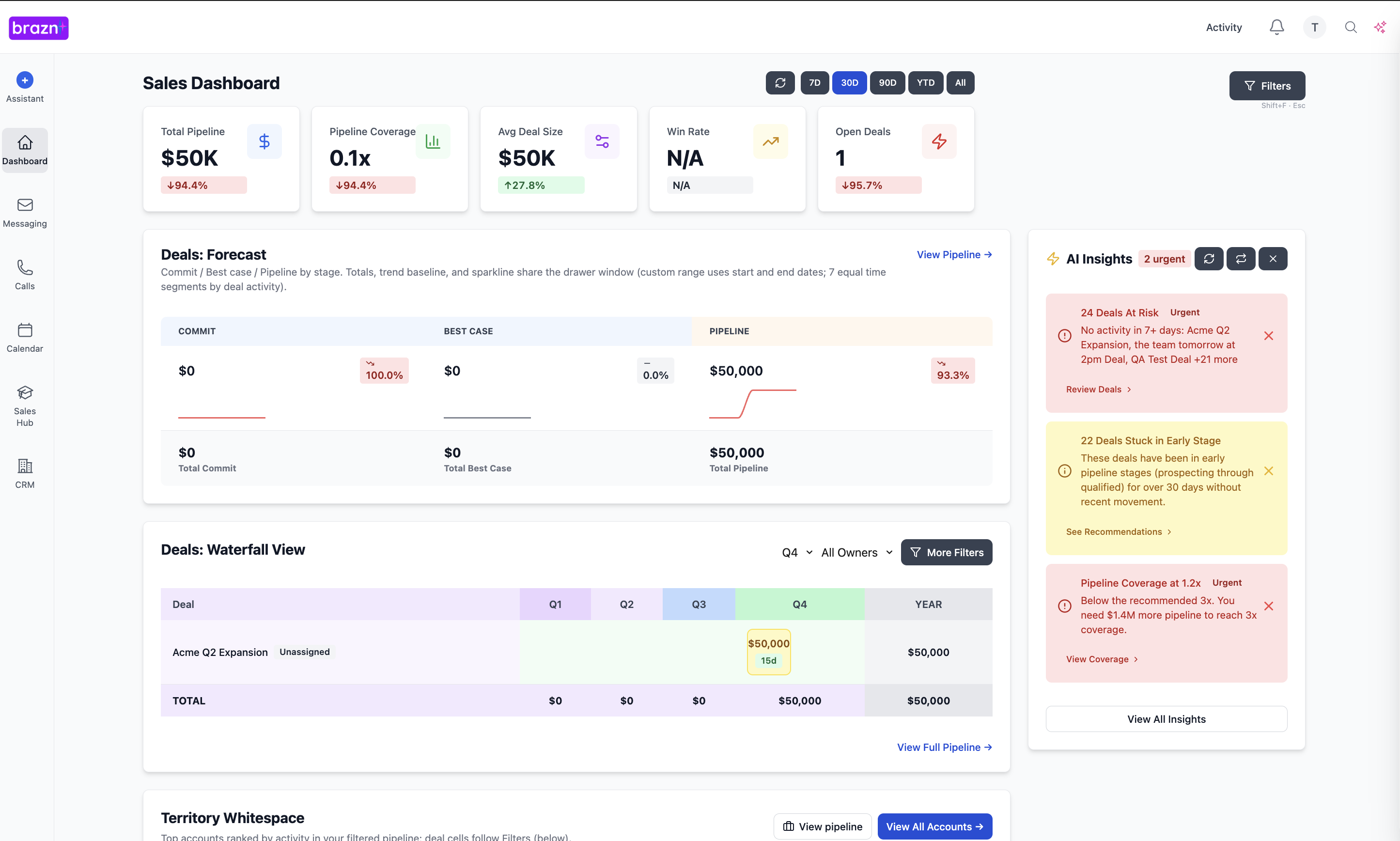
RevOps must build the dashboards that make these AI risk scores immediately visible to both the rep and the manager. The CRM view used for the deal review should be sorted by "Risk Score," not by "Close Date" or "Deal Size." Enablement must train managers to shift their posture. They are no longer interrogators trying to catch the rep in a lie; they're strategic partners helping the rep solve the complex puzzles identified by the AI.Next Steps
The era of the subjective deal review is over. By anchoring your coaching sessions in objective, AI-surfaced data, you can stop wasting time on status updates and start actively managing the risks that derail your revenue.
For your next deal review, refuse to ask "how is it going?" Instead, pick the one deal in the rep's pipeline with the lowest engagement velocity and spend the entire session building a plan to unstick it. Ready to transform your deal reviews? Discover how Brazn surfaces the objective risks in your pipeline.
Book a demo to see how Brazn AI fits into your sales stack.

About the Author

Alex Margarit, Sales AI Expert, SaaS Sales Leader, BMC, ServiceNow, Docusign — 25+ years in SaaS sales.