

Content: # Point Tools vs Platform: A RevOps Decision Framework
The modern RevOps tech stack often becomes a sprawling, expensive mess. Teams buy point tools for every micro-workflow, creating silos, integration headaches, and rep context switching.
As budgets tighten and AI becomes central, RevOps leaders face a decision: manage an ecosystem of point tools or consolidate onto a platform.
This article provides a framework to evaluate the right choice.
What We'll Cover
In this article, we will cover:
- Hidden costs of best-of-breed point tools
- Why AI pushes consolidation
- A point tool vs platform decision framework
- When point tools still make sense
- How to execute consolidation
Understanding the Approach
A point tool solves one narrow problem. A platform handles interconnected workflows on a unified data model.
Example: Point tools require exporting leads between apps for outreach and analysis. Platforms unify lead identification, outreach, and conversation analysis in one interface.
Why This Matters
The right architecture reduces spend and increases productivity.
- Before: RevOps spends time fixing broken integrations. After: RevOps builds workflows on stable unified data.
- Before: Reps reject complex stacks. After: Reps adopt a single pane of glass.
- Before: AI fails on fragmented data. After: AI succeeds with unified context.
The Complete Guide
Factor 1: Data Foundation (AI Imperative)
Question: Does the workflow require cross-functional context?
Guidance: If AI needs deep context, lean platform.
Factor 2: Total Cost of Ownership
Question: Are you including integration and maintenance time?
Guidance: If RevOps is drowning in maintenance, lean platform.
Factor 3: Niche Requirements
Question: Do you need specialized edge-case functionality?
Guidance: If yes and critical, lean point tool.
Factor 4: Adoption and Context Switching
Question: Will this increase rep cognitive load?
Guidance: If tech fatigue is high, lean platform.
How to Implement This
RevOps audits the stack, identifies overlap, and calculates true TCO. CRO provides air cover. Use consolidation to redesign workflows rather than replicate broken ones.
Next Steps
Audit your stack and identify two low-adoption tools. Calculate TCO and evaluate platform consolidation.
Point Tools vs Platform: A RevOps Decision Framework
The modern RevOps tech stack is often a sprawling, expensive mess. Over the past five years, the explosion of specialized SaaS applications has led teams to adopt a "best-of-breed" approach, buying a separate point tool for every conceivable micro-workflow: one tool for email sequencing, another for call recording, a third for intent data, and a fourth for forecasting. The result? Data silos, integration nightmares, and reps who spend more time context-switching between tabs than actually selling.
As budgets tighten and the focus shifts to operational efficiency, RevOps leaders face a critical decision: continue managing a fragile ecosystem of point tools, or consolidate onto a unified platform. This article provides a strategic framework to help you evaluate your tech stack and make the right architectural choice for an AI-native future.
What We'll Cover
In this article, we will cover:
- The hidden costs of the "best-of-breed" point tool approach
- Why AI is forcing a shift towards platform consolidation
- The Point Tool vs. Platform Decision Framework
- When a point tool is still the right choice
- How to execute a tech stack consolidation project
Understanding the Approach
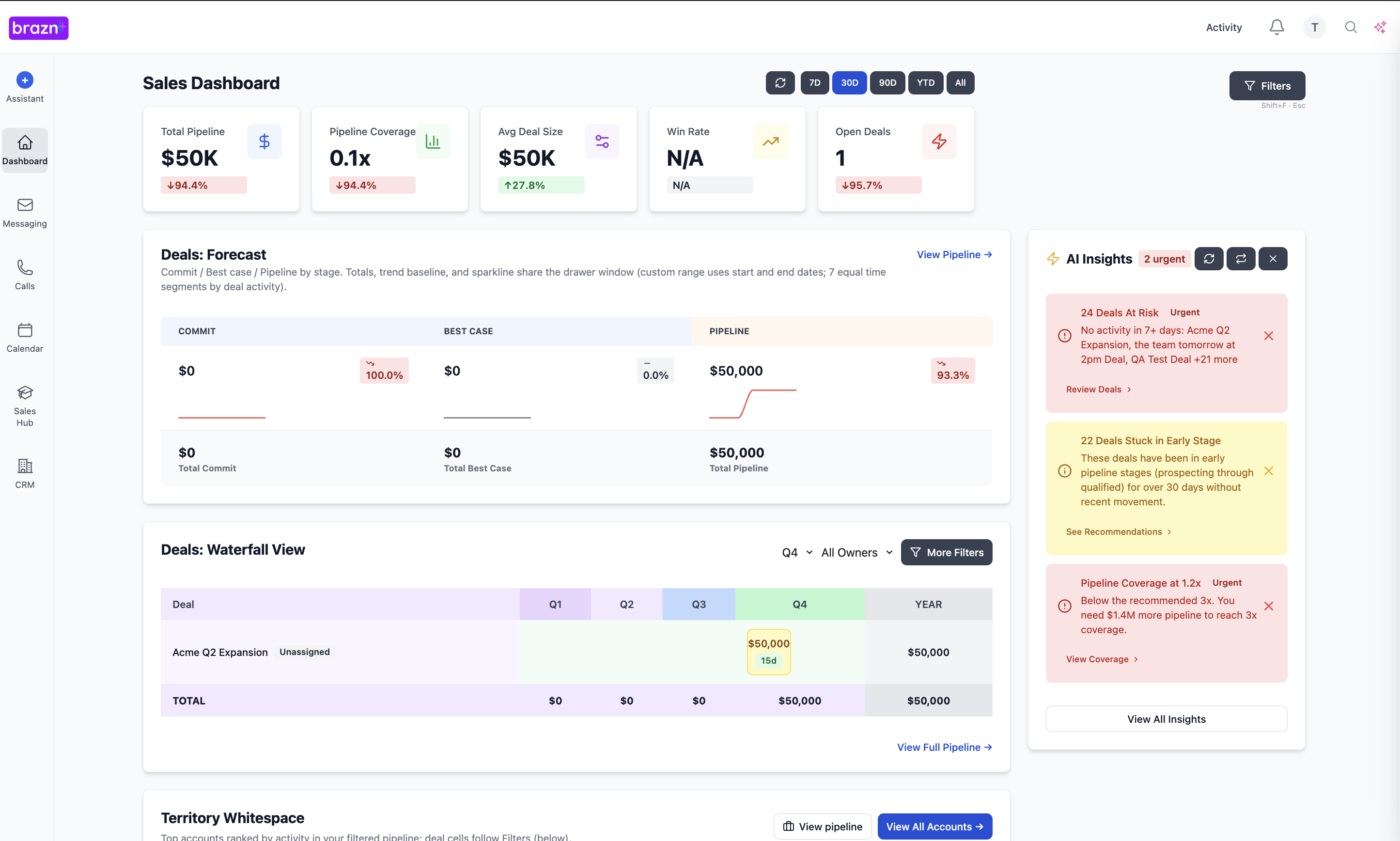
A "Point Tool" is a software application designed to solve one specific problem exceptionally well (e.g., a tool exclusively for Linkedin automation). A "Platform" is an integrated suite of tools that manage a broad range of interconnected workflows across a unified data model (e.g., a complete revenue intelligence and execution platform like Brazn).
Example: In a point tool architecture, an SDR uses Tool A to find a lead, exports it to Tool B to send an email, and the manager uses Tool C to listen to the resulting call. In a platform architecture, the lead identification, outreach, and conversation analysis all happen within a single interface, sharing the same underlying data.
Why This Matters
Choosing the right architectural approach is critical for reducing software spend, improving data integrity, and maximizing rep productivity.
- Before: RevOps spends 40% of their time fixing broken API integrations between mismatched tools. After: RevOps spends their time building strategic, cross-functional workflows on a stable, unified platform.
- Before: Reps refuse to adopt new tools because the tech stack is already too complex and disjointed. After: Reps embrace a unified platform because it simplifies their workflow and reduces context-switching.
- Before: AI initiatives fail because the data is fragmented across six different databases. After: AI models thrive because they have access to a complete, unified dataset of the entire customer journey.
The Complete Guide
Factor 1: The Data Foundation (The AI Imperative)
Framework Question: Does this workflow require deep, cross-functional context to be effective?
Analysis: AI is only as good as its data. If you want an AI agent to automatically draft an email based on a prospect's recent support ticket and their website activity, that data must live in one place. Platforms provide the unified data model necessary for advanced, agentic AI. Point tools inherently fragment data, severely limiting AI capabilities.
Decision: If the workflow is critical for your AI strategy, lean Platform.
Factor 2: Total Cost of Ownership (TCO)
Framework Question: Are we calculating the true cost of this tool, including integration and maintenance?
Analysis: A point tool might have a lower sticker price, but the TCO includes the engineering hours to integrate it, the RevOps hours to maintain it, and the cost of the inevitable data errors. Platforms often have a higher upfront cost but significantly lower TCO due to native integrations and centralized management.
Decision: If RevOps is drowning in integration maintenance, lean Platform.
Factor 3: Workflow Complexity and Niche Requirements
Framework Question: Does this workflow require highly specialized, edge-case functionality that a platform can't provide?
Analysis: Platforms are designed to handle 80-90% of standard workflows exceptionally well. However, if your business has a highly unique requirement (e.g., complex, multi-currency commission routing for a global partner network), a specialized point tool might be necessary.
Decision: If the workflow is highly niche and critical to the business model, lean Point Tool.
Factor 4: User Adoption and Context Switching
Framework Question: Will adding this tool increase the cognitive load on our sales reps?
Analysis: Every new interface a rep has to learn reduces their overall productivity. Platforms offer a single pane of glass, reducing friction and increasing adoption. If a point tool requires reps to constantly switch tabs to complete a single task, it will likely be abandoned.
Decision: If rep adoption is historically low and tech fatigue is high, lean Platform.
How to Implement This
Consolidation is a major change management initiative. RevOps must lead the charge by conducting a comprehensive audit of the current stack, identifying overlapping functionality and calculating the true TCO of each tool. The Chief Revenue Officer must provide executive air cover, as individual teams will often fight to keep their preferred niche tools. When transitioning to a platform, don't try to replicate the old, broken processes in the new system; use the migration as an opportunity to redesign and streamline workflows.
Next Steps
The era of the sprawling, 20-tool revenue stack is ending. Driven by the need for efficiency and the data requirements of AI, the future belongs to unified platforms. By applying this decision framework, you can untangle your tech stack and build a foundation for scalable growth.
Audit your tech stack this week. Identify two point tools that have overlapping functionality or low rep adoption. Calculate their combined TCO (including RevOps maintenance time) and evaluate if a unified platform could replace them both. Ready to consolidate your stack and unlock true AI capabilities? Explore the Brazn platform today.
---
Book a demo to see how Brazn AI fits into your sales stack.

About the Author

Alex Margarit, Sales AI Expert, SaaS Sales Leader, BMC, ServiceNow, Docusign — 25+ years in SaaS sales.