
How to Qualify Enterprise Deals with MEDDPICC: A Step-by-Step Guide
Enterprise deals are the highest-value opportunities in any SaaS pipeline — and the most complex to navigate. Long cycles, multiple stakeholders, formal evaluation processes, procurement bureaucracy, and political dynamics that are invisible from outside the organisation: every one of these factors creates a point of failure that doesn't exist in SMB or mid-market deals.
MEDDPICC is the framework that enterprise sales teams use to navigate this complexity — not because it makes the complexity disappear, but because it ensures the rep has a complete picture of every dimension that determines the deal's outcome. A deal that is fully qualified against MEDDPICC is a deal the rep can predict. A deal that has qualification gaps is a deal that will produce a surprise — and in enterprise sales, surprises are expensive.
---
How Enterprise Deals Differ from Mid-Market
Before mapping MEDDPICC to the enterprise motion, understand what specifically changes at enterprise scale:
The buying committee is larger and more formal. Enterprise deals routinely involve 6–12 stakeholders across multiple functions — Sales, RevOps, IT Security, Legal, Finance, and the C-suite. Each stakeholder has different concerns and different ability to veto. Qualifying the champion is necessary but not sufficient — every stakeholder needs to be mapped and managed. The Economic Buyer is harder to access. At enterprise scale, the EB is often a C-suite executive — CRO, CFO, or CEO — who does not participate in vendor evaluations directly until very late in the process. Getting to the EB requires a champion with genuine senior access and a business case compelling enough to justify executive time. The procurement process is longer and more complex. Enterprise procurement involves legal review, IT security assessment, data privacy review, vendor onboarding, and finance approval — in addition to the evaluation itself. This process can add 60–120 days to the cycle after verbal agreement. The decision timeline is driven by internal cycles, not vendor urgency. Enterprise buying is tied to budget planning cycles, board priorities, and strategic initiatives. The vendor's quarter-end urgency is irrelevant to the buyer. Compelling events that align with the enterprise buyer's own calendar are significantly more effective than artificial urgency.---
Stage-by-Stage MEDDPICC Qualification for Enterprise Deals
Stage 1: Initial Qualification (Pre-Discovery)Minimum MEDDPICC threshold to open an opportunity: M hypothesis established, I (pain hypothesis), and C (a contact with champion potential) identified.
At Stage 1, qualification is primarily about ICP fit and pain hypothesis:
- Is this company a genuine ICP fit — right size, right market, right function?
- Is there an identifiable trigger — funding, leadership change, competitive threat — that makes this a timely conversation?
- Is the contact who has engaged someone who could be a champion or who can navigate the rep to one?
Stage 1 should be quick — no more than two weeks. If a deal stays in Stage 1 beyond two weeks, the ICP fit or trigger hypothesis needs to be re-evaluated.
Stage 2: Discovery and Pain EstablishmentMinimum MEDDPICC threshold to advance: M (partially quantified), I (specific pain established at champion level), C (champion identified and partially tested).
Key milestones:
- Metrics: At least one specific metric established with the champion's own numbers.
- Identify Pain: The pain is specific, not generic, and described in the champion’s own words.
- Champion: Champion identified and at least one test applied (information test or access test).
- EB: EB identified by name and title (even if not engaged yet).
Stage 2 should produce a clear answer to: “Is this problem real, is it costing enough to justify a purchase, and is there a person inside this organisation who is motivated to solve it?”
Stage 3: Solution Validation and Stakeholder ExpansionMinimum MEDDPICC threshold to advance: M (fully quantified), E (EB engaged directly), D/C (criteria confirmed, champion fully tested).
Key milestones:
- Metrics: Business case constructed and shared.
- Economic Buyer: EB engaged in a real conversation.
- Decision Criteria: Explicit criteria confirmed (ideally in writing).
- Champion: Champion passes ≥ 3 tests.
- Competition: Competitors named and position understood.
A deal advancing to Stage 4 without EB engagement is a red flag.
Stage 4: Commercial and Process NavigationMinimum MEDDPICC threshold to advance: All elements established; D fully mapped including paper process.
Key milestones:
- Decision Process: Steps, owners, timelines mapped and agreed.
- Paper Process: Procurement, legal, IT security, finance identified and engaged.
- Champion: Actively managing the internal process.
- Compelling Event: Close date tied to buyer-side event, not vendor quarter.
Stage 5: CloseMinimum MEDDPICC threshold to be in Commit forecast: Overall score ≥ 12/16, with no element at 0.
Deals that reach Stage 5 with MEDDPICC gaps (commonly EB engagement or unmapped paper process) are the ones that slip.
---
The MEDDPICC Enterprise Qualification Conversation Guide
Metrics — enterprise-specific:“When you present the case for this investment internally — to the CFO or the board — what's the financial frame they'll want to see?”
Economic Buyer — enterprise-specific:“For an investment of this size, what's the approval process internally, and when does the C-suite typically get involved?”
Decision Criteria — enterprise-specific:“If you were scoring this evaluation formally, what would be on the scorecard, and how would it be weighted?”
Decision Process — enterprise-specific:“Can you walk me from where we are today to a signed contract — every step, every stakeholder, every approval?”
Champion — enterprise-specific:“What’s in this for you personally? What does solving this problem change for your role and priorities?”
---
How Brazn Scores Enterprise MEDDPICC
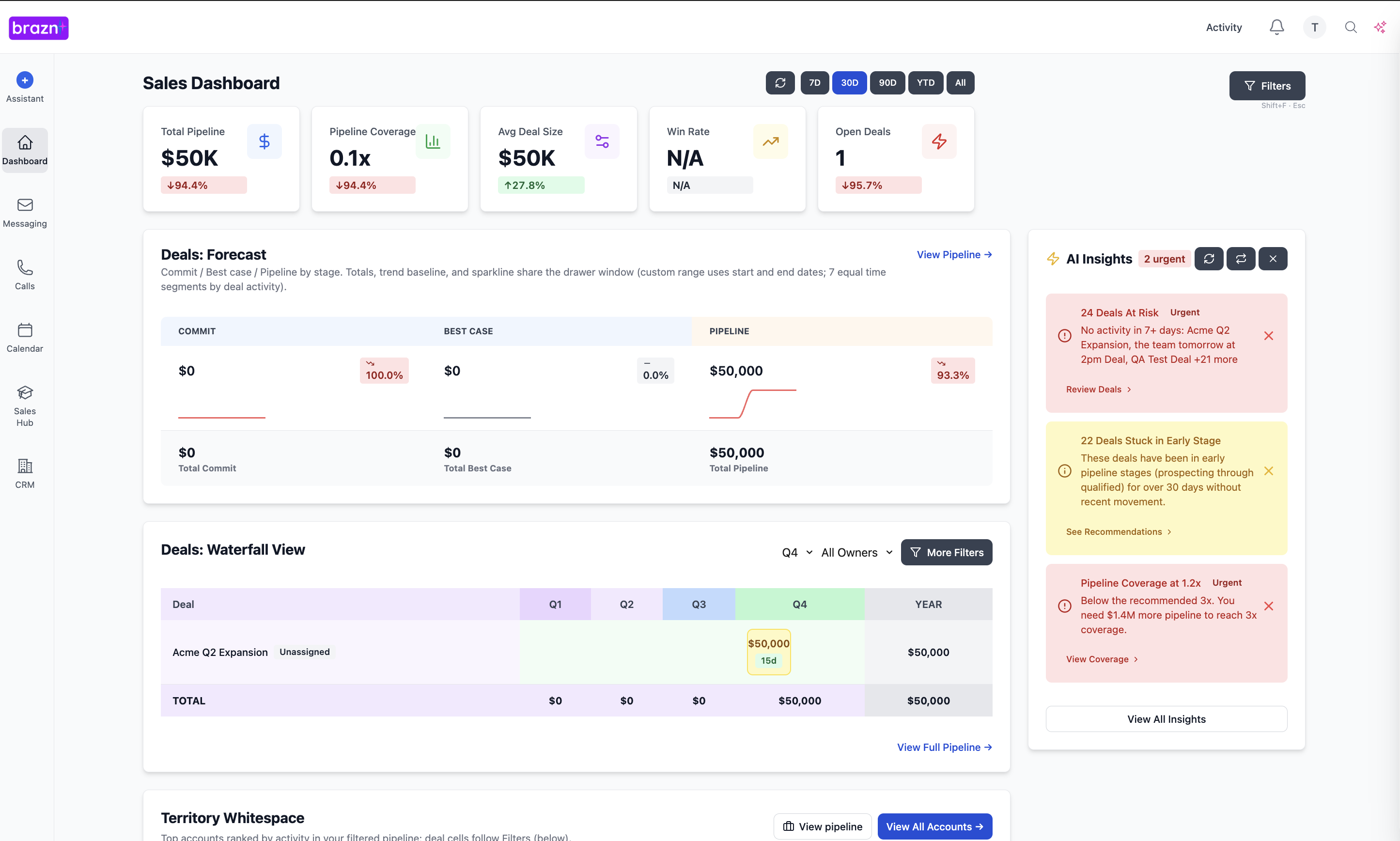
Brazn applies element-level scoring and tracks trend over time — detecting qualification decay as well as gaps. This makes enterprise deal scoring a management tool rather than a field-completion exercise.
Book a demo to see how Brazn AI fits into your sales stack.
About the Author

Alex Margarit, Sales AI Expert, SaaS Sales Leader, BMC, ServiceNow, Docusign — 25+ years in SaaS sales.