
Content: # How to Calculate ROI on an AI Sales Assistant (a CFO-Friendly Model)
The market is flooded with AI sales assistants promising to revolutionize your revenue engine. While the demos look impressive, the actual business case is often murky.
The problem: when it comes time to renew the software contract, "the reps really like it" isn't a metric that will satisfy the CFO.
This article provides a CFO-friendly model for calculating the true ROI of an AI sales assistant. We will show you how to move beyond soft metrics and build a defensible financial case based on hard revenue outcomes.
What We'll Cover
In this article, we will cover:
- Why soft metrics (like time saved) fail the CFO test
- The 3 core pillars of AI Sales ROI
- A step-by-step formula for calculating hard ROI
- How to measure impact on ramp time and attrition
- Presenting the ROI model to executive leadership
Understanding the Approach
Calculating the ROI of an AI sales assistant means quantifying the financial impact across three areas:
- Increased pipeline capacity (efficiency)
- Improved win rates (effectiveness)
- Reduced onboarding time (enablement)
Then subtract the fully loaded cost of the software.
Example: An AI assistant costs $100k/year. It saves each rep 3 hours/week, which is reinvested into selling and generates $500k in additional pipeline. With a 20% win rate, that's $100k in new ARR. If the tool also increases win rate by 2% and yields another $200k ARR, the total return is $300k against a $100k cost.
Why This Matters
A rigorous ROI model is essential for securing budget and justifying renewals.
- Before: AI tools are purchased based on hype and abandoned when budgets tighten. After: Tools become permanent fixtures because financial value is proven.
- Before: RevOps struggles to defend sales tech spend. After: RevOps demonstrates how the stack multiplies revenue.
- Before: The CFO views AI as a risky cost center. After: The CFO views AI as a strategic investment.
The Complete Guide
Pillar 1: The Efficiency Multiplier (Capacity)
Objective: Quantify the value of time saved.
Actionable Advice: Estimate hours saved per rep per week. Multiply by number of reps. Translate time saved into additional opportunities, then multiply by win rate and average deal size to estimate ARR impact.
Best Practices: Enforce that saved time is reinvested into selling.
Pillar 2: The Effectiveness Lift (Win Rate)
Objective: Measure the impact of better execution.
Actionable Advice: Track win rate before/after implementing AI coaching and battlecards.
Best Practices: Use a pilot vs. control group to isolate impact.
Pillar 3: The Enablement Acceleration (Ramp Time)
Objective: Calculate the value of faster onboarding.
Actionable Advice: Measure time to first deal. If AI reduces ramp by one month, estimate additional revenue from that month across hiring volume.
Best Practices: This can be one of the most compelling ROI levers.
How to Implement This
RevOps owns the ROI model and ties together data from the AI platform, CRM, and HR systems. Involve the CFO early to align on baselines and formulas. Sales Leadership must drive adoption so ROI is realized.
Next Steps
Don't buy AI based on faith; buy it based on math.
Start small: use the efficiency multiplier to estimate ARR impact if your team saved two hours per week on admin tasks.
How to Calculate ROI on an AI Sales Assistant (a CFO-Friendly Model)
The market is flooded with AI sales assistants promising to revolutionize your revenue engine. While the demos look impressive, the actual business case is often murky. The problem? when it comes time to renew the software contract, "the reps really like it" isn't a metric that will satisfy the CFO.
This article provides a rigorous, CFO-friendly model for calculating the true Return on Investment (ROI) of an AI sales assistant. We will show you how to move beyond soft metrics and build a defensible financial case based on hard revenue outcomes.
What We'll Cover
In this article, we will cover:
- Why soft metrics (like "time saved") fail the CFO test
- The 3 core pillars of AI Sales ROI
- A step-by-step formula for calculating hard ROI
- How to measure the impact on ramp time and attrition
- Presenting the ROI model to executive leadership
Understanding the Approach
Calculating the ROI of an AI sales assistant involves quantifying the financial impact of the tool across three areas: increased pipeline capacity (efficiency), improved win rates (effectiveness), and reduced onboarding time (enablement), then subtracting the fully loaded cost of the software. It fits into the GTM motion by ensuring that AI investments are held to the same rigorous financial standards as any other capital expenditure or headcount addition.
Example: An AI assistant costs $100k/year. RevOps calculates that the tool saves each rep 3 hours a week, which they use to generate an additional $500k in pipeline. With a 20% win rate, that's $100k in new ARR. Furthermore, the tool's live coaching features increase the overall team win rate by 2%, yielding another $200k in ARR. The total return is $300k against a $100k cost, proving a strong ROI.
Why This Matters
A rigorous ROI model is essential for securing initial budget and justifying renewals.
- Before: AI tools are purchased based on hype and abandoned when budgets tighten. After: AI tools become permanent fixtures in the tech stack because their financial value is proven.
- Before: RevOps struggles to defend the cost of the sales tech stack. After: RevOps clearly demonstrates how the tech stack acts as a revenue multiplier.
- Before: The CFO views AI as a risky cost center. After: The CFO views AI as a strategic investment with a predictable payback period.
The Complete Guide
Pillar 1: The Efficiency Multiplier (Capacity)
Objective: Quantify the value of time saved.
Actionable Advice: Calculate the average hours saved per rep per week (e.g., from automated CRM logging). Multiply that by the number of reps, then determine how many additional opportunities that saved time can generate. Multiply the new opportunities by your historical win rate and average deal size to find the ARR impact.
Best Practices: You must assume (and enforce) that the saved time is reinvested into selling activities, not just taking longer lunches.
Pillar 2: The Effectiveness Lift (Win Rate)
Objective: Measure the impact of better execution.
Actionable Advice: Track the overall team win rate before and after implementing the AI assistant's coaching and battlecard features. Even a 1-2% absolute increase in win rate can have a massive impact on ARR.
Best Practices: Compare a pilot group using the AI against a control group not using it to isolate the tool's impact from other market factors.
Pillar 3: The Enablement Acceleration (Ramp Time)
Objective: Calculate the value of faster onboarding.
Actionable Advice: Measure the average time it takes a new rep to close their first deal. If the AI assistant's guidance reduces that ramp time by one month, calculate the average quota a rep achieves in that one month and multiply it by your annual hiring volume.
Best Practices: This is often the most overlooked, yet most compelling, ROI metric for high-growth teams.
How to Implement This
RevOps owns the creation and maintenance of this ROI model, requiring deep integration between the AI platform, the CRM, and the HR system (for ramp data). The CFO should be involved early to agree on the baseline metrics and the formulas used. Sales Leadership is responsible for ensuring the tool is actually adopted so the projected ROI can be realized.
Next Steps
Don't buy AI based on faith; buy it based on math. By building a rigorous ROI model, you transform the conversation from "can we afford this tool?" to "can we afford not to have it?"
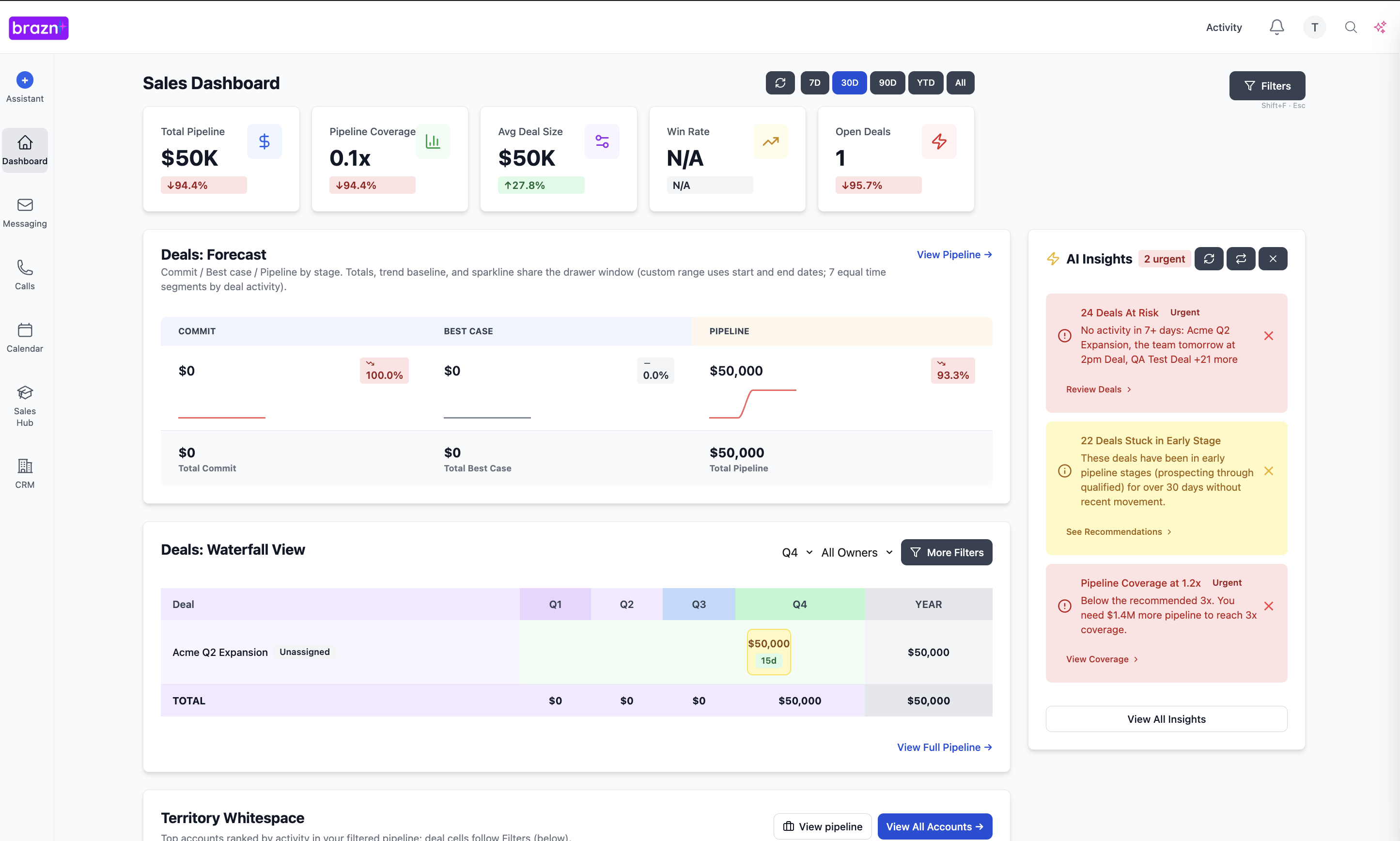
Start small: Use the "Efficiency Multiplier" formula above to estimate the potential ARR impact if your team saved just 2 hours per week on admin tasks. Ready to see real ROI? Explore Brazn's impact analytics.
---
####
Book a demo to see how Brazn AI fits into your sales stack.

About the Author
Alex Margarit, Sales AI Expert, SaaS Sales Leader, BMC, ServiceNow, Docusign — 25+ years in SaaS sales.