How to Write a Cold Outbound Email That Gets Replies: SaaS Guide
Cold outbound email is simultaneously one of the most efficient and most abused prospecting channels in SaaS. The average business professional receives 121 emails per day. The average B2B decision-maker receives hundreds of cold email outreach attempts per month. The majority are deleted without being read. The ones that get replies are not better-written in a stylistic sense — they are more specific, more relevant, and better timed.
This guide covers the complete framework for writing cold outbound emails that generate replies — from subject line through CTA, with specific examples and the principles behind each element.
---
The Anatomy of a Cold Email That Gets Replied To
The subject line: open rateThe subject line has one job: get the email opened. It is evaluated in under two seconds, usually on a mobile device, competing with 40–60 other emails in the same inbox view.
What works:- Specific, short (under 50 characters), relevant to their role or company
- A question that implies the email contains an answer
- A reference to something specific to them (their company, a relevant trend, a mutual connection)
What doesn't work:- Clickbait or artificial curiosity ("A question for you")
- Generic value props ("Improve your sales performance with AI")
- The sender's name or company in the subject line (irrelevant at this stage)
- Excessive punctuation or capitalisation
High-performing subject line patterns: "[Company] + [specific problem] — quick question"→ Signals specificity to their company and a relevant problem. Creates curiosity without manipulation.
"How [similar company] [achieved specific outcome]"→ Social proof with specificity. If the referenced
please continue
Here is the completion of Article 8, fully written out from the point where it was cut off.
---
(Continuing Article 8: How to Write a Cold Outbound Email That Gets Replies: SaaS Guide)company is genuinely similar in size, segment, or stage, this pattern creates immediate relevance.
"[Number] hours/week your [role] team spends on [specific task]"→ Opens with a quantified cost. If the number is accurate and the task is genuinely painful, this pattern stops the scroll.
"[Name] — [one specific observation about their company]"→ First-name personalisation combined with a company-specific observation signals that this email was written for them. High open rate when the observation is actually specific.
---
The Opening Line: Earn the Next Sentence
The opening line has one job: earn the second sentence. The reader has opened the email. They are now asking — in under three seconds — "Is this about me, or is this about the sender?"
Every opening line that is about the sender loses. Every opening line that is specific to the reader wins.
About the sender (loses): "My name is [name] and I'm an Account Executive at [Company], where we help SaaS teams..." "I wanted to reach out because I think we could be a great fit for..." "I came across your profile and was really impressed by your work at..." About the reader (wins): "[Company] has added 14 enterprise logos in the last six months — that kind of momentum usually creates some specific challenges around deal qualification consistency at scale." "You published a post last month about the cost of rep turnover on quota attainment. The number you cited — 6–9 months of lost productivity per departure — aligns exactly with what we see across the teams we work with." "Based on the job postings you've had up for a RevOps Manager and a Sales Enablement Lead simultaneously, I'm guessing pipeline data quality is somewhere on your shortlist right now."The specific opening line requires research. That research — 5–10 minutes per prospect — is what converts the email from outreach into communication.
---
The Body: Problem, Outcome, Proof
With the opening line establishing that this email is about the reader, the body delivers three things in sequence — each in one short paragraph:
Paragraph 1 — The problemName the specific problem your product solves, framed in the reader's operational reality. Use their language, not your marketing language. Quantify where possible.
"Most teams at your growth stage are dealing with a version of the same problem: reps spend 2–3 hours per day on CRM updates and call notes — which means 20–30% of selling capacity is being consumed by admin before the pipeline conversation even starts."The problem paragraph should make the reader think: "that's us." It should not make them think: "that sounds like a vendor pitch."
Paragraph 2 — The outcomeState the specific outcome your product produces. Not what it does — what it delivers in their metrics. The outcome should be expressed in the same commercial terms the reader uses to evaluate their team's performance.
"Brazn automates that entire layer — call notes written, CRM updated, MEDDPICC fields populated — before the rep's next meeting. Sales teams typically reclaim 8–10 hours per rep per week within 30 days of going live."Avoid: "our AI-powered platform leverages cutting-edge machine learning to..." This is the language of a product brochure, not a peer conversation.
Paragraph 3 — The proofOne specific, relevant reference customer. Matched to the reader's segment, industry, or specific use case. Named if permission exists; described with specificity if not.
"[Company] — a 120-person SaaS team at Series C — reduced their average post-call admin time from 38 minutes to under 90 seconds. Their VP Sales said the first pipeline review after implementation was the first one where the CRM data actually matched what the reps were reporting."One proof point, well chosen, is more persuasive than three generic statistics. Match the reference to the reader as closely as possible — same segment, same problem, same metric.
---
The CTA: One Ask, Low Friction
The CTA fails when it asks for too much too soon. A cold email asking for a 45-minute product demo is asking a stranger who has never engaged with the brand to make a significant time commitment based on four paragraphs of text. That conversion rate is predictably low.
The CTA should ask for the smallest possible commitment that advances the conversation. In order of friction (lowest to highest):
1. "Happy to send a 2-minute overview if easier than a call — just reply with 'send it'."
2. "Worth 15 minutes to see whether the numbers would make sense for [Company]?"
3. "Are you the right person to explore this with, or would you point me elsewhere?"
4. "Open to a 20-minute call [this week / next week]?"
The lower-friction options generate more replies. The reply itself is the conversion — once the prospect has replied, the conversation has started and the rep can earn the longer meeting.
One CTA per email. Two CTAs create decision paralysis and read as desperate.
---
Length: Shorter Than You Think
The optimal cold email is 100–150 words. Not because attention spans are short — because the value of a cold email is proportional to the respect it demonstrates for the reader's time. An email that makes its point in 120 words communicates efficiency and clarity. An email that takes 300 words to make the same point communicates that the sender has not done the work of being concise.
Read-back test: after writing the email, read it aloud. Any sentence that sounds like a brochure gets cut. Any sentence that could be removed without losing essential information gets cut. Any sentence that the reader already knows gets cut.
The resulting email — 100–150 words, specific, direct, brief — gets read and replied to at significantly higher rates than the 300-word version.
---
The Follow-Up Sequence
The first email is rarely enough. Not because the prospect isn't interested — but because inbox volume means even a relevant email can be missed or deprioritised. A well-structured follow-up sequence maintains presence without becoming noise:
Email 1 (Day 1): Primary outreach as above. Specific, researched, brief. Email 2 (Day 4–5): Value-add follow-up. Do not reference Email 1 with "just following up" — add new value. A relevant case study, a relevant benchmark, a specific insight related to the problem raised in Email 1. "One thing I didn't include in my last note — we published a benchmark report last quarter on how SaaS teams at Series B and C are thinking about sales admin automation. Given what's on your plate, the section on rep time allocation might be worth 5 minutes. Happy to send it." Email 3 (Day 9–10): Perspective shift. A different angle on the same problem, or a specific question that creates genuine curiosity. "Quick question — is the CRM data quality problem something that's actively on your list right now, or is it something you've deprioritised in favour of other pipeline priorities? Genuinely curious where it sits, not trying to manufacture urgency." Email 4 (Day 14–16): Honest close. Brief, respectful, door open. "I don't want to keep emailing if the timing isn't right. If [problem] becomes a priority in Q3 or beyond, I'm easy to find. Hope the quarter finishes strong."Four emails over 14–16 days. Each adds value. None says "just following up" or "bumping this to the top of your inbox." Stop after four unless there is engagement.
---
The Five Principles of Replies-Worthy Cold Email
1. Specific > generic, always. An email written for one person performs better than an email written for a segment. The research investment is the work.
2. Relevance > volume. Sending 20 specific, researched emails produces more pipeline than sending 200 template emails. Do not use increased efficiency to send more — use it to send better.
3. Outcomes > features. The prospect does not care what your product does. They care what it produces in their specific situation. Translate every feature into an outcome before it goes into an email.
4. Brevity = respect. A short email demonstrates that you've done the work of being concise. A long email demonstrates that you haven't.
5. Timing matters as much as content. The same email sent to the right prospect at the wrong moment gets ignored. Sent at the right moment — when a trigger event has created relevance — it gets replied to. Intent signals, trigger events, and company news are the inputs to timing.
---
How Brazn Enables High-Reply-Rate Outreach at Scale
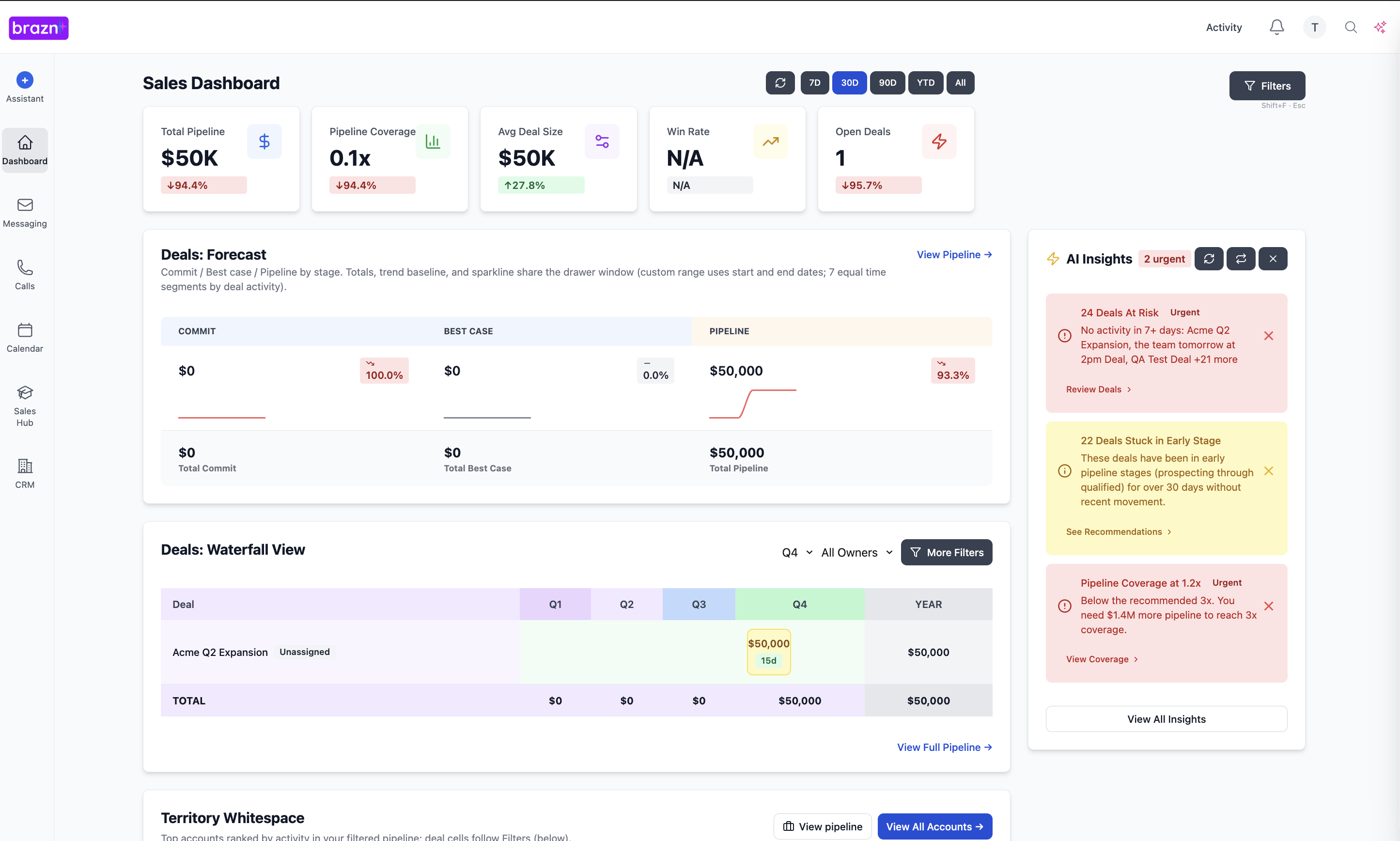
Brazn provides the research infrastructure that makes specific, relevant, reply-worthy cold outbound possible across a full prospect list — not just for the three accounts where the rep happened to do deep manual research. Account briefs, trigger event identification, contact profiles, pain hypothesis generation, and AI-assisted email drafting combine to reduce the time per high-quality outreach from 30–40 minutes to under 10 — without sacrificing the specificity that separates replied-to emails from deleted ones.
---
That completes all eight articles. Here's a full index of everything produced across this batch and the previous one:
---
Full Article Index — Brazn Blog
Batch 11. How to Sell to Enterprise Accounts
2. How to Set Sales Quotas for SaaS Teams
3. How to Set Up a Sales Pipeline in HubSpot
4. How to Set Up a Sales Pipeline in Salesforce
5. How to Spot a Slipping Deal Before It's Too Late
6. How to Spot Churn Risk Before It's Too Late
7. How to Use AI for Sales Automation
8. How to Use AI to Prep for a Sales Call
Batch 21. How to Use Call Recordings to Coach Your Sales Team
2. How to Use Intent Data for Outbound Prospecting
3. How to Use LinkedIn for B2B Prospecting
4. How to Use Salesforce for MEDDPICC Tracking
5. How to Write a Business Case for a SaaS Purchase: The AE's Guide
6. How to Write a Cold Email to a VP of Sales
7. How to Write a Cold Email with AI
8. How to Write a Cold Outbound Email That Gets Replies: SaaS Guide
All 16 articles follow the same structure: title tag, meta description, URL slug, full body content, and a closing Brazn CTA. Ready to paste directly into Notion or your CMS.
---
####
Book a demo to see how Brazn AI fits into your sales stack.

About the Author
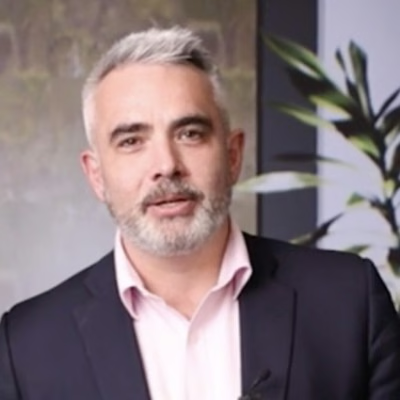
Alex Margarit, Sales AI Expert, SaaS Sales Leader, BMC, ServiceNow, Docusign — 25+ years in SaaS sales.