
How Sales Managers Use AI to Run Better Deal Reviews
Sales managers are expected to run deal reviews that are both fast and forensic. In a 60-minute pipeline review, they're meant to assess 15–20 deals, identify risk, coach reps, update the forecast, and leave with a clear action list. Without AI, most of that work happens on gut feel and half-remembered notes.
AI is changing what's possible in a deal review — not by replacing the manager's judgment, but by doing the data retrieval and gap analysis before the meeting starts.
---
Why Most Deal Reviews Fail
The problem with most deal reviews isn't the format — it's the preparation. Reps arrive with outdated CRM data, managers haven't had time to read through notes, and the conversation defaults to "what's the status?" rather than "what's the risk?"
The result is a review that is reactive rather than proactive. Deals that are about to slip don't get surfaced until they already have. MEDDPICC gaps that should have been caught two weeks ago get discussed too late to act on.
Three structural failures drive this:
- CRM data is stale — Reps update fields inconsistently, so the data managers are working from doesn't reflect current deal reality
- No pre-meeting synthesis — Managers spend 20–30 minutes before a review just trying to understand the current state of each deal
- Reviews are rep-led — The rep controls the narrative, and managers rarely have independent signal to challenge it
---
What AI Does Differently
An AI sales assistant changes the preparation layer entirely. Before the review even starts, the AI has already read every call transcript, email thread, CRM note, and activity log associated with each deal. It synthesises that into a structured deal brief: current stage, last meaningful interaction, MEDDPICC coverage, identified risks, and recommended next actions.
The manager walks into the review with an independent read on every deal — not just the rep's version of events.
During the review itself, AI surfaces the questions a manager should be asking. If the Economic Buyer hasn't been engaged in 21 days, the AI flags it. If the rep hasn't documented a clear Champion, the AI identifies the gap. If a deal has been in the same stage for 30 days with no forward movement, the AI marks it as at risk.
---
The AI-Assisted Deal Review Workflow
Here's how a sales manager using Brazn runs a deal review:
Before the meeting- Brazn generates a deal brief for each pipeline opportunity, pulling from CRM data, call transcripts, and email history
- Each brief includes MEDDPICC coverage scores, last meaningful touchpoint, deal velocity, and a risk summary
- The manager reviews the briefs in 10–15 minutes instead of 30–40
During the review- The manager opens each deal brief alongside the rep
- AI-flagged gaps drive the conversation: "Brazn shows we haven't confirmed the Economic Buyer — who owns the budget decision?"
- The rep provides context; the manager coaches toward the gap, not around it
After the review- Action items are captured and mapped back to MEDDPICC criteria
- CRM is updated automatically based on what was discussed
- The next review brief will reflect what was actioned vs. what was left open
---
MEDDPICC Gap Analysis in Deal Reviews
The most powerful application of AI in deal reviews is MEDDPICC gap detection. Most deals don't lose on price — they lose because a critical qualification criterion was never properly established. AI makes those gaps visible before they become losses.
Here's how AI surfaces each component:
| MEDDPICC Component | What AI detects |
| --- | --- |
| Metrics | No quantified business impact documented in CRM or calls |
| Economic Buyer | No confirmed EB contact; no EB engagement in recent activity |
| Decision Criteria | No documented evaluation criteria from the prospect |
| Decision Process | No mapped buying process or timeline |
| Paper Process | No legal/procurement contacts identified |
| Identify Pain | Pain is generic, not specific to the account |
| Champion | No internal advocate identified or validated |
| Competition | No competitive intelligence documented |
A manager who can see this table for every deal in the pipeline — before the meeting starts — runs a fundamentally different review.
---
Coaching Reps with Deal Intelligence
AI deal reviews create a coaching layer that didn't exist before. When a manager can see that a rep consistently leaves Champion blank, or never documents Decision Process, that's a pattern — not a one-off oversight. AI makes coaching data-driven rather than impressionistic.
Specific coaching opportunities AI enables:
- Pattern detection — Identify which MEDDPICC criteria a rep consistently under-qualifies across multiple deals
- Deal comparison — Compare how a rep handles similar-stage deals to surface inconsistencies
- Win/loss analysis — Review what was and wasn't documented in won vs. lost deals to find qualification patterns
- Real-time prompting — Surface deal-specific questions during the review to model best-practice qualification
This moves deal reviews from status updates to genuine coaching conversations — which is what they were always meant to be.
---
What to Look for in an AI Deal Review Tool
Not every AI sales tool is built for deal reviews. When evaluating options, look for:
- CRM-native integration — The AI should read from and write to your CRM, not sit alongside it
- Call transcript analysis — Deal briefs should incorporate what was actually said in calls, not just what was typed into CRM fields
- MEDDPICC alignment — The gap analysis should map to your qualification framework, not a generic scoring model
- Manager-first design — The tool should give managers independent signal, not just surface what the rep already entered
- Workflow fit — Outputs should be ready before the meeting, not generated during it
---
For sales managers, the deal review is the single most important coaching tool in the job. Done well, it's where reps get the specific feedback and strategic guidance that turns average deals into wins. Done badly — and most of them are done badly — it's a weekly ritual of data gathering, defensive rep narrative, and manager frustration. The difference is not the manager's skill or intent. It's the quality of information they have to work with.
AI changes that fundamentally. This guide covers how sales managers are running deal reviews in 2026 — and why the same managers who used to dread Friday reviews now treat them as the highest-leverage hour of their week.
Why Traditional Deal Reviews Fail Reps
Most deal reviews fail for a structural reason: the manager doesn't actually know what's happening in the deal. The rep walks through their narrative — stage, value, close date, next step — and the manager asks probing questions to try to surface risks the rep might be missing. It's a useful exercise in theory, but in practice the manager is working with whatever data the rep has chosen to share. The gaps in the rep's understanding become the gaps in the manager's understanding. The risks the rep hasn't noticed don't get surfaced.
The second failure mode is that reviews focus on status, not strategy. A typical review spends 80% of its time establishing what's true about each deal — stage, stakeholder map, MEDDPICC coverage, close likelihood — and 20% on what to actually do about it. For a rep managing 30+ active opportunities, this ratio is exactly wrong. They don't need help understanding their deals. They need help knowing which actions will move the needle this week.
The third failure mode is that coaching gets generic. Without specific, reliable data on where each rep is struggling, managers default to coaching everyone on the same things: "make sure you're multi-threading," "qualify MEDDPICC better," "get a champion." The advice is correct but too abstract to drive behaviour change. Reps nod, go back to their desks, and keep doing what they were doing.
How AI Transforms the Deal Review
AI-assisted deal reviews start with the manager having better data than the rep. Before the review, Brazn has already scored every deal on MEDDPICC completeness, engagement quality, and objective risk signals. The manager opens the review with a specific view: these are the deals that need attention today, here's the signal-based reason each one is flagged, here's the recommended action. The review conversation starts at "what are we going to do about this?" rather than "what's happening with this?"
The coaching gets specific because the data is specific. Instead of "work on your MEDDPICC," the manager says "your Economic Buyer coverage across the pipeline is 40% — the team average is 70%. Let's walk through how you're approaching that conversation on your top three deals." Instead of "make sure you're following up," the manager says "I see your average follow-up time after a discovery call is 3.5 days. The reps closing at the highest rate are under 24 hours. Here's what they're doing differently." Specific data enables specific coaching.
The review cadence also changes. Instead of inspecting every deal every week — an exhausting and mostly unproductive ritual — managers inspect the deals Brazn has flagged. A deal progressing well with strong engagement and full MEDDPICC coverage doesn't need 20 minutes of review time. A deal with declining champion engagement and an unqualified economic buyer does. Manager attention goes where it creates the most value.
The Manager's AI-Assisted Deal Review Workflow
The highest-performing sales managers are running a specific weekly workflow. Before the 1:1 with each rep, they spend 15 minutes reviewing the Brazn deal health dashboard for that rep's pipeline. They note which deals are flagged, why they're flagged, and what the recommended action is. They arrive at the 1:1 prepared — not with generic questions, but with specific deals and specific risks to discuss.
The 1:1 itself is shorter and sharper. Instead of a 60-minute meeting where the rep walks through every deal, it's a 30–45 minute meeting focused on the 3–5 flagged deals, the coaching opportunities Brazn has surfaced, and the specific actions the rep is committing to for the week. Coaching moments are tied to specific deals with specific data. The rep leaves the meeting with a clear action plan — not a vague sense that they should "work on their MEDDPICC."
Coaching Opportunities AI Surfaces Automatically
Brazn surfaces coaching opportunities that managers often miss in manual review cycles. It identifies reps whose MEDDPICC coverage is systematically weak in specific areas — reps who consistently fail to qualify the Economic Buyer, or who struggle with Paper Process, or who don't develop Champions effectively. It spots patterns in follow-up timing, meeting cadence, and stakeholder breadth that correlate with deal outcomes.
These pattern-level insights turn into skill-development plans. A rep who's weak on Economic Buyer qualification gets specific coaching on how to earn access to executives. A rep who follows up slowly gets a workflow intervention to speed up their post-meeting cadence. The coaching is diagnostic, not generic — and it improves rep capability in ways that compound over time.
What Better Deal Reviews Produce
Sales managers who've shifted to AI-assisted deal reviews report specific outcomes. Their reps close at higher win rates because risks are caught earlier. Their forecast accuracy improves because deal health data is reliable. Their 1:1s are shorter and more productive. Their reps report higher satisfaction with the coaching they're getting because the advice is specific and actionable. And their own effectiveness as managers is more visible because the coaching outcomes are measurable.
The role itself gets more rewarding. The data-gathering grind that consumes most of a traditional manager's week disappears. The coaching work — the reason most managers took the job — becomes the primary activity.
See AI-Assisted Deal Reviews in Action
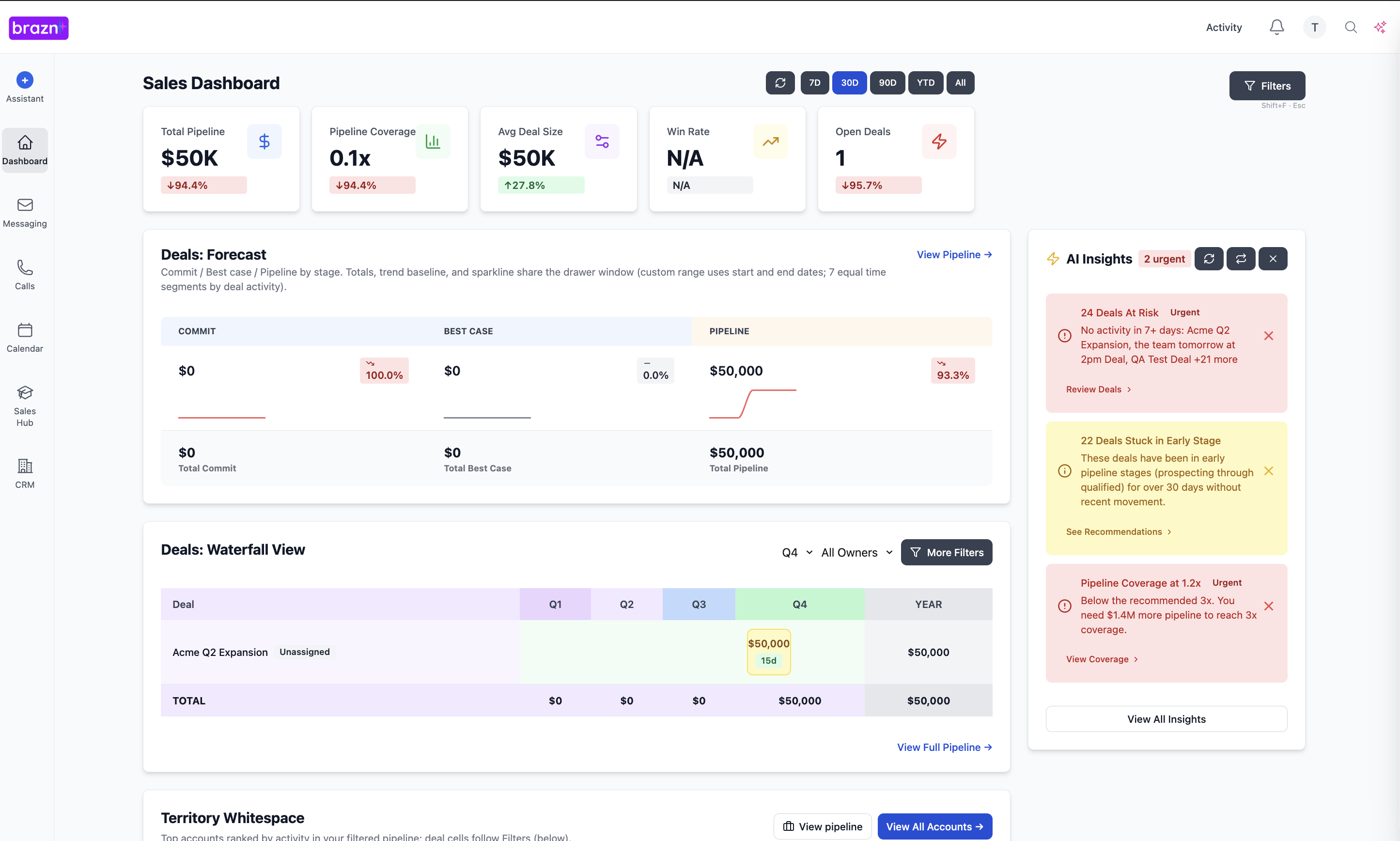
Brazn gives sales managers a pre-prepared deal review dashboard — risk flags surfaced, MEDDPICC gaps identified, coaching opportunities detected per rep, and recommended actions generated per deal.
The Bottom Line
AI doesn't run your deal reviews. It makes sure they're worth running. When every manager walks into a pipeline review with an independent, AI-generated brief on every deal — with gaps flagged, risks surfaced, and coaching prompts ready — the conversation changes from "what's happening?" to "what are we going to do about it?"
That's the difference between a deal review that feels productive and one that actually moves pipeline.
> 🚀 See how Brazn helps sales managers run sharper deal reviews.
>
---
####
Book a demo to see how Brazn AI fits into your sales stack.

About the Author

Alex Margarit, Sales AI Expert, SaaS Sales Leader, BMC, ServiceNow, Docusign — 25+ years in SaaS sales.