Automated Account & Contact Research for SaaS Sellers
Let's talk about the thirty minutes before a discovery call.
You've got a prospect on the calendar. You know their name, their company, and their title. You open a new tab and start the ritual. LinkedIn for their background. The company website for the overview. Crunchbase for funding history. G2 for what their customers say. Google News for anything recent. Back to Salesforce to check if anyone at your company has spoken to them before. Back to Gong to find the call if they have.
Forty-five minutes later you have a collection of browser tabs, a few notes on a sticky, and a vague sense of the account. You're better prepared than if you'd gone in blind. But you're not as prepared as you could be — because you ran out of time before you got to the good stuff. The strategic context. The hiring signals. The technology stack. The specific initiatives that make your solution relevant right now.
And then you do it again for the next call. And the next. And the one after that.
For a SaaS AE with four calls a day, pre-call research alone consumes two to three hours. That's before a single word of pipeline admin, follow-up writing, or sequence management. It's the hidden tax on every rep's selling day — and it's almost entirely automatable.
Here's what automated account and contact research actually looks like when it's done properly.
What Good Pre-Call Research Actually Covers
Before we get into the automation, let's be precise about what a genuinely useful research brief contains. Because there's a difference between a brief that tells you what everyone already knows and a brief that actually changes how you run the call.
The basics — necessary but not sufficient:- Company overview, size, industry, revenue range
- Funding history and investor context
- Key products and target market
- LinkedIn profile of the contact — role, tenure, background, previous companies
Most reps get this far. It takes twenty minutes and produces a brief that's useful for not embarrassing yourself in the first two minutes of the call. It doesn't produce insights that drive the conversation.
The strategic layer — where the value actually is:- Current strategic initiatives — what is this company publicly focused on right now? New market expansion? Cost reduction? Product launch? Hiring scale?
- Trigger events — recent funding, new executive hire, product announcement, acquisition, earnings release, regulatory change. These are the moments that create buying urgency and make your outreach relevant.
- Technology stack — what tools are they currently running? Where does your solution fit in their existing infrastructure? What are they likely replacing?
- Hiring signals — what roles are they actively recruiting for? Hiring a VP of Revenue Operations is a signal about sales stack investment. Hiring twenty SDRs is a signal about outbound scaling. Job posts are one of the most underused intelligence sources in sales.
- Competitive landscape — are they currently using a competitor? Have they reviewed your category before? Is there a contract renewal coming up?
- Stakeholder context — not just the person on the call, but the broader buying committee. Who else is likely involved? What are their priorities?
The deal-specific layer — for active opportunities:- Previous conversation history — what has been discussed across all previous calls and emails? What was agreed? What gaps were identified?
- MEDDPICC coverage status — which components are strong, which are weak, which are missing?
- Open risks — what has been flagged as a concern? What questions remain unanswered?
- Suggested questions — based on the gap analysis, what specifically needs to be covered on this call to advance the deal?
A brief that covers all three layers doesn't just prepare the rep for the call. It transforms the call — from a generic discovery into a highly contextualised conversation that the prospect immediately recognises as different from every other vendor conversation they're having.
Why Manual Research Falls Short
The problem with manual research isn't effort. Most reps are willing to put the time in for important calls. The problem is threefold.
Coverage is inconsistent. Reps do thorough research for their top five deals and adequate research for the rest. The discovery call with a mid-pipeline account gets fifteen minutes of prep instead of forty-five. The signals that would have changed the conversation go unnoticed. Sources are incomplete. A rep doing manual research typically checks four or five sources — LinkedIn, website, Crunchbase, maybe Google News. They miss the job postings that reveal strategic priorities. They miss the G2 reviews that show what current users actually care about. They miss the technographic data that reveals the full stack. They miss the intent signals that show the account is actively researching your category right now. Synthesis is shallow. Even when a rep finds good individual data points, the synthesis — "given everything I know about this account, here is what I think they care about most and here is the specific value angle I should lead with" — takes time and cognitive effort that's hard to do well when you're between two other calls.Automated research solves all three problems simultaneously.
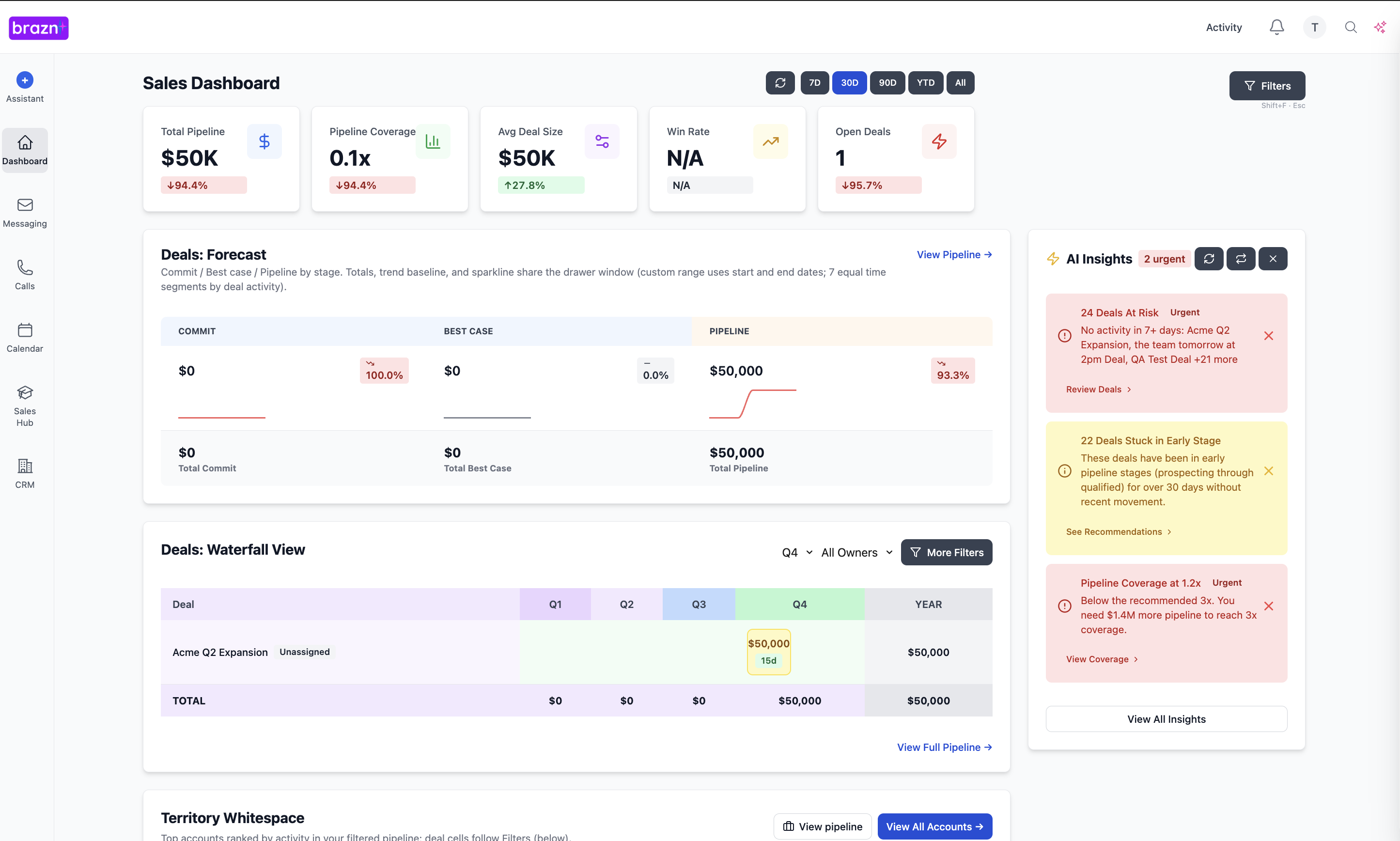
How Brazn Builds the Research Brief
Here's exactly what happens when Brazn handles pre-call research for a SaaS seller.
Step 1: The Call Is Detected
When a meeting is booked — whether through your calendar integration, your CRM, or your scheduling tool — Brazn automatically detects the upcoming call and identifies the account and contacts involved.
No rep input required. The brief preparation starts the moment the meeting appears on the calendar.
Step 2: Multi-Source Intelligence Gathering
Brazn pulls from every connected data source simultaneously:
From your CRM: Full deal history, previous call notes, MEDDPICC coverage, contact records, stakeholder map, open risks, last meaningful activity. From Gong or Chorus: Every previous call transcript for this account. Not just the summary — the full transcript, mined for context, open questions, agreements made, concerns raised, relationship signals. From enrichment tools (ZoomInfo, Cognism, Clearbit): Firmographics, technographics, org chart data, contact details, direct dials. From intent data (6sense, Bombora): Is this account actively researching your category? What topics are they consuming content about? Are they showing buying intent signals? From public sources: Recent news, press releases, funding announcements, executive changes, product launches, job postings, G2 reviews, LinkedIn activity. From your inbox: Any email thread history with this account or contact — prior outreach, responses, objections raised, context established.All of this happens automatically, in parallel, in the background — while the rep is on their previous call.
Step 3: Synthesis and Brief Generation
Raw data isn't a research brief. The synthesis layer is where Brazn earns its keep.
From everything gathered, Brazn produces a structured brief that covers:
Account snapshot — the essential context in three sentences. What the company does, where they are in their growth trajectory, and why now is a relevant moment to be talking to them. Trigger events — the two or three most recent and relevant developments at the account. Recent funding, new executive hire, product announcement, relevant news. Each one framed not just as a fact but as a relevance signal — why this matters for your conversation. Strategic priorities — inferred from job postings, public statements, product roadmap, and industry context. What is this company trying to accomplish in the next six to twelve months? Where does your solution fit in that agenda? Technology stack — current tools in the relevant category. What are they running? What are they likely to be replacing or supplementing? Where are the gaps? Contact context — not just the LinkedIn summary but a synthesis of the contact's background, likely priorities based on their role, any previous interaction history, and their apparent position in the buying process. Open deal questions (for active opportunities) — based on current MEDDPICC coverage, what specifically needs to be answered on this call? Framed as suggested questions the rep can use directly or adapt. Suggested opening angle — based on everything above, what is the single most compelling value angle to lead with for this specific account at this specific moment?Step 4: Delivery at the Right Moment
The brief lands in the rep's inbox or Slack thirty minutes before the call. Not the night before — when they're not thinking about it. Not five minutes before — when there's no time to process it. Thirty minutes before. Enough time to read it properly, absorb the context, and walk into the call with genuine preparation.
Total rep time: four to six minutes of reading. Previously: forty-five minutes of tab-switching.
What This Looks Like on the Call
The difference in call quality is immediate and noticeable to the prospect.
Instead of "so tell me a bit about what you're working on at [Company]" — the rep opens with "I noticed you've just completed your Series B and you're scaling the sales team significantly — we work with a lot of growth-stage SaaS companies at exactly this inflection point. I'd love to understand what's driving the push into enterprise accounts specifically."
That opening tells the prospect three things: you've done your homework, you understand their context, and you have something relevant to say about it. The call dynamic shifts immediately from vendor interrogation to peer conversation.
The prospect doesn't know that the research was done in four minutes by an AI. They just know that this rep is different from the last six who asked them to "tell me about your biggest challenges."
The Contact Research Layer
Account research gets most of the attention. Contact research is equally important — and equally automatable.
For every contact in a meeting, Brazn builds a contact brief alongside the account brief:
Professional background: Current role and tenure, previous companies and roles, career trajectory. Are they a long-tenured operator or a recent hire still establishing themselves? Have they worked at companies that use your product or a competitor? Role context: What does someone in this role typically care about? What are their KPIs likely to be? What problems do they face that your solution addresses? Interaction history: Every previous touchpoint with this contact. Emails sent and replied to. Calls had and their content. Objections raised. Commitments made. Nothing gets forgotten and nothing gets repeated. Personality and communication signals: Inferred from call transcripts and email tone — are they analytical and data-driven? Relationship-oriented and conversational? Direct and time-pressed? Adjust your approach accordingly. Buying role: What is their likely role in the decision? Champion, Economic Buyer, user, blocker, influencer? What does that mean for how you should position the conversation?Scaling Research Across the Full Pipeline
The individual call impact is significant. The pipeline-wide impact is transformational.
An AE managing twenty active opportunities needs research prep for every meaningful interaction across all twenty. Manually, this is impossible to do well. Something gets deprioritised. The lower-priority account gets fifteen minutes of prep. The trigger event that would have changed the pitch goes unnoticed.
With Brazn, every account gets the same quality of research regardless of deal priority. The brief is built automatically. The trigger events are captured. The MEDDPICC gaps are identified. The suggested questions are ready.
The rep allocates their attention based on deal priority — but every account is prepared for, not just the top five.
That's the compounding advantage. Not just better individual calls. A fundamentally higher floor of preparation across the entire pipeline, maintained continuously without the rep spending more than a few minutes per call reviewing what Brazn has built.
The Bottom Line on Automated Research
Pre-call research is not a competitive advantage when it's done manually. It's a tax — a necessary cost that every rep pays, that produces inconsistent results, and that consumes time that should be going to selling.
Automated research turns it into a genuine advantage. Every call, every rep, every account — fully prepared, with strategic context, with deal-specific questions, with a suggested opening angle. Consistently. Automatically. In four minutes instead of forty-five.
The reps who have this aren't just saving time. They're having fundamentally better conversations. And better conversations close more deals.
---
Want to see what a Brazn research brief looks like for one of your accounts?---
####
Book a demo to see how Brazn AI fits into your sales stack.

About the Author
Alex Margarit, Sales AI Expert, SaaS Sales Leader, BMC, ServiceNow, Docusign — 25+ years in SaaS sales.